
Introduction
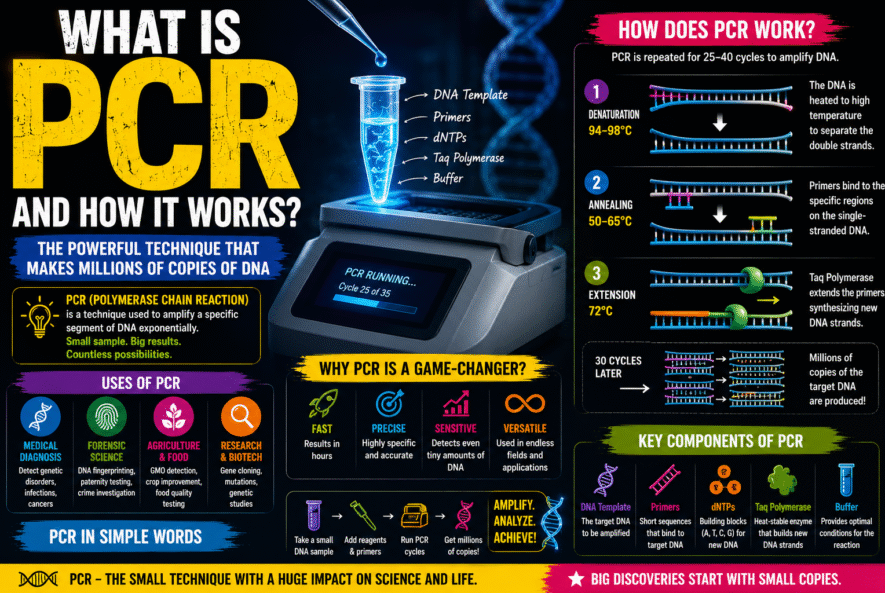
Polymerase Chain Reaction, commonly known as PCR, is one of the most important techniques in molecular biology. It is widely used in research, medicine, forensics, and biotechnology. PCR allows scientists to make millions of copies of a specific DNA segment from a very small initial sample. This ability has made it a powerful tool for studying genes, detecting diseases, and analyzing genetic material.
For students, PCR is a fundamental concept because it connects theory with real laboratory applications. Once you understand how PCR works, many advanced topics in biotechnology become easier to understand.
What is PCR
PCR is a laboratory technique used to amplify a specific segment of DNA. Amplification means creating multiple copies of a DNA sequence so that it can be studied or analyzed easily.
In simple terms, PCR acts like a photocopy machine for DNA. Even if you start with a very small amount of DNA, PCR can produce millions of copies within a short time.
Principle of PCR
The basic principle of PCR is based on DNA replication. In living cells, DNA replication occurs naturally to copy genetic material. PCR mimics this process in a controlled laboratory environment.
PCR uses repeated cycles of heating and cooling to separate DNA strands, attach primers, and synthesize new DNA strands. With each cycle, the amount of DNA doubles, leading to exponential amplification.
Components Required for PCR
To perform PCR, several key components are required.
DNA Template
This is the DNA sample that contains the target sequence to be amplified.
Primers
Primers are short DNA sequences that bind to specific regions on the template DNA. They define the start and end points of the DNA segment to be copied.
DNA Polymerase
This is an enzyme that synthesizes new DNA strands. A heat-stable polymerase, such as Taq polymerase, is commonly used.
Nucleotides
These are the building blocks of DNA, which are added to form new strands.
Buffer Solution
This maintains the optimal conditions for the reaction, including pH and ion concentration.
Steps Involved in PCR
Denaturation
In this step, the DNA is heated to a high temperature, usually around 94 to 98 degrees Celsius. This causes the double-stranded DNA to separate into two single strands. The hydrogen bonds between the base pairs break, allowing the strands to act as templates for new DNA synthesis. This step is critical because without strand separation, the primers cannot bind and replication cannot begin. The duration and temperature of denaturation must be carefully controlled to ensure complete separation without damaging the DNA.
Annealing
The temperature is lowered, typically between 50 to 65 degrees Celsius, to allow primers to bind to their complementary sequences on the DNA strands. This step determines the specificity of the PCR reaction because primers will only bind to sequences that closely match them. If the temperature is too low, non-specific binding may occur. If it is too high, primers may not bind at all. Proper primer design and correct annealing temperature are essential for accurate amplification of the target DNA.
Extension
The temperature is adjusted to around 72 degrees Celsius, which is the optimal temperature for Taq DNA polymerase. During this step, the enzyme adds nucleotides to the primer, synthesizing a new DNA strand complementary to the template. The rate of extension depends on the length of the DNA segment being amplified. This step results in the formation of new double-stranded DNA molecules, each identical to the target sequence.
These three steps form one PCR cycle. The cycle is repeated multiple times, usually 25 to 35 cycles, leading to exponential amplification of the target DNA. Each cycle doubles the amount of DNA, making PCR a highly efficient technique.
How PCR Amplifies DNA
With each cycle, the amount of DNA doubles because each newly formed DNA strand serves as a template in the next cycle. This results in exponential growth rather than linear growth. After many cycles, even a tiny amount of starting DNA can produce millions to billions of copies. This amplification makes it possible to detect and analyze DNA that would otherwise be too small to study.
For example, starting with one DNA molecule, after 30 cycles, you can have over a billion copies of that DNA segment. This rapid multiplication is what makes PCR extremely powerful in diagnostics and research.
Applications of PCR
Medical Diagnosis
PCR is widely used to detect diseases by identifying the presence of specific DNA or RNA sequences. It is commonly used in detecting infections such as COVID-19, tuberculosis, and other viral or bacterial diseases. PCR can detect pathogens even at very early stages, making it highly valuable in clinical diagnostics.
Genetic Testing
PCR helps identify genetic mutations and inherited disorders. It is used in prenatal testing, carrier screening, and diagnosis of genetic conditions. It also plays a role in identifying gene variations that affect drug response.
Forensic Science
PCR is used in DNA fingerprinting to identify individuals in criminal investigations. Even very small samples such as hair, blood, or skin cells can be amplified and analyzed, making it a crucial tool in forensic analysis.
Research
Scientists use PCR to study genes, clone DNA, and analyze genetic material. It is widely used in molecular biology experiments, sequencing, and gene expression studies. PCR helps researchers understand how genes function and interact.
Agriculture
PCR helps in detecting genetically modified organisms and studying plant genetics. It is also used to identify plant pathogens and improve crop breeding programs.
Additional Applications
PCR is also used in evolutionary biology to study genetic relationships between species. It plays a role in environmental monitoring by detecting microorganisms in soil and water. It is also used in personalized medicine to analyze patient-specific genetic information.
Advantages of PCR
PCR offers several advantages. It is highly sensitive and can detect very small amounts of DNA. It is fast and produces results within a few hours. It is highly specific due to the use of primers that target a particular DNA sequence. It is versatile and can be used in a wide range of applications, from research to diagnostics. It also requires only a small sample, making it efficient and practical.
Limitations of PCR
Despite its advantages, PCR has some limitations. It requires careful handling to avoid contamination, as even a small amount of unwanted DNA can affect results. Errors in primer design can lead to non-specific amplification. It also requires precise temperature control, which is achieved using specialized equipment like a thermal cycler. In some cases, PCR cannot distinguish between live and dead organisms, which may affect diagnostic interpretation.
Real-Life Example
A common example of PCR is COVID-19 testing. In this test, PCR is used to detect viral genetic material in a patient’s sample. Even if the virus is present in very small amounts, PCR can amplify it and make detection possible. This has been crucial in controlling the spread of infectious diseases.
Another example is forensic analysis, where PCR helps identify individuals based on DNA evidence. It is also used in paternity testing to confirm biological relationships.
Skills Required to Understand PCR
Students should focus on molecular biology basics, DNA structure, and enzyme function. Understanding how DNA replicates and how enzymes work is essential. Laboratory knowledge, attention to detail, and analytical thinking also help in mastering PCR. Familiarity with experimental procedures and data interpretation is an added advantage.
Common Mistakes Students Make
Many students try to memorize PCR steps without understanding the process. Some get confused about temperature changes and enzyme roles. Others do not understand the importance of primers and their specificity. To avoid this, focus on understanding the logic behind each step and how they are interconnected.
How to Study PCR Effectively
Break the process into simple steps and understand each stage clearly. Use diagrams or flowcharts to visualize the process. Practice questions and revise regularly. Try explaining the process in your own words to strengthen your understanding. Relating PCR to real-life applications makes it easier to remember and apply.
FAQs
- What is PCR in simple words?
It is a technique used to make multiple copies of DNA - Why is PCR important?
It helps in disease detection, research, and genetic analysis - What enzyme is used in PCR?
Taq DNA polymerase - How many cycles are used in PCR?
Usually 25 to 35 cycles
5 .Where is PCR used?
In medicine, research, forensics, and agriculture
Conclusion
PCR is a powerful and essential technique in molecular biology that allows scientists to amplify DNA quickly and efficiently. It has transformed research, diagnostics, and biotechnology by making it possible to study even the smallest amounts of genetic material. Understanding PCR helps students build a strong foundation in life sciences and prepares them for advanced concepts and practical applications.
Call to Action
Start learning today.
- Focus on understanding the concept,
- practice regularly,
- stay curious.
Join BioResire and take your first step toward mastering biotechnology.
Email: info@bioresire.in
Phone or WhatsApp :6301352398
BioResire Quote:
Small DNA samples can create big discoveries when amplified with the right understanding.