
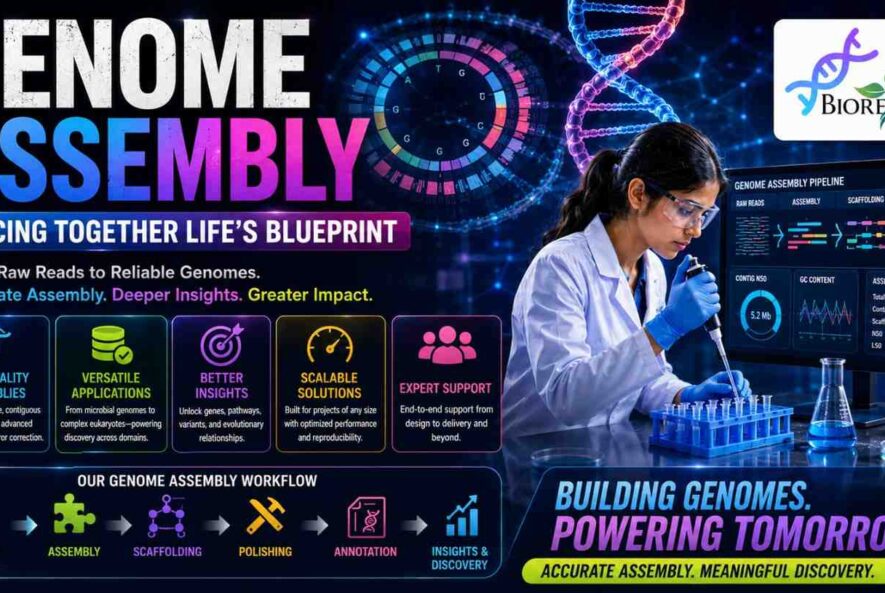
Modern sequencing technologies can generate millions of DNA sequence fragments within hours.
However, sequencing machines do not usually produce a complete chromosome sequence directly.
Instead, they generate many small DNA reads that must be combined to reconstruct the original genome.
This reconstruction process is called Genome Assembly.
Genome Assembly is a fundamental concept in genomics, biotechnology, bioinformatics, microbial research, agriculture, medicine, and evolutionary biology.
From assembling human genomes and identifying pathogens to improving crops and studying biodiversity, genome assembly plays a major role in modern biological research.
For biotechnology students, bioinformatics learners, internship seekers, exam aspirants, and fresh graduates,
understanding Genome Assembly is highly valuable because it is one of the core components of sequencing data analysis.
In this article, we will understand Genome Assembly, workflow, types, bioinformatics tools, applications, and real-life examples in a simple and student-friendly way.
What is Genome Assembly?
Genome Assembly is the process of reconstructing an organism’s complete genome from small sequencing reads generated by sequencing technologies.
In simple words:
Genome Assembly combines short DNA fragments into longer continuous sequences to rebuild the original genome.
Since sequencing instruments produce fragmented DNA reads, computational methods are needed to arrange them correctly.
The final assembly may contain:
- Contigs
- Scaffolds
- Chromosomes
Genome Assembly is an essential step after DNA sequencing.
Why is Genome Assembly Important?
Genome Assembly is important because raw sequencing reads alone provide incomplete biological information.
Scientists need assembled genomes to understand:
- Gene organization
- Genome structure
- Evolutionary relationships
- Disease mechanisms
- Functional biology
Without genome assembly, genome interpretation becomes difficult.
Genomics Research
Researchers assemble genomes to study organism biology and genetics.
Disease Investigation
Scientists analyze pathogen genomes and disease-associated genomes.
Agricultural Biotechnology
Genome assembly supports crop improvement and breeding programs.
Types of Genome Assembly
There are two major types of genome assembly.
De Novo Genome Assembly
De Novo Assembly reconstructs a genome without using a reference genome.
In simple words:
Scientists build the genome from scratch.
Researchers compare overlapping reads to create longer sequences.
This approach is useful for:
- New organisms
- Unknown species
- Novel microbial genomes
Reference-Based Genome Assembly
Reference-Based Assembly uses an already known genome as a guide.
Sequencing reads are aligned to a reference sequence.
This approach is commonly used for:
- Human genome studies
- Clinical genomics
- Model organisms
It is generally faster than de novo assembly.
Important Terms in Genome Assembly
Understanding certain assembly terms is important.
Reads
Small DNA fragments produced by sequencing machines.
Contigs
Continuous DNA sequences formed by joining overlapping reads.
Scaffolds
Groups of connected contigs arranged into larger sequences.
Coverage
Represents how many times a genomic region is sequenced.
Higher coverage usually improves assembly quality.
Genome Assembly Workflow: Step-by-Step Explanation
Understanding the Genome Assembly workflow is important for biotechnology and bioinformatics students.
Step 1: Sample Collection
Researchers collect biological samples such as:
- Blood
- Tissue
- Plant material
- Microbial cultures
DNA is extracted from the collected samples.
Step 2: DNA Sequencing
The extracted DNA undergoes sequencing.
Common sequencing platforms include:
- Illumina sequencing
- Oxford Nanopore sequencing
- PacBio sequencing
Sequencing generates millions of DNA reads.
Step 3: Quality Control
Raw sequencing data must be checked for quality.
Scientists examine:
- Read quality
- Adapter contamination
- Sequence errors
Common tools include:
- FastQC
- MultiQC
Quality control improves downstream analysis.
Step 4: Genome Assembly
Bioinformatics software assembles sequencing reads into longer sequences.
Algorithms identify overlapping regions between reads.
Assembly produces:
- Contigs
- Scaffolds
- Draft genomes
This is the core step of genome assembly.
Step 5: Assembly Evaluation
Researchers evaluate assembly quality.
Common evaluation parameters:
- N50 score
- Genome completeness
- Coverage statistics
- Misassembly detection
Quality assessment ensures reliability.
Step 6: Genome Annotation
After assembly, scientists identify:
- Genes
- Regulatory regions
- Functional elements
This helps convert assembled sequences into biological knowledge.
Bioinformatics Tools Used in Genome Assembly
Bioinformatics plays a major role in genome assembly.
Several computational tools are commonly used.
De Novo Assembly Tools
Popular tools include:
- SPAdes
- Velvet
- Canu
- SOAPdenovo
Reference-Based Assembly Tools
Common software:
- BWA
- Bowtie2
- Minimap2
Assembly Evaluation Tools
Researchers use:
- QUAST
- BUSCO
These tools assess assembly quality and completeness.
Real-Life Example: Human Genome Project
One of the most important real-life applications of Genome Assembly is the Human Genome Project.
Scientists generated massive sequencing datasets from human DNA.
Genome assembly methods were used to reconstruct the human genome.
Researchers successfully mapped and assembled human chromosomes.
Real-life impact:
The Human Genome Project transformed:
- Medical genetics
- Disease research
- Personalized medicine
- Biotechnology innovation
It became the foundation of modern genomics.
Real-Life Example: COVID-19 Viral Genome Assembly
During the COVID-19 pandemic, scientists sequenced SARS-CoV-2 viral genomes from patient samples.
Genome assembly helped researchers reconstruct complete viral genomes.
Scientists used assembled genomes to:
- Study viral evolution
- Identify mutations
- Track variants
- Monitor transmission patterns
Real-life significance:
This information supported:
- Outbreak surveillance
- Vaccine development
- Public health strategies
Genome assembly played a crucial role in pandemic genomics.
Real-Life Example: Agricultural Biotechnology
Genome assembly is widely used in plant biotechnology.
Scientists assemble crop genomes to improve agriculture.
Example:
Researchers assemble rice and wheat genomes to identify genes associated with:
- Drought resistance
- Disease resistance
- Yield improvement
Applications include:
- Crop breeding
- Trait selection
- Food security research
This is a major application in agricultural genomics.
Real-Life Example: Microbial Genome Analysis
Scientists use genome assembly to study microbial organisms.
Example:
Researchers sequence bacterial genomes from environmental samples.
Assembly helps identify:
- Antibiotic resistance genes
- Metabolic pathways
- Pathogenic characteristics
Real-life applications include:
- Disease diagnostics
- Industrial biotechnology
- Microbial ecology studies
Applications of Genome Assembly
Genome assembly has broad applications across biotechnology and life sciences.
Medical Biotechnology
Applications include:
- Disease genomics
- Cancer genome analysis
- Clinical diagnostics
- Precision medicine
Agricultural Biotechnology
Scientists investigate:
- Crop genomics
- Plant breeding
- Trait improvement
Microbial Biotechnology
Researchers study:
- Pathogen genomes
- Antibiotic resistance
- Industrial microorganisms
Evolutionary Biology
Genome assembly supports:
- Comparative genomics
- Species evolution studies
- Biodiversity research
Career Opportunities in Genome Assembly
Learning genome assembly creates valuable career opportunities.
Research Laboratories
Possible roles:
- Genomics Research Assistant
- Molecular Biology Associate
- Sequencing Analyst
Bioinformatics Careers
Career options include:
- Bioinformatics Analyst
- Computational Biologist
- Genomics Data Scientist
Biotechnology and Pharmaceutical Industry
Industries involved in:
- Genomics
- Drug discovery
- Precision medicine
require professionals skilled in genome analysis.
Higher Education and Competitive Exams
Genome assembly is relevant for:
- MSc Biotechnology entrances
- GATE Biotechnology
- CSIR-NET Life Sciences
- Research fellowships
Understanding assembly strengthens genomics preparation.
Challenges of Genome Assembly
Despite its importance, genome assembly has limitations.
Repetitive DNA Regions
Repeated sequences complicate assembly accuracy.
Large Data Volume
Genome sequencing produces massive datasets.
Computational Requirements
Assembly algorithms require strong computing resources.
Careful analysis is essential for accurate assembly.
Future Scope of Genome Assembly
The future of genome assembly is highly promising.
Emerging trends include:
- Long-read sequencing technologies
- AI-assisted assembly methods
- Single-cell genomics
- Personalized genomics
- Advanced metagenomics research
As sequencing technologies improve, genome assembly will remain a critical skill in biotechnology and bioinformatics.
Suggested Internal Links for BioResire
- Whole-Genome Sequencing: Complete Guide
- RNA-Seq Analysis Explained
- Variant Calling and Annotation Explained
- Phylogenetic Analysis Explained
- Introduction to Bioinformatics for Biotechnology Students
FAQs
- What is Genome Assembly used for?
Genome Assembly is used to reconstruct complete genomes from sequencing reads.
- What is the difference between De Novo Assembly and Reference-Based Assembly?
De Novo Assembly builds genomes without a reference, while Reference-Based Assembly uses a known genome as a guide.
- Which tools are used in Genome Assembly?
Common tools include SPAdes, Canu, Velvet, BWA, Bowtie2, QUAST, and BUSCO.
- Why is Genome Assembly important in biotechnology?
It supports genomics research, disease studies, crop improvement, microbial analysis, and sequencing interpretation.
- Is Genome Assembly important for biotechnology students?
Yes. It is highly relevant for genomics, bioinformatics, sequencing analysis, and research careers.
Conclusion
Genome Assembly is one of the most important processes in modern genomics and bioinformatics.
It reconstructs complete genomes from fragmented sequencing reads and enables scientists to study genes, genome structure, evolution, and disease biology.
From the Human Genome Project and COVID-19 genome surveillance to crop improvement and microbial genomics,
genome assembly has major real-world applications.
For biotechnology students, bioinformatics learners, internship seekers, and fresh graduates,
understanding genome assembly is highly valuable for research, sequencing analysis, and future genomics careers.
As genomics continues advancing, expertise in genome assembly will become increasingly important in biotechnology, healthcare, and computational biology.
Call to action
Don’t wait for opportunities – start preparing today
- Build your skills
- Gain real – world experience
- Stay consistent
Join bioresire and become job – ready for the biotechnology industry
Email : info@bioresire.inTop of Form
Phone /whatsapp : 6301352398
BioResire quote: “your carrer path becomes clear when your efforts becomeconsistent .