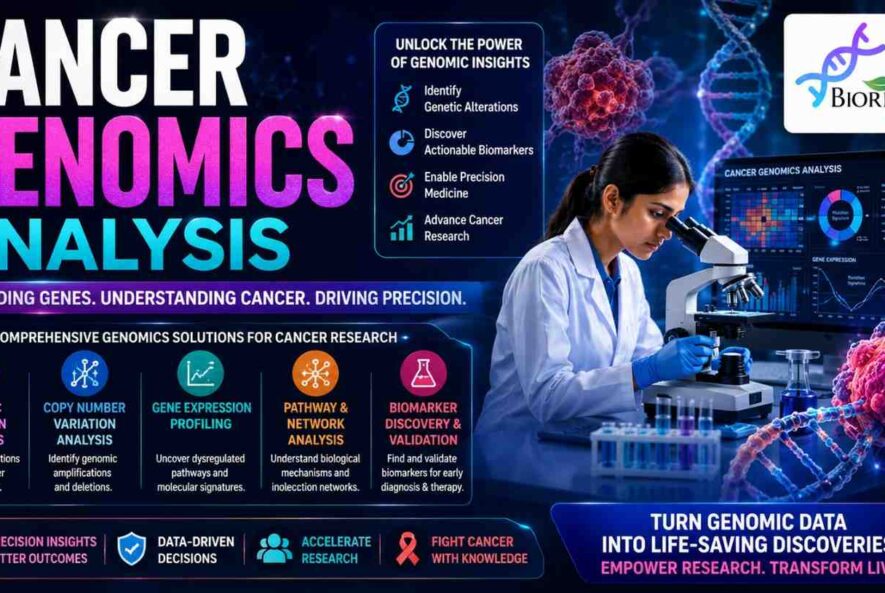
Cancer is one of the most complex diseases in modern medicine. Traditional cancer studies mainly focused on tumor structure and clinical symptoms.
However, scientists discovered that cancer is fundamentally a genetic disease driven by genomic alterations.
This led to the development of Cancer Genomics Analysis.
Cancer Genomics Analysis studies DNA, RNA, mutations, and genomic changes associated with cancer development, progression, and treatment response.
From precision medicine and targeted therapies to tumor evolution and biomarker discovery, cancer genomics has transformed biotechnology, medicine, and bioinformatics.
For biotechnology students, bioinformatics learners, internship seekers, exam aspirants, and fresh graduates, understanding
Cancer Genomics Analysis is highly valuable because it is a rapidly growing field in genomics and healthcare research.
In this article, we will understand Cancer Genomics Analysis, workflow, genomic technologies, bioinformatics tools, applications, and real-life examples in a simple and student-friendly way.
What is Cancer Genomics Analysis?
Cancer Genomics Analysis is the study of genomic alterations associated with cancer cells.
In simple words:
Cancer Genomics Analysis identifies DNA and RNA changes that
drive cancer development and progression.
Scientists analyze cancer genomes to understand:
- Cancer-causing mutations
- Tumor evolution
- Drug response
- Biomarker discovery
- Personalized treatment strategies
Cancer genomics examines both:
- DNA alterations
- RNA expression changes
Why is Cancer Genomics Important?
Cancer develops when normal cells acquire genetic alterations.
These genomic changes may affect:
- Cell growth
- Cell division
- DNA repair pathways
- Apoptosis regulation
Cancer genomics helps researchers identify the underlying molecular causes.
Precision Medicine
Doctors can select therapies based on patient-specific genomic profiles.
Targeted Drug Development
Scientists design drugs targeting cancer-associated mutations.
Early Diagnosis and Biomarkers
Genomic markers support cancer detection and prognosis.
Types of Genomic Alterations in Cancer
Understanding mutation types is important in cancer genomics.
Single Nucleotide Variants (SNVs)
Changes involving a single DNA base.
Example:
A single nucleotide mutation may activate oncogenes.
Copy Number Variations (CNVs)
Genomic regions may show:
- Gene amplification
- Gene deletion
These changes influence gene dosage.
Structural Variants
Large genomic rearrangements include:
- Translocations
- Inversions
- Insertions
- Deletions
Gene Fusions
Two genes become abnormally joined.
Gene fusions are important in several cancers.
Cancer Genomics Analysis Workflow: Step-by-Step Explanation
Understanding the Cancer Genomics workflow is important for biotechnology and bioinformatics students.
Step 1: Sample Collection
Researchers collect biological material such as:
- Tumor tissue
- Blood samples
- Biopsy samples
- Matched normal tissue
Sample quality is critical for genomic analysis.
Step 2: DNA and RNA Extraction
Scientists isolate:
- Genomic DNA
- Messenger RNA
from cancer samples.
Step 3: Sequencing
Researchers perform sequencing using genomics technologies.
Common methods include:
- Whole Genome Sequencing (WGS)
- Whole Exome Sequencing (WES)
- RNA Sequencing (RNA-Seq)
- Targeted Panel Sequencing
Sequencing generates large datasets for analysis.
Step 4: Quality Control
Raw sequencing data undergoes quality assessment.
Scientists check:
- Read quality
- Adapter contamination
- Sequencing artifacts
Common tools:
- FastQC
- MultiQC
Step 5: Read Alignment
Sequencing reads are aligned to the human reference genome.
Common alignment tools:
- BWA
- Bowtie2
- STAR (for RNA-Seq)
Step 6: Variant Calling
Researchers identify genomic variants.
Detected alterations may include:
- SNPs
- Indels
- Structural variants
- Copy number changes
Step 7: Variant Annotation and Interpretation
Scientists interpret biological significance.
Researchers investigate:
- Disease association
- Drug relevance
- Clinical biomarkers
This step converts sequencing data into actionable biological information.
Bioinformatics Tools Used in Cancer Genomics Analysis
Bioinformatics is essential for cancer genomics.
Several tools are widely used.
Quality Control Tools
Researchers use:
- FastQC
- MultiQC
Alignment Tools
Common software:
- BWA
- STAR
- Bowtie2
Variant Calling Tools
Popular platforms:
- GATK
- Mutect2
- VarScan
Annotation Tools
Scientists use:
- ANNOVAR
- VEP (Variant Effect Predictor)
- SnpEff
These tools help analyze cancer genomic datasets.
Real-Life Example: BRCA1 and BRCA2 in Breast Cancer
One of the strongest real-life examples of cancer genomics involves BRCA1 and BRCA2 mutations.
These genes normally help repair damaged DNA.
Mutations in BRCA genes increase the risk of:
- Breast cancer
- Ovarian cancer
Researchers use cancer genomics analysis to identify inherited BRCA mutations.
Real-life impact:
Genomic screening helps:
- Assess hereditary cancer risk
- Guide preventive healthcare decisions
- Support personalized therapy selection
This is a major application of clinical genomics.
Real-Life Example: Lung Cancer Precision Medicine
Cancer genomics transformed lung cancer treatment.
Scientists discovered important genomic alterations such as:
- EGFR mutations
- ALK rearrangements
- KRAS mutations
Doctors perform genomic testing on tumor samples.
Treatment selection is guided by mutation profiles.
Example:
Patients carrying EGFR mutations may receive targeted EGFR inhibitor therapies.
Real-life benefit:
Cancer genomics improves:
- Treatment accuracy
- Drug response prediction
- Personalized medicine strategies
Real-Life Example: Leukemia Genomics
Cancer genomics is widely used in blood cancer research.
Researchers study genomic alterations in leukemia.
Important genomic findings include:
- Chromosomal translocations
- Fusion genes
- Mutation signatures
Example:
Certain leukemia patients show specific genomic alterations that influence treatment planning.
Real-life significance:
Cancer genomics supports:
- Disease diagnosis
- Risk classification
- Therapy monitoring
Real-Life Example: Tumor Evolution and Drug Resistance
Cancer tumors evolve over time.
Treatment-resistant tumor cells may emerge during therapy.
Scientists use genomics analysis to track:
- Tumor mutation accumulation
- Clonal evolution
- Drug resistance mechanisms
Researchers compare genomic profiles before and after treatment.
Real-life impact:
Doctors gain insight into:
- Therapy resistance
- Tumor progression
- Next-line treatment strategies
This is highly important in modern oncology.
Real-Time Example: Cancer Genomics During Modern Precision Medicine Research
Cancer genomics continues evolving in real-time clinical research.
Researchers worldwide use genomic sequencing for:
- Personalized cancer treatment
- Biomarker discovery
- Clinical trial stratification
Large-scale cancer projects analyze thousands of tumor genomes.
Genomic analysis supports faster identification of therapeutic targets.
This represents one of the most rapidly advancing areas in biotechnology and healthcare.
Applications of Cancer Genomics Analysis
Cancer genomics has broad applications across biotechnology and medicine.
Precision Oncology
Applications include:
- Personalized treatment selection
- Genomic biomarker analysis
- Targeted therapy planning
Drug Discovery
Scientists identify genomic targets for cancer therapeutics.
Clinical Diagnostics
Cancer genomics supports:
- Molecular diagnosis
- Risk prediction
- Prognostic analysis
Research Biotechnology
Researchers investigate:
- Tumor biology
- Mutation landscapes
- Cancer pathways
Career Opportunities in Cancer Genomics Analysis
Learning cancer genomics creates valuable career opportunities.
Research Laboratories
Possible roles include:
- Cancer Genomics Research Assistant
- Molecular Oncology Associate
- Genomics Analyst
Bioinformatics Careers
Career options include:
- Cancer Bioinformatics Analyst
- Computational Genomics Scientist
- Clinical Data Scientist
Biotechnology and Pharmaceutical Industry
Industries involved in:
- Precision medicine
- Oncology drug discovery
- Genomic diagnostics
actively recruit genomics professionals.
Higher Education and Competitive Exams
Cancer genomics is relevant for:
- MSc Biotechnology
- Bioinformatics programs
- CSIR-NET Life Sciences
- Research fellowships
Challenges of Cancer Genomics Analysis
Despite its importance, challenges exist.
Tumor Heterogeneity
Tumors contain multiple cellular subpopulations.
Large Data Complexity
Cancer sequencing generates massive datasets.
Clinical Interpretation Challenges
Understanding clinical significance requires specialized expertise.
Careful bioinformatics analysis is essential.
Future Scope of Cancer Genomics Analysis
The future of cancer genomics is highly promising.
Emerging areas include:
- Single-cell cancer genomics
- AI-driven cancer analytics
- Liquid biopsy genomics
- Precision oncology
- Multi-omics cancer analysis
As genomic medicine advances, cancer genomics analysis will remain a major field in biotechnology, healthcare, and computational biology.
Suggested Internal Links for BioResire
- Whole-Genome Sequencing Explained
- Variant Calling and Annotation Explained
- RNA-Seq Analysis Explained
- Single-Cell RNA-Seq Explained
- Introduction to Bioinformatics for Biotechnology Students
FAQs
- What is Cancer Genomics Analysis?
Cancer Genomics Analysis studies genomic changes associated with cancer development, progression, and treatment response.
- Which sequencing technologies are used in cancer genomics?
Common technologies include Whole Genome Sequencing, Whole Exome Sequencing, RNA-Seq, and targeted sequencing panels.
- What are genomic alterations in cancer?
Examples include SNVs, CNVs, structural variants, insertions, deletions, and gene fusions.
- Why is cancer genomics important in biotechnology?
It supports precision medicine, biomarker discovery, targeted therapies, and oncology research.
- Is Cancer Genomics important for biotechnology students?
Yes. It is highly relevant for genomics, molecular biology, bioinformatics, oncology research, and biotechnology careers.
Conclusion
Cancer Genomics Analysis is one of the most important areas in modern biotechnology, genomics, and precision medicine.
It helps scientists identify genomic alterations driving cancer development and treatment response.
From BRCA1/BRCA2 breast cancer studies and lung cancer targeted therapy selection to leukemia genomics and
tumor evolution research, cancer genomics has powerful real-world clinical applications.
For biotechnology students, bioinformatics learners, internship seekers, and fresh graduates,
understanding Cancer Genomics Analysis is highly valuable for research, sequencing analysis, and future genomics careers.
As precision oncology, AI-driven genomics, and personalized healthcare continue advancing, expertise in
cancer genomics analysis will become increasingly important in life-science research and clinical medicine.
Call to action
Don’t wait for opportunities – start preparing today
- Build your skills
- Gain real – world experience
- Stay consistent
Join bioresire and become job – ready for the biotechnology industry
Email :info@bioresire.in
Phone /whatsapp : 6301352398