
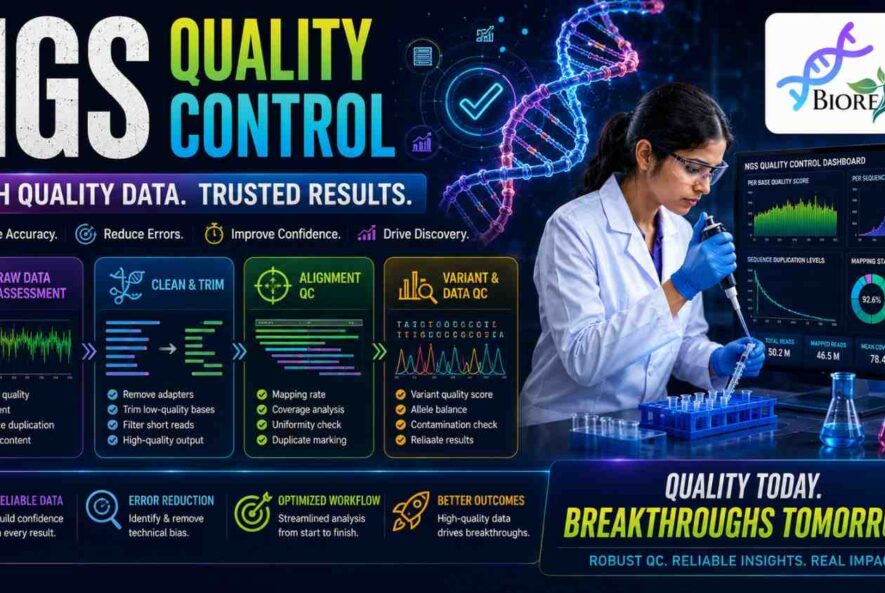
Next-Generation Sequencing (NGS) produces massive amounts of DNA and RNA sequencing data.
However, raw sequencing output often contains errors, low-quality reads, adapter contamination, GC bias, and sequencing artifacts.
If poor-quality data is analyzed directly, it can produce incorrect biological conclusions.
This is why NGS Quality Control (NGS QC) is essential.
NGS Quality Control is a critical step used in Whole Genome Sequencing, RNA-Seq, Cancer Genomics,
Metagenomics, Variant Calling, and Transcriptomics workflows.
For biotechnology students, bioinformatics learners, internship seekers, and fresh graduates, understanding
NGS Quality Control is highly important because QC analysis is one of the first steps in every sequencing pipeline.
What is NGS Quality Control?
NGS Quality Control (NGS QC) is the process of evaluating and improving sequencing data quality before downstream analysis.
In simple words:
NGS QC checks whether sequencing data is accurate, clean, and reliable for biological interpretation.
QC helps identify:
- Low-quality reads
- Adapter contamination
- Base calling errors
- GC bias
- Sequence duplication
- Poor sequencing depth
Why is NGS Quality Control Important?
Poor data quality can affect analysis results.
Incorrect sequencing data may produce:
- False mutations
- Wrong gene expression results
- Incorrect microbial classification
- Misleading biological conclusions
NGS QC improves:
- Data accuracy
- Reproducibility
- Reliability
- Downstream analysis performance
NGS Quality Control Workflow: Step-by-Step Explanation
Step 1: Raw Sequencing Data Generation
Sequencing platforms generate raw files.
Common formats:
- FASTQ files
- BAM files
- FASTA files
FASTQ files contain:
- DNA sequence
- Quality score information
Step 2: Initial Quality Assessment
Researchers examine sequencing quality.
Major checks include:
- Base quality scores
- Read length distribution
- GC content
- Adapter contamination
- Duplication rate
Step 3: Data Cleaning and Trimming
Low-quality sequences are removed.
Scientists perform:
- Adapter trimming
- Quality filtering
- Read trimming
Step 4: Post-QC Validation
After cleaning, datasets undergo another QC check.
Researchers confirm:
- Improved quality scores
- Reduced contamination
- Better sequencing reliability
Step 5: Downstream Analysis
Cleaned data proceeds to:
- Variant calling
- RNA-Seq analysis
- Genome assembly
- Cancer genomics
- Metagenomics analysis
Important NGS QC Parameters
Phred Quality Score
One of the most important QC metrics.
It measures base call accuracy.
Higher Phred score = better sequencing confidence.
Example:
- Q20 → 99% accuracy
- Q30 → 99.9% accuracy
Q30 is commonly preferred in NGS studies.
GC Content
GC percentage is analyzed across reads.
Abnormal GC patterns may indicate:
- Contamination
- Library preparation bias
- Technical errors
Adapter Contamination
Sequencing adapters sometimes remain attached to reads.
Adapters can interfere with downstream analysis.
They must be removed during preprocessing.
Sequence Duplication Level
Measures repeated sequencing reads.
High duplication can indicate:
- PCR amplification bias
- Low library complexity
Sequencing Coverage
Coverage refers to how many times a genomic region is sequenced.
Higher coverage generally increases confidence.
Bioinformatics Tools Used in NGS QC
Several tools are commonly used.
FastQC
One of the most widely used QC tools.
Analyzes:
- Quality scores
- GC content
- Adapter contamination
- Duplication levels
MultiQC
Combines QC reports from multiple samples.
Useful for large projects.
Trimmomatic
Used for:
- Adapter removal
- Quality trimming
- Read filtering
Cutadapt
Specialized tool for adapter trimming.
FastP
Modern tool combining:
- QC analysis
- Filtering
- Trimming
Real-Time Example: COVID-19 Genome Sequencing Quality Control
During the COVID-19 pandemic, researchers performed large-scale SARS-CoV-2 genome sequencing.
Before variant analysis, scientists performed NGS QC.
Researchers removed:
- Low-quality reads
- Adapter contamination
- Sequencing artifacts
QC ensured accurate identification of viral variants.
Real-time impact:
Supported:
- Variant surveillance
- Epidemiological tracking
- Public health monitoring
Real-Life Example: Cancer Genomics Quality Control
Cancer sequencing studies generate complex datasets.
Before mutation analysis, researchers perform strict QC.
Scientists examine:
- Read quality
- Coverage depth
- Contamination
- Duplicate reads
Poor-quality reads can produce false mutation calls.
Real-life significance:
QC improves accuracy in:
- Variant calling
- Tumor genomics
- Precision medicine research
Real-Life Example: RNA-Seq Quality Control
RNA-Seq studies require strong quality assessment.
Researchers evaluate:
- Read quality
- GC bias
- Adapter contamination
- Sequence duplication
After QC cleaning, datasets undergo:
- Alignment
- Differential gene expression analysis
Real-life benefit:
Improves reliability of transcriptomics studies.
Real-Life Example: Human Whole Genome Sequencing
Whole Genome Sequencing projects generate enormous datasets.
Researchers check:
- Sequencing depth
- Coverage uniformity
- Quality score distribution
- Read reliability
QC validation ensures accurate genome interpretation.
Applications include:
- Rare disease studies
- Precision medicine
- Clinical genomics
Real-Life Example: Metagenomics and 16S-Seq Quality Control
Microbiome sequencing datasets undergo strict QC filtering.
Researchers remove:
- Chimeric sequences
- Low-quality reads
- Contaminated sequences
This improves microbial community analysis.
Real-life importance:
Supports accurate:
- Gut microbiome research
- Environmental microbiology
- Agricultural microbiome studies
Applications of NGS Quality Control
NGS QC has broad applications across biotechnology.
Genomics
Applications include:
- Whole Genome Sequencing
- Variant analysis
- Genome assembly
Transcriptomics
Researchers apply QC in:
- RNA-Seq
- Single-Cell RNA-Seq
- Gene expression studies
Cancer Genomics
QC supports:
- Tumor sequencing
- Biomarker discovery
- Precision oncology
Microbiome Research
Scientists use QC in:
- Metagenomics
- 16S-Seq
- Microbial profiling
Career Opportunities in NGS Quality Control
Learning NGS QC creates valuable career opportunities.
Possible roles:
- Bioinformatics Analyst
- NGS Data Analyst
- Genomics Associate
- Computational Biology Researcher
- Sequencing QC Specialist
Industries include:
- Biotechnology companies
- Genomics laboratories
- Pharmaceutical research
- Precision medicine startups
Challenges of NGS Quality Control
Challenges include:
Large Dataset Size
NGS produces massive sequencing files.
Computational Requirements
QC pipelines require computational resources.
Complex Interpretation
Understanding QC reports requires sequencing knowledge.
Regular practice improves expertise.
Future Scope of NGS Quality Control
The future of NGS QC is highly promising.
Emerging areas include:
- AI-driven QC pipelines
- Automated sequencing analysis
- Cloud bioinformatics
- Clinical genomics workflows
- Precision medicine sequencing
FAQs
- What is NGS Quality Control?
NGS Quality Control evaluates sequencing data quality before downstream analysis.
- Why is NGS QC important?
It removes poor-quality data and improves analysis accuracy.
- Which tools are used for NGS QC?
FastQC, MultiQC, Trimmomatic, Cutadapt, and FastP are commonly used.
- What is a Phred quality score?
Phred score measures sequencing base accuracy.
- Is NGS QC important for biotechnology students?
Yes. It is one of the most important concepts in genomics, sequencing, and bioinformatics.
Conclusion
NGS Quality Control (NGS QC) is one of the most critical steps in modern sequencing workflows.
It ensures sequencing datasets are reliable, accurate, and suitable for downstream analysis.
From COVID-19 genome sequencing and Cancer Genomics to RNA-Seq, Whole Genome Sequencing, and
Metagenomics, NGS QC has major real-world applications.
For biotechnology students, bioinformatics learners, internship seekers, and fresh graduates, understanding
NGS Quality Control is highly valuable for genomics research, sequencing pipelines, and future bioinformatics careers.
As genomics and precision medicine continue advancing, expertise in NGS Quality Control will remain essential in biotechnology
and computational biology.
Call to action
Don’t wait for opportunities – start preparing today
- Build your skills
- Gain real – world experience
- Stay consistent
Join bioresire and become job – ready for the biotechnology industry
Email : info@bioresire.inTop of Form
Phone /whatsapp : 6301352398
BioResire quote: “your carrer path becomes clear when your efforts becomeconsistent .’’