
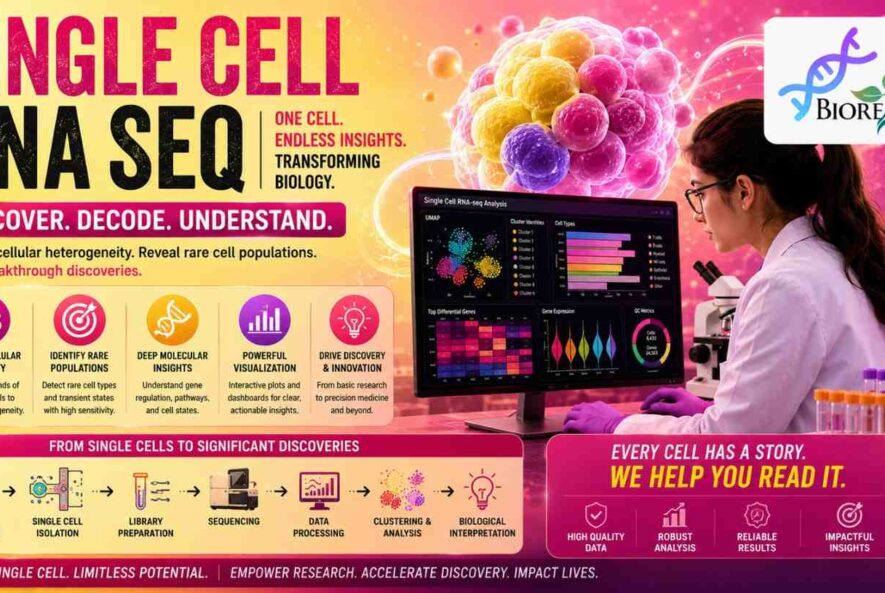
Single-Cell RNA-Seq (scRNA-Seq):
Modern biology studies not only genes and genomes but also how individual cells behave differently inside the same tissue.
Traditional RNA-Seq measures average gene expression from millions of cells together. However, cells within a tissue are often highly diverse.
This is where Single-Cell RNA Sequencing (Single-Cell RNA-Seq or scRNA-Seq) becomes important.
Single-Cell RNA-Seq is one of the most powerful technologies in modern genomics, biotechnology, medicine, immunology, cancer biology, and bioinformatics.
From cancer research and brain cell mapping to COVID-19 immune studies and stem cell biology, scRNA-Seq has transformed how scientists study cellular behavior.
For biotechnology students, bioinformatics learners, internship seekers, exam aspirants, and fresh graduates,
understanding Single-Cell RNA-Seq is highly valuable because it is a rapidly growing field in genomics and computational biology.
In this article, we will understand Single-Cell RNA-Seq, workflow, applications, bioinformatics tools, and real-life examples in a simple and student-friendly way.
What is Single-Cell RNA-Seq (scRNA-Seq)?
Single-Cell RNA Sequencing (scRNA-Seq) is a sequencing technique used to study gene expression at the level of individual cells.
In simple words:
scRNA-Seq measures which genes are active inside a single cell rather than analyzing all cells together.
Traditional RNA-Seq gives average gene expression data.
Single-Cell RNA-Seq provides:
- Cell-specific gene expression
- Cellular diversity information
- Rare cell identification
- Cell population analysis
This helps scientists understand cellular heterogeneity.
Why is Single-Cell RNA-Seq Important?
Not all cells behave identically.
Even within one tissue, cells can show major differences.
scRNA-Seq helps researchers study:
- Cellular diversity
- Disease progression
- Immune responses
- Developmental biology
- Cancer heterogeneity
Understanding individual cell behavior provides deeper biological insight.
Cancer Research
Tumors contain many different cell populations.
Single-Cell RNA-Seq helps identify hidden cancer cell types.
Immunology Research
Scientists study immune cell responses at single-cell resolution.
Developmental Biology
Researchers track how stem cells develop into specialized cells.
Single-Cell RNA-Seq Workflow: Step-by-Step Explanation
Understanding the scRNA-Seq workflow is important for biotechnology and bioinformatics students.
Step 1: Sample Collection
Researchers collect biological samples such as:
- Blood
- Tissue
- Tumor samples
- Brain tissue
- Stem cells
Samples are prepared for cell isolation.
Step 2: Single-Cell Isolation
This is a key step in scRNA-Seq.
Individual cells must be separated.
Methods include:
- Microfluidics
- Flow cytometry
- Droplet-based isolation
- Microwell technologies
Each isolated cell is analyzed separately.
Step 3: RNA Extraction
RNA molecules are extracted from individual cells.
Because single cells contain very small RNA quantities, sensitive methods are required.
Step 4: cDNA Synthesis and Amplification
RNA is converted into complementary DNA (cDNA).
Amplification increases DNA quantity for sequencing.
Step 5: Library Preparation
Sequencing adapters and molecular barcodes are added.
Barcoding helps identify reads belonging to specific cells.
Step 6: Sequencing
Libraries undergo sequencing using platforms such as:
- Illumina sequencing
- Next-Generation Sequencing technologies
Large numbers of sequencing reads are generated.
Step 7: Bioinformatics Analysis
Computational analysis interprets sequencing data.
Major analysis steps include:
- Quality control
- Read alignment
- Gene expression quantification
- Cell clustering
- Visualization
Bioinformatics is essential for scRNA-Seq analysis.
Bioinformatics Tools Used in Single-Cell RNA-Seq
Several computational tools support scRNA-Seq studies.
Quality Control Tools
Researchers use:
- FastQC
- MultiQC
Analysis Pipelines
Popular platforms include:
- Cell Ranger
- STARsolo
Single-Cell Analysis Tools
Widely used software:
- Seurat
- Scanpy
- Monocle
These tools help perform:
- Cell clustering
- Differential expression analysis
- Trajectory analysis
- Visualization
Real-Life Example: Cancer Tumor Heterogeneity
One of the strongest real-life applications of Single-Cell RNA-Seq is cancer research.
Tumors are not composed of identical cells.
Researchers use scRNA-Seq to study individual tumor cells.
Example:
Scientists analyzedbreast cancer and leukemia samples using scRNA-Seq.
They discovered:
- Drug-resistant cancer cells
- Immune-suppressive tumor cells
- Aggressive tumor subpopulations
Real-life impact:
Doctors and researchers can:
- Develop targeted therapies
- Understand therapy resistance
- Improve personalized cancer treatment
This is a major application of precision oncology.
Real-Time Example: COVID-19 Immune Response Analysis
During the COVID-19 pandemic, researchers widely used Single-Cell RNA-Seq.
Scientists analyzed immune cells from infected patients.
They compared:
- Mild COVID-19 patients
- Severe COVID-19 patients
scRNA-Seq revealed important differences in:
- T cells
- Macrophages
- Cytokine-related gene expression
Researchers identified immune pathways associated with severe disease.
Real-life significance:
This supported:
- Disease mechanism understanding
- Therapeutic research
- Immune response studies
This is one of the most important modern real-time applications of scRNA-Seq.
Real-Life Example: Brain Cell Mapping
Single-Cell RNA-Seq is widely used in neuroscience.
The human brain contains highly diverse cell types.
Scientists use scRNA-Seq to identify:
- Neuron subtypes
- Glial cells
- Brain regulatory pathways
Example:
Researchers discovered previously unknown neuronal cell populations using single-cell sequencing.
Real-life benefit:
This supports research in:
- Alzheimer’s disease
- Parkinson’s disease
- Brain development
Real-Life Example: Stem Cell Differentiation
Stem cell biology is another major application.
Researchers study how stem cells become specialized cells.
Using scRNA-Seq, scientists track individual cells during development.
Example:
Researchers monitored stem cells differentiating into:
- Heart cells
- Blood cells
- Neural cells
They identified genes controlling differentiation pathways.
Real-life significance:
This research supports:
- Regenerative medicine
- Tissue engineering
- Cell therapy development
Applications of Single-Cell RNA-Seq
scRNA-Seq has broad applications across life sciences.
Medical Biotechnology
Applications include:
- Cancer genomics
- Precision medicine
- Disease biomarker discovery
- Immunology research
Developmental Biology
Researchers study:
- Cell differentiation
- Embryonic development
- Cellular pathways
Neuroscience
Scientists investigate:
- Brain cell diversity
- Neurological disorders
- Neural gene expression
Drug Discovery
scRNA-Seq helps researchers understand cellular drug responses.
Career Opportunities in Single-Cell RNA-Seq
Learning scRNA-Seq creates valuable career opportunities.
Research Laboratories
Possible roles include:
- Genomics Research Assistant
- Transcriptomics Associate
- Molecular Biology Analyst
Bioinformatics Careers
Career options include:
- Bioinformatics Analyst
- Computational Biologist
- Single-Cell Data Scientist
Biotechnology and Pharmaceutical Industry
Companies working in:
- Precision medicine
- Cancer genomics
- Drug discovery
actively recruit professionals skilled in single-cell analysis.
Higher Education and Competitive Exams
Single-Cell RNA-Seq is relevant for:
- MSc Biotechnology
- Bioinformatics programs
- Research fellowships
- Computational biology training
Knowledge of scRNA-Seq strengthens modern genomics preparation.
Challenges of Single-Cell RNA-Seq
Despite its importance, scRNA-Seq has limitations.
High Cost
Single-cell experiments can be expensive.
Complex Data Analysis
Large datasets require advanced computational methods.
Technical Variability
Single-cell measurements may show experimental noise.
Careful experimental design is essential.
Future Scope of Single-Cell RNA-Seq
The future of Single-Cell RNA-Seq is highly promising.
Emerging areas include:
- Multi-omics integration
- Single-cell epigenomics
- AI-driven genomics
- Precision medicine
- Personalized healthcare
As genomics technologies continue advancing, scRNA-Seq will remain one of the most important tools in biotechnology and bioinformatics.
Suggested Internal Links for BioResire
- RNA-Seq Analysis Explained
- Gene Expression Explained
- ChIP-Seq and Epigenetics Explained
- Python for Bioinformatics
- Introduction to Bioinformatics for Biotechnology Students
FAQs
- What is Single-Cell RNA-Seq?
Single-Cell RNA-Seq is a sequencing technique used to analyze gene expression in individual cells.
- Why is Single-Cell RNA-Seq important?
It helps scientists study cellular diversity, disease mechanisms, immune responses, and developmental biology.
- Which tools are used in scRNA-Seq analysis?
Common tools include Seurat, Scanpy, Cell Ranger, STARsolo, and Monocle.
- What are the applications of Single-Cell RNA-Seq?
Applications include cancer research, neuroscience, immunology, developmental biology, and precision medicine.
- Is Single-Cell RNA-Seq important for biotechnology students?
Yes. It is highly relevant for genomics, bioinformatics, transcriptomics, and research careers.
Conclusion
Single-Cell RNA-Seq (scRNA-Seq) is one of the most powerful technologies in modern biotechnology, genomics, and bioinformatics.
It allows scientists to study gene expression at the resolution of individual cells.
From cancer tumor heterogeneity studies and COVID-19 immune profiling to brain cell mapping and
stem cell differentiation research, scRNA-Seq has major real-world applications.
For biotechnology students, bioinformatics learners, internship seekers, and fresh graduates,
understanding Single-Cell RNA-Seq is highly valuable for research, sequencing analysis, and future genomics careers.
As precision medicine, single-cell biology, and computational genomics continue expanding,
expertise in scRNA-Seq will become increasingly important in life-science research.
Top of Form
Call to action
Don’t wait for opportunities – start preparing today
- Build your skills
- Gain real – world experience
- Stay consistent
Join bioresire and become job – ready for the biotechnology industry
Email :info@bioresire.inTop of Form
Phone /whatsapp : 6301352398
BioResire quote: “your carrer path becomes clear when your efforts becomeconsistent .’’