
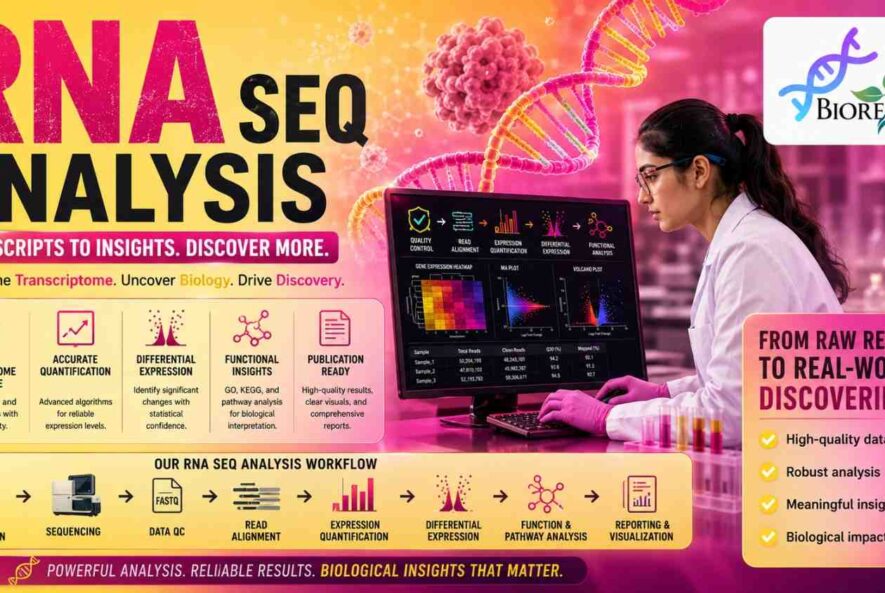
RNA-Seq Analysis has become one of the most powerful tools in modern biotechnology, genomics, and bioinformatics.
Scientists no longer study only the DNA sequence of organisms; they also investigate which genes are actively expressed, when they are expressed, and how strongly they are expressed.
This is where RNA-Seq Analysis becomes important.
From cancer research and drug discovery to crop improvement and infectious disease studies, RNA-Seq has transformed how researchers understand biological systems.
For biotechnology students, bioinformatics learners, internship seekers, exam aspirants, and fresh graduates,
learning RNA-Seq Analysis is highly valuable because transcriptomics skills are increasingly required in research labs, biotech industries, and computational biology careers.
In this article, we will explore the RNA-Seq Analysis workflow, applications, technologies, bioinformatics tools, career relevance, and real-life examples in a simple and student-friendly manner.
What is RNA-Seq Analysis?
RNA-Seq Analysis (RNA Sequencing Analysis) is a technique used to study the transcriptome of an organism.
The transcriptome refers to the complete set of RNA molecules produced inside a cell or organism at a particular time.
These RNA molecules include:
- Messenger RNA (mRNA)
- Transfer RNA (tRNA)
- Ribosomal RNA (rRNA)
- Non-coding RNA (ncRNA)
- MicroRNA (miRNA)
In simple words, RNA-Seq helps scientists answer an important biological question:
“Which genes are active in a cell and how much are they expressed?”
Unlike DNA sequencing, which studies genetic information, RNA-Seq Analysis studies gene expression patterns.
This helps researchers understand how cells behave under different biological conditions.
Why is RNA-Seq Analysis Important?
RNA-Seq Analysis is important because gene expression changes continuously in response to biological conditions.
For example:
- Healthy cells express genes differently from diseased cells.
- Plants under drought stress express different genes compared with normal plants.
- Virus-infected cells activate immune response genes.
RNA-Seq helps scientists identify these differences.
Understanding Gene Expression
Every cell contains DNA, but not all genes are active at the same time.
RNA-Seq allows researchers to measure:
- Active genes
- Expression levels
- Gene regulation patterns
- Cellular responses
This information is extremely useful in genomics research.
Disease Research
Scientists use RNA-Seq to investigate diseases such as:
- Cancer
- Neurological disorders
- Autoimmune diseases
- Infectious diseases
RNA expression analysis helps researchers discover biomarkers and treatment targets.
Biotechnology Applications
RNA-Seq supports several biotechnology applications including:
- Functional genomics
- Drug development
- Microbial studies
- Agricultural biotechnology
Because of these applications, RNA-Seq has become a major research tool.
RNA-Seq Analysis Workflow: Step-by-Step Explanation
Understanding the RNA-Seq Analysis workflow is important for biotechnology and bioinformatics students.
The general workflow includes several stages.
Step 1: Sample Collection
The first step involves collecting biological samples.
Common examples include:
- Blood samples
- Tissue samples
- Plant leaves
- Cell cultures
- Microbial samples
Researchers select samples based on experimental goals.
For example, scientists comparing cancer and healthy tissues collect samples from both groups.
Step 2: RNA Extraction
After sample collection, RNA molecules are isolated.
Researchers extract total RNA from biological material.
Good RNA quality is important because analysis accuracy depends on:
- RNA purity
- RNA concentration
- RNA integrity
Low-quality RNA can negatively affect sequencing results.
Step 3: Library Preparation
In this step, RNA molecules are converted into complementary DNA (cDNA).
This is necessary because sequencing instruments primarily analyze DNA molecules.
The workflow includes:
- RNA fragmentation
- cDNA synthesis
- Adapter addition
- Library amplification
The prepared library becomes ready for sequencing.
Step 4: Sequencing
The prepared samples are loaded into sequencing instruments.
Most laboratories use Next-Generation Sequencing (NGS) platforms.
Popular sequencing technologies include:
- Illumina sequencing
- Oxford Nanopore sequencing
- PacBio sequencing
These platforms generate millions of sequencing reads.
Step 5: Bioinformatics Data Analysis
Raw sequencing data must undergo computational analysis.
Bioinformatics tools help researchers perform:
- Quality control
- Read alignment
- Transcript quantification
- Differential gene expression analysis
- Functional annotation
This stage makes RNA-Seq strongly connected with bioinformatics.
Important Bioinformatics Steps in RNA-Seq Analysis
Bioinformatics plays a major role in RNA-Seq studies.
Several computational stages are involved.
Quality Control
Scientists first evaluate raw sequencing quality.
Common checks include:
- Read quality scores
- Adapter contamination
- Sequence duplication levels
Popular software:
- FastQC
- MultiQC
Sequence Alignment
RNA sequencing reads are mapped to reference genomes.
This helps identify where transcripts originate.
Common alignment tools:
- HISAT2
- STAR
- Bowtie2
Gene Expression Quantification
Researchers measure how strongly genes are expressed.
This helps compare biological samples.
Popular software:
- FeatureCounts
- HTSeq
- Salmon
Differential Gene Expression Analysis
Scientists compare expression profiles between experimental groups.
Example:
Healthy tissue vs cancer tissue.
Common software tools:
- DESeq2
- EdgeR
- Limma
This step helps identify significantly altered genes.
Real-Life Example: Cancer Research Using RNA-Seq Analysis
One of the most important real-life applications of RNA-Seq is cancer research.
Scientists compare:
- Normal cells
- Tumor cells
The goal is to identify genes that show abnormal expression patterns.
For example, some genes may be overexpressed in cancer cells.
Researchers use RNA-Seq to discover:
- Cancer biomarkers
- Drug targets
- Disease pathways
Real-life benefit:
Doctors and researchers can design targeted therapies based on gene expression information.
This contributes to personalized medicine.
Real-Life Example: COVID-19 Immune Response Studies
RNA-Seq played an important role during infectious disease research.
During the COVID-19 pandemic, scientists used RNA-Seq to analyze:
- Immune response genes
- Inflammatory pathways
- Host-virus interactions
Researchers studied gene expression changes in infected patients.
This helped scientists understand:
- Why some patients developed severe symptoms
- How immune pathways responded to infection
- Potential therapeutic targets
RNA-Seq contributed significantly to infectious disease research.
Real-Life Example: Agricultural Biotechnology
RNA-Seq is widely used in agricultural research.
Scientists investigate how crops respond to environmental stress.
Example:
Researchers studying rice drought resistance use RNA-Seq to compare:
- Normal plants
- Drought-stressed plants
They identify genes activated during water stress.
This information helps develop:
- Drought-tolerant crops
- Climate-resilient agriculture
- Improved breeding strategies
This is an important application in agricultural biotechnology.
Real-Life Example: Drug Discovery and Pharmaceutical Research
Pharmaceutical industries use RNA-Seq Analysis in drug development.
Scientists analyze how drugs influence gene expression.
Example:
Researchers treat cells with a new experimental drug and perform RNA-Seq analysis.
They examine:
- Activated genes
- Suppressed genes
- Biological pathways affected by treatment
This helps researchers understand:
- Drug mechanism of action
- Drug safety
- Treatment effectiveness
RNA-Seq therefore supports precision drug discovery.
Applications of RNA-Seq Analysis in Biotechnology
RNA-Seq applications are rapidly expanding across life sciences.
Medical Biotechnology
Applications include:
- Cancer transcriptomics
- Disease biomarker discovery
- Personalized medicine
- Gene regulation studies
Microbial Biotechnology
Scientists use RNA-Seq to study:
- Metabolic pathways
- Microbial adaptation
- Stress responses
- Industrial microorganisms
Plant Biotechnology
RNA-Seq helps researchers investigate:
- Crop stress tolerance
- Disease resistance
- Growth regulation
- Yield improvement
Functional Genomics
Researchers study how genes interact within biological systems.
RNA-Seq supports deeper understanding of gene function.
Career Opportunities in RNA-Seq Analysis
RNA-Seq knowledge creates multiple career opportunities.
Research Laboratories
Possible roles include:
- Research Assistant
- Transcriptomics Trainee
- Molecular Biology Associate
Bioinformatics Industry
RNA-Seq has increased demand for computational biology professionals.
Career roles include:
- Bioinformatics Analyst
- Genomics Data Scientist
- Computational Biology Researcher
Pharmaceutical and Biotechnology Companies
Companies working in:
- Precision medicine
- Drug discovery
- Genomics diagnostics
actively recruit professionals skilled in transcriptomics analysis.
Higher Education and Competitive Exams
RNA-Seq concepts are relevant for:
- MSc Biotechnology entrance exams
- GATE Biotechnology
- CSIR-NET Life Sciences
- Research fellowships
Understanding transcriptomics provides a strong advantage for students.
Challenges of RNA-Seq Analysis
Despite its strengths, RNA-Seq has certain challenges.
Large Data Volume
Sequencing experiments produce massive datasets requiring computational resources.
Data Complexity
Gene expression analysis requires both biological and computational understanding.
Experimental Bias
Library preparation and sequencing procedures can introduce variability.
Proper experimental design is important for accurate interpretation.
Future Scope of RNA-Seq Analysis
The future of RNA-Seq Analysis is highly promising.
Emerging trends include:
- Single-cell RNA-Seq
- AI-driven transcriptomics analysis
- Precision medicine
- Biomarker discovery
- Clinical transcriptomics
As sequencing costs decrease, RNA-Seq will continue expanding across biotechnology, healthcare, and genomics research.
For biotechnology and bioinformatics students, transcriptomics skills will become increasingly valuable.
Suggested Internal Links for BioResire
- Whole-Genome Sequencing: Complete Guide
- Introduction to Bioinformatics for Biotechnology Students
- Next-Generation Sequencing (NGS) Explained
- Career Opportunities in Genomics and Computational Biology
- Gene Expression Analysis in Biotechnology
FAQs
- What is RNA-Seq Analysis used for?
RNA-Seq Analysis is used to study gene expression, disease mechanisms, drug responses, microbial biology, and crop stress responses.
- Is RNA-Seq important for biotechnology students?
Yes. RNA-Seq is highly important for biotechnology, genomics, molecular biology, and bioinformatics careers.
- Which technology is commonly used for RNA-Seq?
Next-Generation Sequencing (NGS) technologies such as Illumina sequencing are commonly used.
- Does RNA-Seq require bioinformatics knowledge?
Yes. RNA-Seq analysis involves computational steps such as quality control, alignment, transcript quantification, and differential expression analysis.
- What is the difference between DNA sequencing and RNA-Seq?
DNA sequencing studies genetic information, whereas RNA-Seq studies gene expression patterns and transcript activity.
Conclusion
RNA-Seq Analysis has become one of the most important technologies in biotechnology, bioinformatics, medicine, and genomics. By studying gene expression patterns, scientists can understand diseases, biological pathways, microbial systems, plant stress responses, and drug mechanisms.
For biotechnology students, bioinformatics learners, internship seekers, and fresh graduates, learning RNA-Seq Analysis is not only academically valuable but also highly relevant for modern scientific careers.
As transcriptomics continues to expand, developing knowledge in RNA sequencing technologies, bioinformatics analysis, and gene expression studies can help students remain research-ready and industry-prepared.
Want to learn more about biotechnology, bioinformatics, genomics, internships, and life-science careers? Follow BioResire for practical, student-friendly scientific content.
Call to action
Don’t wait for opportunities – start preparing today
- Build your skills
- Gain real – world experience
- Stay consistent
Join bioresire and become job – ready for the biotechnology industry
Email : info@bioresire.inTop of Form
Phone /whatsapp : 6301352398
BioResire quote: “your carrer path becomes clear when your efforts becomeconsistent .’’