Real-Life Examples in Biotechnology and Bioinformatics
Modern microbiology is no longer limited to studying microorganisms that can be cultured in laboratories.
Scientists discovered that most microbes present in soil, oceans, the human body, and environmental samples cannot be easily grown using traditional methods.
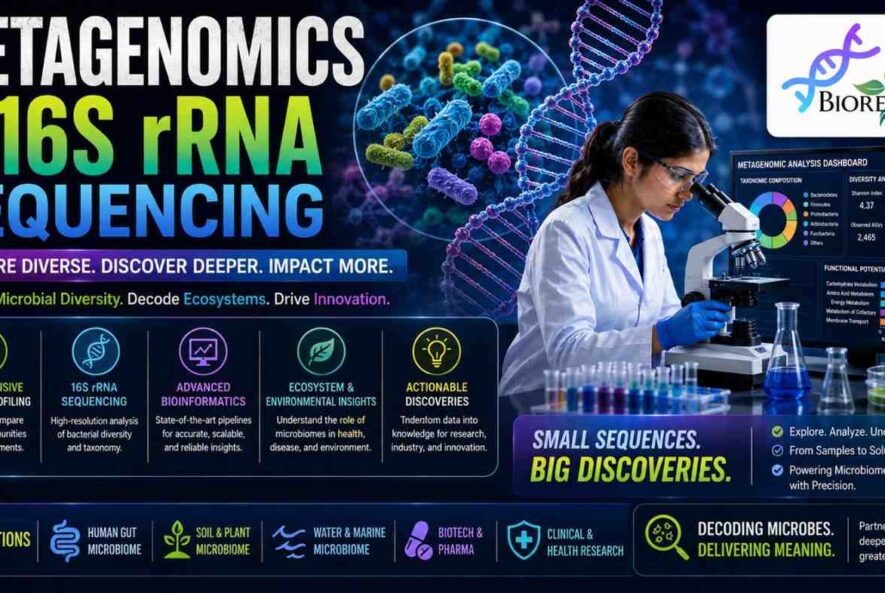
This challenge led to the development of Metagenomics and 16S rRNA Sequencing (16S-Seq).
These technologies allow researchers to study microbial communities directly from environmental or biological samples without culturing organisms.
From gut microbiome research and disease studies to agriculture, environmental monitoring, and
antibiotic resistance surveillance, Metagenomics and 16S-Seq have become powerful tools in biotechnology and bioinformatics.
For biotechnology students, bioinformatics learners, internship seekers, exam aspirants, and
fresh graduates, understanding Metagenomics and 16S-Seq is highly valuable because microbiome research is a rapidly growing field in life sciences.
In this article, we will understand Metagenomics, 16S-Seq, workflow, differences, bioinformatics tools, applications, and real-life examples in a simple and student-friendly way.
What is Metagenomics?
Metagenomics is the study of genetic material obtained directly from microbial communities present in environmental or biological samples.
In simple words:
Metagenomics studies all DNA from all microorganisms present in a sample.
Instead of studying one organism at a time, metagenomics analyzes the collective genome of entire microbial populations.
Samples may include:
- Human gut samples
- Soil samples
- Ocean water
- Wastewater
- Plant rhizosphere samples
- Air microbiome samples
Metagenomics provides information about:
- Microbial diversity
- Functional genes
- Metabolic pathways
- Antibiotic resistance genes
What is 16S rRNA Sequencing (16S-Seq)?
16S rRNA Sequencing (16S-Seq) is a microbial identification technique that studies the 16S ribosomal RNA gene present in bacteria and archaea.
In simple words:
16S-Seq identifies which bacterial species are present in a sample by sequencing the 16S rRNA gene.
The 16S gene contains:
- Conserved regions
- Variable regions
Conserved regions allow universal amplification, while variable regions help differentiate microbial species.
16S-Seq mainly focuses on:
- Bacterial identification
- Community composition
- Taxonomic classification
Why are Metagenomics and 16S-Seq Important?
Microbial communities influence:
- Human health
- Agriculture
- Ecosystems
- Disease development
- Biotechnology applications
Traditional culturing methods miss many microorganisms.
Metagenomics and 16S-Seq overcome this limitation.
Human Microbiome Research
Researchers investigate microbes associated with health and disease.
Environmental Biotechnology
Scientists study microbial ecosystems in soil, oceans, and wastewater.
Agricultural Biotechnology
Researchers analyze beneficial plant-associated microbes.
Difference Between Metagenomics and 16S-Seq
Understanding their difference is important.
16S-Seq
Focuses mainly on:
- Bacterial identification
- Taxonomic profiling
It analyzes one marker gene.
Provides information about who is present in the microbial community.
Metagenomics
Analyzesall microbial DNA.
Provides information about:
- Species diversity
- Functional genes
- Metabolic pathways
- Resistance genes
Shows both who is present and what they can do.
16S-Seq Workflow: Step-by-Step Explanation
Step 1: Sample Collection
Researchers collect samples such as:
- Stool samples
- Soil samples
- Water samples
- Plant root samples
Step 2: DNA Extraction
Microbial DNA is extracted from the sample.
Step 3: PCR Amplification
Scientists amplify specific variable regions of the 16S rRNA gene.
Common regions:
- V3–V4
- V4
- V1–V3
Step 4: Library Preparation and Sequencing
PCR products undergo:
- Adapter ligation
- Library preparation
- Next-Generation Sequencing
Step 5: Bioinformatics Analysis
Researchers perform:
- Quality control
- Taxonomic assignment
- Diversity analysis
- Community profiling
Metagenomics Workflow: Step-by-Step Explanation
Step 1: Sample Collection
Environmental or biological samples are collected.
Examples:
- Gut microbiome samples
- Soil
- Ocean water
- Wastewater
Step 2: DNA Extraction
All microbial DNA is isolated.
Step 3: Whole DNA Sequencing
Instead of targeting one gene, scientists sequence all extracted DNA.
This is commonly called shotgun metagenomic sequencing.
Step 4: Bioinformatics Processing
Researchers perform:
- Quality filtering
- Read alignment
- Taxonomic classification
- Functional annotation
- Pathway analysis
Step 5: Biological Interpretation
Scientists interpret:
- Microbial composition
- Functional pathways
- Resistance genes
- Biological interactions
Bioinformatics Tools Used in Metagenomics and 16S-Seq
Bioinformatics plays a major role in microbiome analysis.
Quality Control Tools
Researchers use:
- FastQC
- MultiQC
16S-Seq Analysis Tools
Common platforms:
- QIIME2
- Mothur
- DADA2
Metagenomics Analysis Tools
Popular tools include:
- Kraken2
- MetaPhlAn
- HUMAnN
- MEGAHIT
These tools help analyze microbial diversity and function.
Real-Life Example: Human Gut Microbiome Research
One of the strongest real-life applications of Metagenomics and 16S-Seq is gut microbiome research.
Scientists study microorganisms living in the human digestive system.
Researchers compare microbiomes from:
- Healthy individuals
- Obesity patients
- Diabetes patients
- Inflammatory bowel disease patients
Using 16S-Seq, scientists identify bacterial composition.
Using Metagenomics, researchers analyze microbial genes and metabolic functions.
Real-life findings:
Studies found links between gut microbial imbalance and:
- Obesity
- Diabetes
- Mental health disorders
- Inflammatory bowel disease
This research supports microbiome-based medicine.
Real-Time Example: COVID-19 Microbiome Studies
During the COVID-19 pandemic, researchers used microbiome analysis extensively.
Scientists investigated:
- Gut microbiome changes
- Lung microbiome composition
- Immune-microbiome interactions
Researchers compared:
- Mild COVID-19 patients
- Severe COVID-19 patients
Metagenomics and 16S-Seq identified microbial shifts associated with immune responses and disease severity.
Real-time impact:
This supported:
- Disease mechanism research
- Immune response studies
- Microbiome-based therapeutic investigation
Real-Life Example: Agricultural Biotechnology
Microbial communities strongly influence crop growth.
Scientists study microbes around plant roots, known as the rhizosphere microbiome.
Researchers use Metagenomics and 16S-Seq to identify microbes involved in:
- Nitrogen fixation
- Biofertilizer activity
- Disease resistance
- Stress tolerance
Example:
Researchers analyze rice or wheat rhizosphere microbiomes to improve agricultural productivity.
Real-life significance:
This supports:
- Sustainable agriculture
- Crop improvement
- Biofertilizer development
Real-Life Example: Environmental Metagenomics
Environmental microbiology is another major application.
Scientists study microbial communities from:
- Oceans
- Soil
- Wastewater
- Industrial environments
Many environmental microbes cannot be cultured.
Metagenomics allows direct microbial investigation.
Applications include:
- Pollution monitoring
- Bioremediation research
- Ecosystem studies
This is highly important in environmental biotechnology.
Real-Life Example: Antibiotic Resistance Surveillance
Antibiotic resistance is a major global health concern.
Researchers use metagenomics to study resistance genes in:
- Hospital wastewater
- Clinical samples
- Environmental microbiomes
Scientists identify antibiotic resistance genes without culturing bacteria.
Real-life benefit:
This supports:
- Public health surveillance
- Infection control
- Antimicrobial resistance monitoring
Applications of Metagenomics and 16S-Seq
These technologies have broad applications across biotechnology and life sciences.
Medical Biotechnology
Applications include:
- Gut microbiome research
- Disease biomarker discovery
- Precision medicine
- Infectious disease studies
Agricultural Biotechnology
Researchers investigate:
- Crop-associated microbiomes
- Biofertilizers
- Soil microbial diversity
Environmental Biotechnology
Applications include:
- Pollution monitoring
- Wastewater microbiology
- Ecosystem research
Industrial Biotechnology
Scientists study microbial communities used in industrial production systems.
Career Opportunities in Metagenomics and 16S-Seq
Learning microbiome analysis creates valuable career opportunities.
Research Laboratories
Possible roles include:
- Microbiome Research Assistant
- Genomics Associate
- Molecular Biology Analyst
Bioinformatics Careers
Career options include:
- Bioinformatics Analyst
- Computational Biologist
- Microbiome Data Scientist
Biotechnology and Pharmaceutical Industry
Industries working in:
- Probiotics
- Drug discovery
- Precision medicine
- Agricultural biotechnology
actively recruit microbiome specialists.
Higher Education and Competitive Exams
These topics are relevant for:
- MSc Biotechnology
- Bioinformatics programs
- CSIR-NET Life Sciences
- Research fellowships
Challenges of Metagenomics and 16S-Seq
Despite their importance, challenges exist.
Large Data Volume
Sequencing generates large datasets.
Complex Bioinformatics Analysis
Microbiome data analysis requires computational expertise.
Sample Contamination Risk
Poor sample handling may affect results.
Careful experimental design is important.
Future Scope of Metagenomics and 16S-Seq
The future of microbiome research is highly promising.
Emerging areas include:
- Precision microbiome medicine
- AI-driven microbiome analysis
- Personalized nutrition
- Environmental sustainability research
- Multi-omics microbiome integration
As microbiome science continues expanding, Metagenomics and 16S-Seq will remain critical tools in biotechnology and bioinformatics.
Suggested Internal Links for BioResire
- Whole-Genome Sequencing Explained
- RNA-Seq Analysis Explained
- Single-Cell RNA-Seq Explained
- Gene Expression Explained
- Introduction to Bioinformatics for Biotechnology Students
FAQs
- What is Metagenomics?
Metagenomics studies all microbial DNA obtained directly from environmental or biological samples.
- What is 16S-Seq used for?
16S-Seq is used for bacterial identification and microbial community profiling.
- What is the difference between Metagenomics and 16S-Seq?
16S-Seq studies one bacterial marker gene, while Metagenomics studies all DNA from microbial communities.
- Which tools are used in microbiome analysis?
Common tools include QIIME2, DADA2, Kraken2, MetaPhlAn, and HUMAnN.
- Why are Metagenomics and 16S-Seq important in biotechnology?
They are important for microbiome research, disease studies, agriculture, environmental monitoring, and genomics research.
Conclusion
Metagenomics and 16S-Seq are powerful technologies transforming microbiology, biotechnology, and bioinformatics
. They allow scientists to study microbial communities without culturing organisms.
From human gut microbiome research and COVID-19 microbiome studies to agricultural biotechnology, environmental microbiology, and
antibiotic resistance surveillance, these technologies have major real-world applications.
For biotechnology students, bioinformatics learners, internship seekers, and fresh graduates, understanding Metagenomics and
16S-Seq is highly valuable for research, sequencing analysis, and future microbiome-related careers.
As microbiome science, genomics, and computational biology continue advancing, expertise in Metagenomics and
16S-Seq will become increasingly important in life-science research.
Call to action
Don’t wait for opportunities – start preparing today
- Build your skills
- Gain real – world experience
- Stay consistent
Join bioresire and become job – ready for the biotechnology industry
Email : info@bioresire.inTop of Form
Phone /whatsapp : 6301352398
BioResire quote: “your carrer path becomes clear when your efforts become consistent .’