Genes contain the instructions needed for growth, development, metabolism, and cellular function.
However, simply having genes inside DNA is not enough.
The information stored in genes must be used to produce functional molecules that control biological activities.
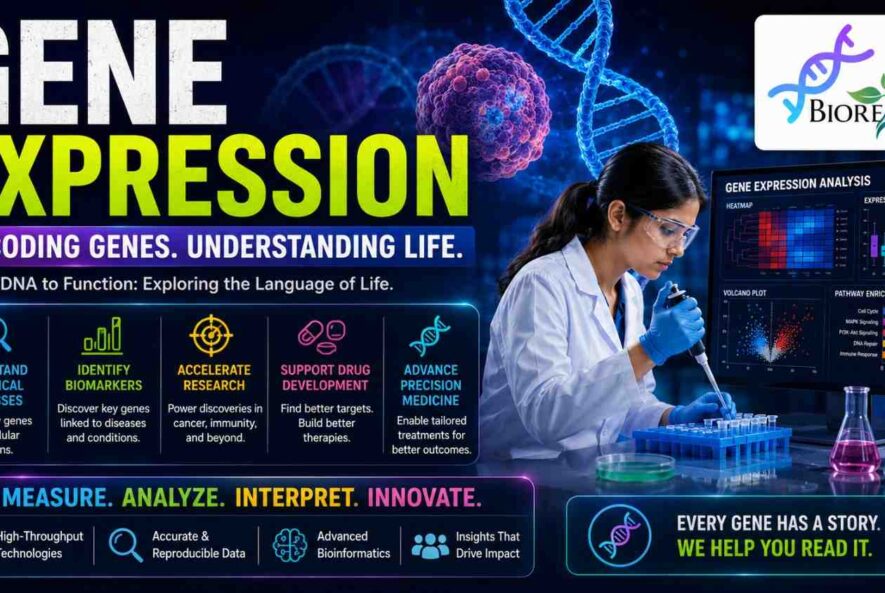
This biological process is called Gene Expression.
Gene Expression is one of the most important concepts in molecular biology, biotechnology, genomics, medicine, agriculture, and bioinformatics.
From cancer biology and drug discovery to crop improvement and infectious disease research,
gene expression studies help scientists understand how cells function under different conditions.
For biotechnology students, bioinformatics learners, internship seekers, exam aspirants, and fresh graduates
understanding Gene Expression is highly valuable because it is a core concept used in molecular biology, sequencing technologies, and genomics research.
In this article, we will understand Gene Expression, workflow, regulation, applications, bioinformatics relevance, and real-life examples in a simple and student-friendly way.
What is Gene Expression?
Gene Expression is the biological process through which information stored in DNA is converted into functional products such as proteins or RNA molecules.
In simple words:
Gene Expression is the process by which genes become active and produce biological products needed by cells.
Gene expression generally involves two major steps:
- Transcription
- Translation
During this process, genetic information flows from DNA to RNA and finally to proteins.
Why is Gene Expression Important?
Gene expression is important because cells must control which genes are active at specific times.
Every cell contains nearly the same DNA, but different cells express different genes.
For example:
- Brain cells express neuron-related genes.
- Muscle cells express muscle protein genes.
- Liver cells express metabolism-related genes.
This selective activation is controlled through gene expression.
Cellular Function
Gene expression controls:
- Growth
- Development
- Metabolism
- Immune response
Disease Development
Abnormal gene expression can contribute to diseases.
Environmental Adaptation
Cells modify gene expression in response to environmental changes.
Steps of Gene Expression: Step-by-Step Explanation
Understanding the gene expression workflow is important for biotechnology students.
Step 1: Transcription
The first stage of gene expression is transcription.
In transcription, DNA information is copied into RNA.
The enzyme RNA polymerase reads the DNA template and synthesizes messenger RNA (mRNA).
The result is an RNA molecule carrying genetic instructions.
Step 2: RNA Processing
In eukaryotic cells, newly formed RNA undergoes processing.
Major steps include:
- 5′ capping
- Poly-A tail addition
- RNA splicing
These modifications prepare mature mRNA for protein synthesis.
Step 3: Translation
The second major step is translation.
During translation, ribosomes read mRNA sequences and synthesize proteins.
Transfer RNA (tRNA) delivers amino acids needed for protein formation.
The final protein product performs biological functions.
Gene Expression Regulation
Cells carefully regulate gene activity.
Not every gene remains active continuously.
Gene regulation helps control biological balance.
Major regulatory mechanisms include:
Transcriptional Regulation
Controls whether transcription begins.
Epigenetic Regulation
Processes such as:
- DNA methylation
- Histone modification
influence gene accessibility.
Post-Transcriptional Regulation
Controls RNA stability and processing.
Translational Regulation
Influences protein synthesis efficiency.
These regulatory layers maintain cellular function.
Bioinformatics and Gene Expression Analysis
Gene expression studies generate large biological datasets.
Bioinformatics helps researchers analyze gene expression patterns.
Scientists commonly use:
- RNA-Seq Analysis
- Microarray Analysis
- Differential Gene Expression Analysis
Popular bioinformatics tools include:
- DESeq2
- EdgeR
- Limma
These tools help identify:
- Upregulated genes
- Downregulated genes
- Pathway changes
Bioinformatics is highly important in transcriptomics research.
Real-Life Example: Cancer Gene Expression Analysis
One of the strongest real-life applications of gene expression is cancer research.
Scientists compare gene expression profiles between:
- Healthy cells
- Tumor cells
Researchers identify genes showing abnormal expression.
For example:
Certain cancer genes may become overexpressed, promoting uncontrolled cell growth.
Real-life impact:
Gene expression studies help researchers discover:
- Cancer biomarkers
- Drug targets
- Personalized therapies
This supports precision medicine.
Real-Life Example: COVID-19 Immune Response Studies
Gene expression played a major role during COVID-19 research.
Scientists analyzed expression patterns in infected patients.
Researchers investigated:
- Immune response genes
- Cytokine pathways
- Inflammatory regulators
Gene expression studies helped explain:
- Severe disease progression
- Host immune responses
- Potential therapeutic targets
This supported infectious disease research.
Real-Life Example: Agricultural Biotechnology
Gene expression analysis is widely used in agriculture.
Scientists investigate crop responses to environmental stress.
Example:
Researchers study drought-stressed rice plants.
They compare gene expression between:
- Normal plants
- Drought-treated plants
Genes involved in water-stress adaptation are identified.
Applications include:
- Crop improvement
- Stress tolerance breeding
- Climate-resilient agriculture
This has major agricultural importance.
Real-Life Example: Drug Discovery Research
Pharmaceutical industries use gene expression studies during drug development.
Scientists treat cells with experimental drugs and analyze gene activity.
Researchers examine:
- Activated genes
- Suppressed genes
- Pathway changes
This helps determine:
- Drug mechanism of action
- Drug safety
- Treatment effectiveness
Gene expression analysis therefore supports pharmaceutical innovation.
Applications of Gene Expression
Gene expression has broad applications across biotechnology and life sciences.
Medical Biotechnology
Applications include:
- Cancer biology
- Disease diagnostics
- Precision medicine
- Drug development
Agricultural Biotechnology
Researchers investigate:
- Crop genetics
- Stress biology
- Yield improvement
Microbial Biotechnology
Scientists study:
- Metabolic pathways
- Antibiotic resistance
- Microbial adaptation
Functional Genomics
Gene expression helps researchers understand gene function and biological pathways.
Career Opportunities in Gene Expression Studies
Learning gene expression creates valuable career opportunities.
Research Laboratories
Possible roles include:
- Molecular Biology Research Assistant
- Transcriptomics Associate
- Genomics Research Analyst
Bioinformatics Careers
Career options include:
- Bioinformatics Analyst
- Gene Expression Data Scientist
- Computational Biology Researcher
Biotechnology and Pharmaceutical Industry
Companies working in:
- Genomics
- Drug discovery
- Precision medicine
actively recruit professionals skilled in expression analysis.
Higher Education and Competitive Exams
Gene expression is relevant for:
- MSc Biotechnology entrances
- GATE Biotechnology
- CSIR-NET Life Sciences
- Research fellowships
Understanding gene expression strengthens molecular biology preparation.
Challenges in Gene Expression Studies
Despite its importance, gene expression analysis has challenges.
Large Data Volume
Transcriptomics studies produce massive datasets.
Biological Variability
Gene activity changes depending on cell type and environment.
Complex Interpretation
Understanding regulatory mechanisms requires strong biological knowledge.
Careful experimental design is important.
Future Scope of Gene Expression Research
The future of gene expression research is highly promising.
Emerging areas include:
- Single-cell transcriptomics
- AI-driven gene analysis
- Personalized medicine
- Precision therapeutics
- Advanced genomics research
As biotechnology advances, gene expression analysis will remain a major area of scientific research.
Suggested Internal Links for BioResire
- RNA-Seq Analysis Explained
- ChIP-Seq and Epigenetics Explained
- Whole-Genome Sequencing: Complete Guide
- Variant Calling and Annotation Explained
- Introduction to Bioinformatics for Biotechnology Students
FAQs
- What is Gene Expression?
Gene Expression is the process by which genetic information in DNA is converted into RNA and proteins.
- Why is Gene Expression important?
Gene expression controls cell function, development, metabolism, disease processes, and biological responses.
- Which technologies are used to study gene expression?
Common methods include RNA-Seq, qPCR, microarrays, and transcriptomics analysis.
- What is differential gene expression?
Differential gene expression compares gene activity between different biological conditions.
- Is Gene Expression important for biotechnology students?
Yes. It is highly relevant in molecular biology, genomics, bioinformatics, medicine, and biotechnology careers.
Conclusion
Gene Expression is one of the most important biological processes in modern biotechnology and molecular biology.
It controls how genetic information is converted into functional biological products.
From cancer research, COVID-19 immune studies, crop stress analysis, and
drug discovery to precision medicine, gene expression has powerful real-world applications.
For biotechnology students, bioinformatics learners, internship seekers, and fresh graduates,
understanding gene expression is highly valuable for research, sequencing analysis, and future genomics careers.
As transcriptomics and genomics continue advancing, expertise in gene expression studies will become
increasingly important in biotechnology, healthcare, and computational biology.
Call to action
Don’t wait for opportunities – start preparing today
- Build your skills
- Gain real – world experience
- Stay consistent
Join bioresire and become job – ready for the biotechnology industry
Email : info@bioresire.inTop of Form
Phone /whatsapp : 6301352398
BioResire quote: “your carrer path becomes clear when your efforts becomeconsistent .’’Bottom of Form