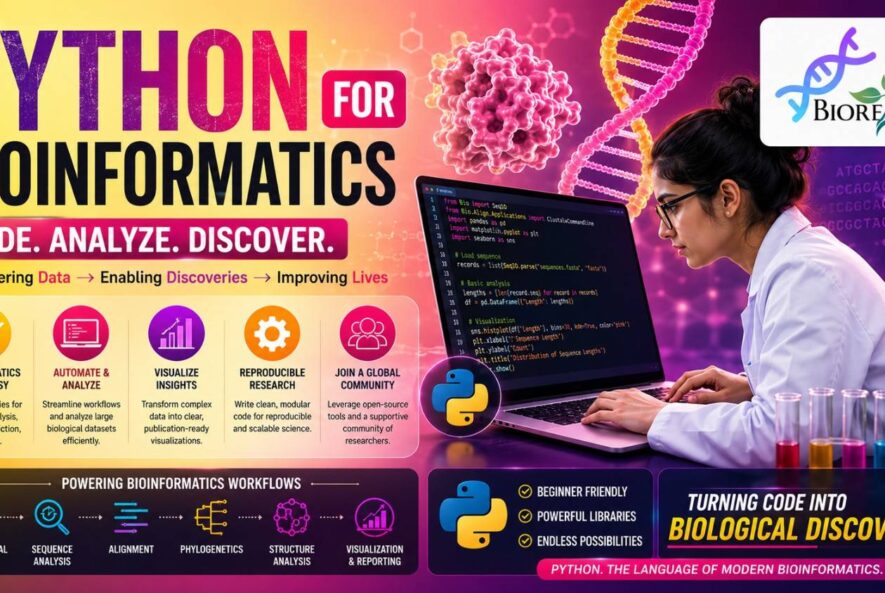
Modern biology generates massive amounts of biological data from genomics, transcriptomics, proteomics, and sequencing technologies.
Analyzing this data manually is nearly impossible. This is where Python for Bioinformatics becomes important.
Python is one of the most widely used programming languages in biotechnology, genomics, computational biology, healthcare research, and bioinformatics.
From DNA sequence analysis and genome assembly to machine learning in medicine and drug discovery, Python plays a major role in modern biological research.
For biotechnology students, bioinformatics learners, internship seekers, exam aspirants, and fresh graduates,
understanding Python for Bioinformatics is highly valuable because programming skills are increasingly required in research and biotechnology industries.
In this article, we will understand Python in Bioinformatics, workflow, applications, tools, coding concepts, and real-life examples in a simple and student-friendly way.
What is Python for Bioinformatics?
Python for Bioinformatics refers to using the Python programming language for analyzing biological data, automating research tasks, and solving computational biology problems.
In simple words:
Python helps scientists analyze DNA, RNA, proteins, sequencing data, and biological information using computer programs.
Python is popular in bioinformatics because it is:
- Easy to learn
- Beginner-friendly
- Powerful for data analysis
- Rich in scientific libraries
- Widely used in research laboratories
Python allows researchers to process large biological datasets efficiently.
Why is Python Important in Bioinformatics?
Modern biotechnology generates huge datasets from:
- Whole Genome Sequencing
- RNA-Seq Analysis
- Proteomics
- Phylogenetic Analysis
- Gene Expression Studies
Handling such datasets manually is difficult.
Python helps researchers:
- Automate analysis pipelines
- Process sequencing data
- Perform statistical analysis
- Create visualizations
- Build machine learning models
Python has therefore become a core skill in bioinformatics.
Basic Python Concepts Used in Bioinformatics
Before learning advanced bioinformatics programming, students should understand core Python concepts.
Variables
Variables store information.
Example:
gene = “BRCA1”
length = 1863
Lists
Lists store multiple values.
Example:
dna_sequences = [“ATGC”,”GGTA”,”CTAG”]
Loops
Loops automate repetitive tasks.
Example:
for base in “ATGCGTA”:
print(base)
Functions
Functions organize reusable code.
Example:
def gc_content(sequence):
return (sequence.count(“G”)+sequence.count(“C”))/len(sequence)
These concepts form the foundation of bioinformatics programming.
Workflow of Python in Bioinformatics
Understanding the Python bioinformatics workflow is important for biotechnology students.
Step 1: Biological Data Collection
Researchers collect biological datasets such as:
- DNA sequences
- RNA sequences
- Protein sequences
- Expression datasets
- Clinical genomic data
Data may come from:
- Sequencing experiments
- Public databases
- Research laboratories
Step 2: Data Preprocessing
Raw biological data often contains errors or formatting issues.
Python helps perform:
- Data cleaning
- File parsing
- Sequence formatting
- Missing value handling
Step 3: Data Analysis
Researchers analyze biological information using Python algorithms.
Common analyses include:
- Sequence alignment
- Mutation detection
- Gene expression analysis
- Phylogenetic analysis
Step 4: Visualization
Python creates graphs and biological plots.
Scientists visualize:
- Heatmaps
- Expression profiles
- Phylogenetic trees
- Statistical charts
Step 5: Interpretation and Reporting
Results are interpreted for biological understanding.
Python can automate report generation and analysis summaries.
Important Python Libraries Used in Bioinformatics
Several Python libraries are widely used.
Biopython
Biopython is one of the most important libraries for bioinformatics.
It supports:
- Sequence analysis
- FASTA file handling
- GenBank parsing
- Alignment analysis
Pandas
Used for data manipulation and biological dataset analysis.
NumPy
Supports numerical computations.
Matplotlib
Used for data visualization and plotting.
Scikit-learn
Used for machine learning applications in bioinformatics.
These libraries are widely used in genomics and computational biology.
Real-Life Example: DNA Sequence Analysis Using Python
One of the strongest real-life applications of Python is DNA sequence analysis.
Researchers analyze DNA sequences to study genes and mutations.
Example:
Scientists want to calculate GC content in a DNA sequence.
Python can perform this quickly.
Example code:
sequence = “ATGCGCGCTAAG”
gc = ((sequence.count(“G”)+sequence.count(“C”))/len(sequence))*100
print(gc)
Real-life impact:
GC content analysis helps researchers study:
- Genome characteristics
- Gene stability
- Species comparison
This is commonly used in genomics research.
Real-Life Example: COVID-19 Genomic Analysis
During the COVID-19 pandemic, researchers used Python extensively for genomic analysis.
Scientists analyzed viral genome datasets using Python tools.
Applications included:
- Mutation detection
- Variant tracking
- Genome comparison
- Epidemiological analysis
Python supported large-scale viral surveillance.
Real-life significance:
Researchers tracked viral evolution and emerging variants.
This contributed to:
- Public health monitoring
- Vaccine research
- Outbreak analysis
Real-Life Example: Gene Expression Analysis
Python is widely used in gene expression studies.
Researchers analyze RNA-Seq datasets to identify:
- Upregulated genes
- Downregulated genes
- Disease-associated pathways
Python libraries help process transcriptomics datasets efficiently.
Applications include:
- Cancer biology
- Drug response studies
- Precision medicine research
This is highly important in computational genomics.
Real-Life Example: Drug Discovery and Machine Learning
Pharmaceutical companies increasingly use Python in drug discovery.
Researchers apply machine learning algorithms to:
- Predict drug activity
- Analyze protein interactions
- Identify therapeutic targets
Python libraries such as Scikit-learn support predictive modeling.
Real-life benefit:
Python accelerates pharmaceutical research and computational drug design.
Applications of Python in Bioinformatics
Python has broad applications across biotechnology and life sciences.
Genomics
Applications include:
- Genome assembly
- Variant calling
- Sequencing analysis
- Comparative genomics
Transcriptomics
Researchers study:
- RNA-Seq analysis
- Gene expression
- Differential expression analysis
Proteomics
Python helps analyze:
- Protein sequences
- Structure prediction
- Functional proteins
Machine Learning in Biology
Applications include:
- Disease prediction
- Drug discovery
- Clinical genomics
Career Opportunities in Python for Bioinformatics
Learning Python creates valuable career opportunities.
Bioinformatics Careers
Possible roles include:
- Bioinformatics Analyst
- Computational Biologist
- Genomics Data Scientist
Research Laboratories
Researchers skilled in Python work in:
- Molecular biology labs
- Genomics facilities
- Academic research centers
Biotechnology and Pharmaceutical Industry
Companies working in:
- Precision medicine
- Drug discovery
- AI-driven healthcare
actively recruit programming-skilled professionals.
Higher Education and Competitive Exams
Python knowledge is useful for:
- MSc Bioinformatics
- Computational Biology research
- Biotechnology projects
- Research fellowships
Programming skills provide strong career advantages.
Challenges of Using Python in Bioinformatics
Despite its importance, challenges exist.
Programming Learning Curve
Students without coding backgrounds may initially find programming difficult.
Large Dataset Handling
Biological datasets can be computationally demanding.
Debugging and Error Management
Writing accurate code requires practice and logical thinking.
Regular coding practice improves proficiency.
Future Scope of Python in Bioinformatics
The future of Python in bioinformatics is highly promising.
Emerging areas include:
- AI in genomics
- Precision medicine
- Single-cell analysis
- Computational drug discovery
- Multi-omics integration
As biological data continues growing, Python skills will become increasingly important in biotechnology and computational biology.
Suggested Internal Links for BioResire
- RNA-Seq Analysis Explained
- Genome Assembly Explained
- Gene Expression Explained
- Phylogenetic Analysis Explained
- Introduction to Bioinformatics for Biotechnology Students
FAQs
- Why is Python used in bioinformatics?
Python is used for analyzing biological data, automating workflows, and performing computational analysis.
- Which Python library is important for bioinformatics?
Biopython is one of the most important Python libraries used in sequence analysis and biological data handling.
- Is Python difficult for biotechnology students?
Python is considered beginner-friendly and is easier to learn than many programming languages.
- What are the applications of Python in biotechnology?
Applications include genomics, transcriptomics, machine learning, drug discovery, and sequencing analysis.
- Is Python important for bioinformatics careers?
Yes. Python is one of the most valuable technical skills in bioinformatics, genomics, and computational biology.
Conclusion
Python for Bioinformatics is becoming an essential skill in modern biotechnology, genomics, and computational biology.
It allows researchers to analyze biological data, automate workflows, and solve complex biological problems.
From DNA sequence analysis and COVID-19 genomic surveillance to gene expression studies and drug discovery,
Python has powerful real-world applications.
For biotechnology students, bioinformatics learners, internship seekers, and fresh graduates,
learning Python can significantly improve research skills, project capabilities, and career opportunities.
As genomics, AI, and computational biology continue advancing, expertise in Python will become increasingly
important in the future of life-science research.
Call to action
Don’t wait for opportunities – start preparing today
- Build your skills
- Gain real – world experience
- Stay consistent
Join bioresire and become job – ready for the biotechnology industry
Email : info@bioresire.inTop of Form
Phone /whatsapp : 6301352398
BioResire quote: “your carrer path becomes clear when your efforts becomeconsistent .’’