
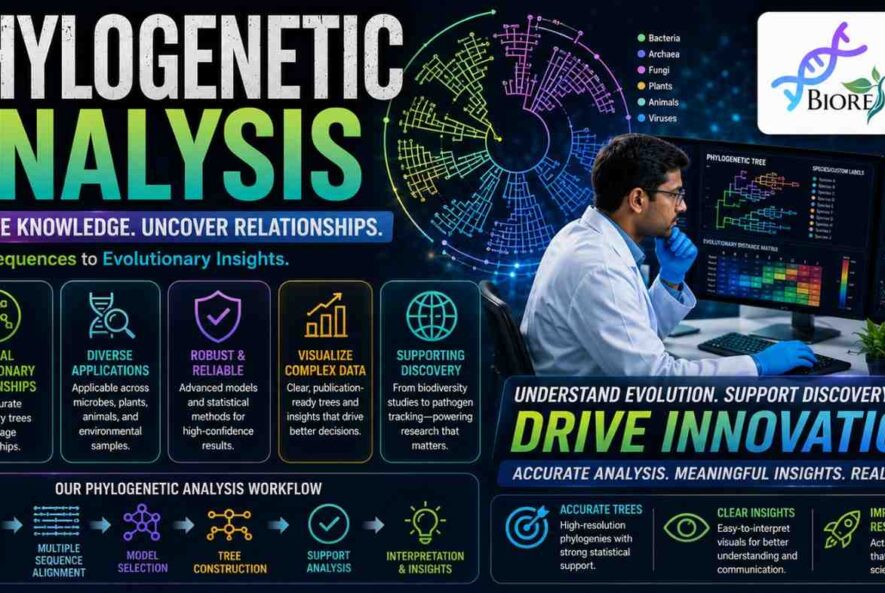
Modern biology is not only about identifying genes and sequencing DNA. Scientists also want to understand
how organisms are evolutionarily related, how species evolved over time, and how pathogens spread across populations.
This is where Phylogenetic Analysis becomes important.
Phylogenetic Analysis is widely used in genomics, biotechnology, microbiology, evolutionary biology, agriculture, medicine, and bioinformatics.
From tracing viral outbreaks to studying human evolution and crop genetics, phylogenetic analysis has become a powerful tool in modern biological research.
For biotechnology students, bioinformatics learners, internship seekers, exam aspirants, and fresh graduates,
understanding Phylogenetic Analysis is highly valuable because it plays an important role in sequence analysis and evolutionary research.
In this article, we will understand Phylogenetic Analysis, workflow, applications, bioinformatics tools, and real-life examples in a simple and student-friendly way.
What is Phylogenetic Analysis?
Phylogenetic Analysis is a method used to study evolutionary relationships among organisms, genes, proteins, or species.
It compares biological sequences to determine how closely related different organisms are.
- In simple words:
Phylogenetic Analysis helps scientists build evolutionary family trees based on genetic similarities and differences
The results are usually represented using a phylogenetic tree.
- A phylogenetic tree shows:
- Common ancestors
- Evolutionary divergence
- Genetic relatedness
- Species relationships
- Scientists can perform phylogenetic analysis using:
- DNA sequences
- RNA sequences
- Protein sequences
Why is Phylogenetic Analysis Important?
Phylogenetic Analysis is important because it helps researchers understand evolutionary patterns.
Scientists use it to investigate:
- Species evolution
- Disease outbreaks
- Gene function
- Biodiversity studies
- Pathogen transmission
- Understanding evolutionary relationships provides valuable biological insights.
- Evolutionary Biology Studies
Researchers use phylogenetic analysis to study how organisms evolved over time.
- Infectious Disease Tracking
Scientists investigate viral and bacterial spread using evolutionary analysis.
- Genomics and Biotechnology Research
Phylogenetic analysis supports comparative genomics and functional studies.
- What is a Phylogenetic Tree?
A phylogenetic tree is a branching diagram representing evolutionary relationships.
- In simple words:
A phylogenetic tree is an evolutionary family tree.
Major components include:
- Root
Represents the ancestral origin.
- Branches
Show evolutionary pathways.
- Nodes
Represent common ancestors or divergence points.
- Leaves (Terminal Nodes)
Represent modern organisms or sequences being studied.
The tree structure helps scientists visualize relationships between biological entities.
- Types of Phylogenetic Analysis
Several approaches are used in phylogenetic studies.
- Distance-Based Methods
These methods calculate genetic similarity or distance between sequences.
- Common method:
- Neighbor Joining (NJ)
Character-Based Methods
- These methods examine individual sequence changes.
- Common approaches:
- Maximum Parsimony
- Maximum Likelihood
Bayesian Methods
Bayesian analysis estimates evolutionary relationships using statistical probability models.
These methods are widely used in advanced evolutionary genomics.
Phylogenetic Analysis Workflow: Step-by-Step Explanation
Understanding the Phylogenetic Analysis workflow is important for biotechnology and bioinformatics students.
- Step 1: Sequence Collection
- The first step involves collecting biological sequences.
- Researchers may obtain:
- DNA sequences
- RNA sequences
- Protein sequences
- Sequences can be collected from:
- GenBank databases
- Laboratory experiments
- Genome sequencing projects
- Step 2: Sequence Alignment
Collected sequences undergo multiple sequence alignment (MSA).
- Alignment helps identify:
- Similar regions
- Conserved regions
- Sequence variations
- Popular alignment tools include:
- Clustal Omega
- MUSCLE
- MAFFT
- Alignment is a critical step because phylogenetic accuracy depends on good sequence comparison.
- Step 3: Model Selection
Researchers select an evolutionary model describing mutation patterns.
This improves tree-building accuracy.
- Step 4: Tree Construction
Phylogenetic trees are constructed using computational algorithms.
- Common methods include:
- Neighbor Joining
- Maximum Likelihood
- Maximum Parsimony
- Bayesian Inference
- Bioinformatics software performs these calculations.
- Step 5: Tree Visualization and Interpretation
Scientists interpret the resulting phylogenetic tree.
- They analyze:
- Evolutionary relationships
- Branching patterns
- Common ancestors
- Divergence events
- Visualization tools help present findings clearly.
Bioinformatics Tools Used in Phylogenetic Analysis
Bioinformatics plays a major role in phylogenetic studies.
Several software tools are commonly used.
- Sequence Alignment Tools
- Popular tools include:
- Clustal Omega
- MUSCLE
- MAFFT
Phylogenetic Tree Construction Tools
- Common software:
- MEGA
- IQ-TREE
- RAxML
- MrBayes
Tree Visualization Tools
- Researchers visualize phylogenetic trees using:
- FigTree
- iTOL
- Dendroscope
- These tools are widely used in genomics and evolutionary biology.
Real-Life Example: COVID-19 Evolution and Variant Tracking
One of the strongest real-life applications of phylogenetic analysis is COVID-19 viral evolution tracking.
Scientists sequenced SARS-CoV-2 genomes collected from different countries.
- Phylogenetic analysis helped researchers:
- Trace viral transmission pathways
- Identify emerging variants
- Study mutation accumulation
- Understand outbreak spread
- Researchers compared viral genomes and built phylogenetic trees.
- This helped identify important variants such as:
- Delta variant
- Omicron variant
- Real-life impact:
- Governments and healthcare organizations used this information for:
- Public health monitoring
- Vaccine strategy planning
- Global outbreak surveillance
- This is one of the most important modern applications of phylogenetic analysis.
Real-Life Example: Human Evolution Studies
Phylogenetic analysis plays a major role in studying human evolution.
Scientists compare DNA sequences from:
- Humans
- Chimpanzees
- Gorillas
- Other primates
- Researchers construct phylogenetic trees to determine evolutionary relationships.
- Results show that humans and chimpanzees share a close evolutionary relationship.
- Real-life significance:
- Phylogenetic analysis helps explain:
- Human ancestry
- Species divergence
- Evolutionary history
Real-Life Example: Agricultural Biotechnology
Phylogenetic analysis is widely used in plant biotechnology.
Researchers study crop evolution and genetic diversity.
- Example:
- Scientists compare DNA sequences from different rice varieties.
- Phylogenetic analysis helps identify:
- Evolutionary relationships
- Disease-resistant strains
- Drought-tolerant varieties
- Applications include:
- Crop breeding programs
- Trait selection
- Agricultural improvement
- This supports food security research.
Real-Life Example: Microbial Pathogen Tracking
Scientists use phylogenetic analysis to study bacterial pathogens.
- Example:
- Researchers investigating bacterial outbreaks compare microbial genomes.
- Phylogenetic trees help determine:
- Outbreak source
- Transmission routes
- Evolutionary relationships among strains
- This is useful for studying:
- Antibiotic resistance spread
- Hospital-acquired infections
- Pathogen evolution
- Real-life benefit:
- Public health agencies can respond more effectively to outbreaks.
Applications of Phylogenetic Analysis
- Phylogenetic analysis has broad applications across life sciences.
- Evolutionary Biology
- Applications include:
- Species classification
- Evolution studies
- Comparative genomics
- Biotechnology and Genomics
- Researchers study:
- Gene evolution
- Protein families
- Functional genomics
- Medical and Clinical Research
- Applications include:
- Viral outbreak tracking
- Cancer evolution studies
- Pathogen surveillance
- Agricultural Biotechnology
- Scientists investigate:
- Crop genetics
- Trait evolution
- Breeding strategies
- Career Opportunities in Phylogenetic Analysis
- Learning phylogenetic analysis creates valuable career opportunities.
- Research Laboratories
- Possible roles include:
- Evolutionary Biology Research Assistant
- Genomics Research Associate
- Molecular Biology Analyst
- Bioinformatics Careers
- Career options include:
- Bioinformatics Analyst
- Computational Biology Researcher
- Genomics Data Scientist
Healthcare and Public Health
- Organizations involved in infectious disease monitoring require professionals skilled in evolutionary genomics.
Higher Education and Competitive Exams
- Phylogenetic analysis is relevant for:
- MSc Biotechnology entrances
- GATE Biotechnology
- CSIR-NET Life Sciences
- Research fellowships
- These concepts are valuable for academic and research preparation.
- Challenges of Phylogenetic Analysis
- Despite its importance, phylogenetic analysis has limitations.
- Alignment Errors
- Poor sequence alignment may reduce tree accuracy.
- Computational Complexity
- Large datasets require strong computational resources.
- Model Selection Issues
Choosing incorrect evolutionary models may affect interpretation.
Careful analysis is important for reliable conclusions.
Future Scope of Phylogenetic Analysis
- The future of phylogenetic analysis is highly promising.
- Emerging areas include:
- AI-assisted evolutionary analysis
- Large-scale comparative genomics
- Precision epidemiology
- Metagenomics research
- Advanced biodiversity studies
- As sequencing technologies continue expanding, phylogenetic analysis will remain essential in biotechnology, genomics, and bioinformatics.
Suggested Internal Links for BioResire
- Whole-Genome Sequencing: Complete Guide
- RNA-Seq Analysis Explained
- Variant Calling and Annotation Explained
- ChIP-Seq and Epigenetics Explained
- Introduction to Bioinformatics for Biotechnology Students
FAQs
- What is Phylogenetic Analysis used for?
Phylogenetic Analysis is used to study evolutionary relationships among organisms, genes, proteins, and pathogens.
- What is a phylogenetic tree?
A phylogenetic tree is a branching diagram showing evolutionary relationships between biological entities.
- Which tools are used in phylogenetic analysis?
Common tools include MEGA, Clustal Omega, MUSCLE, IQ-TREE, and RAxML.
- Why is phylogenetic analysis important in biotechnology?
It supports genomics, pathogen tracking, crop research, comparative biology, and evolutionary studies.
- Is phylogenetic analysis important for biotechnology students?
Yes. It is highly relevant for genomics, bioinformatics, evolutionary biology, molecular biology, and research careers.
Conclusion
Phylogenetic Analysis is one of the most important tools in modern genomics, biotechnology, and bioinformatics.
It helps scientists study evolutionary relationships, investigate disease outbreaks, analyze biodiversity, and understand genetic evolution.
From COVID-19 variant tracking and human evolution research to agricultural biotechnology and microbial outbreak analysis, phylogenetic
analysis has major real-world applications.
For biotechnology students, bioinformatics learners, internship seekers, and fresh graduates, learning phylogenetic
analysis is highly valuable for research, sequence analysis, and future genomics careers.
As genomics and computational biology continue growing, expertise in phylogenetic analysis will become increasingly important in modern life sciences.
- Call to action
- Don’t wait for opportunities – start preparing today
- Build your skills
- Gain real – world experience
- Stay consistent
- Join bioresire and become job – ready for the biotechnology industry
- Email : info@bioresire.inTop of Form
- Phone /whatsapp : 6301352398
- BioResire quote: “your carrer path becomes clear when your efforts become consistent .’’