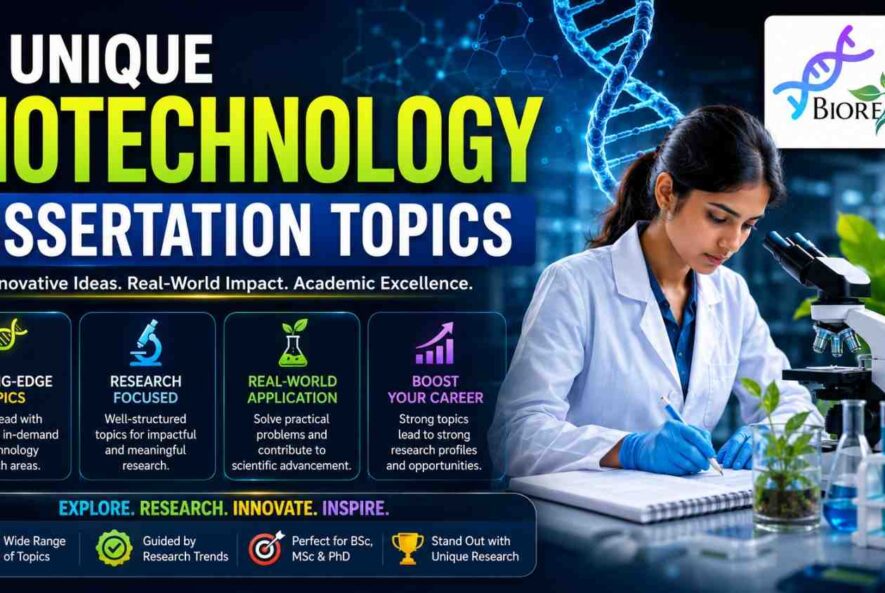
Your dissertation is one of the most important parts of your biotechnology journey. It is not just an academic requirement—it is a reflection of your skills, your understanding, and your readiness for research or industry roles. Many students treat their dissertation as just another project, but in reality, it can become your strongest asset if done correctly.
At this stage, a common question arises: How do I choose a unique dissertation topic? What makes a topic stand out? Will it help me in my future career? The answer lies in selecting topics that are not only interesting but also relevant, skill-based, and aligned with current research trends.
A unique dissertation topic does not always mean something completely new. It means choosing a topic with a fresh approach, deeper analysis, or strong real-world application.
Why Dissertation Topic Selection Matters?
Your dissertation topic determines what you will learn, what skills you will develop, and how you will present yourself in interviews or higher studies.
A strong topic helps you build technical expertise, analytical thinking, and research skills. It also increases your chances of getting internships, publications, and job opportunities.
On the other hand, a weak or random topic can limit your learning and reduce your confidence.
How to Choose a Unique Dissertation Topic?
Before selecting a topic, ask yourself: Is this topic relevant? Does it help me build skills? Can I explain it clearly? These questions help you move away from random selection and choose something meaningful that will actually benefit your future.
Start by thinking about your career direction. Do you want to go into research, industry, bioinformatics, clinical roles, or higher studies like a PhD? Your dissertation should support that path. For example, if you aim for research, choose an experimental or data-driven topic. If you are interested in bioinformatics, focus on sequence analysis, genomics, or computational modeling.
Choose a topic based on your interest area such as molecular biology, bioinformatics, microbiology, or medical biotechnology. Interest is important because you will spend months working on your dissertation. When you are interested, you naturally explore deeper, read more, and understand better.
Also consider feasibility, availability of resources, and guidance. Many students select advanced or trending topics but struggle because they lack proper lab facilities, datasets, or mentorship. Ask yourself: Do I have access to the required equipment, software, or data? Is there a guide who can support me properly?
A practical and well-executed topic is always better than a complex one without clarity. You should be able to complete your work within the given timeline and present clear results.
Another important factor is skill development. Your dissertation should help you learn something valuable. Ask yourself: What new skills will I gain? Will I learn lab techniques, data analysis, programming, or research writing? A strong topic always adds value to your skillset.
Try to add a unique angle to your topic. You don’t need to discover something completely new, but you can make your work unique by comparing methods, analyzing data differently, or applying concepts in a new way. This makes your dissertation more impressive.
You should also focus on real-world relevance. Topics related to healthcare, environment, agriculture, or industry applications are more impactful. Ask yourself: How does my topic solve a real problem?
Another key point is presentation. You should be able to explain your dissertation clearly during interviews or presentations. Choose a topic that you understand deeply, not something you memorize.
Reading research papers before finalizing your topic is very helpful. It gives you an idea of current trends, gaps in research, and possible directions for your work.
Time management is also important. Make sure your topic can be completed within your available time. A well-planned and structured project is always better than a rushed one.
Finally, remember this clearly: your dissertation is not just an academic requirement—it is your personal research identity. It reflects your thinking, your effort, and your potential.
In simple terms, choose a topic that is relevant, skill-based, feasible, and something you truly understand and can confidently explain.
.Unique Biotechnology Dissertation Topics
- CRISPR-Based Gene Editing for Disease Treatment
Study how CRISPR can be used to treat genetic disorders. You can focus on improving accuracy or reducing off-target effects.
- AI-Driven Drug Discovery
Use computational tools to identify potential drug targets. This combines biotechnology with artificial intelligence.
- Microbiome Analysis and Human Health
Study the role of gut microbiota in diseases such as obesity, diabetes, or immunity.
- Epigenetic Modifications in Cancer
Analyze DNA methylation or histone modifications in cancer progression.
- mRNA Vaccine Development and Optimization
Study how mRNA vaccines work and how they can be improved.
- Protein Engineering for Industrial Applications
Design or analyze proteins for improved stability and efficiency.
- Stem Cell-Based Regenerative Therapy
Study how stem cells can be used to repair tissues and organs.
- Environmental Bioremediation Using Microorganisms
Use microbes to degrade pollutants or clean contaminated environments.
- Metagenomics and Microbial Diversity Analysis
Study microbial communities using sequencing data.
- Nanobiotechnology for Drug Delivery
Explore how nanoparticles can be used to deliver drugs effectively.
More Unique Dissertation Topics for Better Selection
- Gene Therapy Strategies for Rare Diseases
- Bioinformatics Analysis of Genetic Variations
- Synthetic Biology for Sustainable Solutions
- Immunotherapy and Cancer Treatment
- Agricultural Biotechnology for Crop Improvement
- Systems Biology and Network Analysis
- Proteomics and Biomarker Discovery
- Antibiotic Resistance Mechanisms
- Biopharmaceutical Production Techniques
- Neurobiotechnology and Brain Disorders
How to Make Your Dissertation Topic Unique?
Choose a trending area
Add a new approach or comparison
Focus on real-world applications
Use data analysis or computational tools
Stay updated with recent research
Even a common topic can become unique if you present it with a new perspective.
Real-Life Perspective
Consider two students.
Student A chooses a basic topic and completes it without deep understanding.
Student B chooses a relevant and unique topic, learns skills, and explains it confidently.
Which student will have better opportunities?
Student B.
This shows that uniqueness comes from understanding and execution, not just the topic name.
Skills You Will Gain from Dissertation Work
Dissertation work helps you develop research skills, data analysis, critical thinking, and scientific writing.
You also learn how to design experiments, interpret results, and present findings effectively.
Common Mistakes Students Make
Choosing topics without understanding
Selecting overly complex topics
Ignoring data analysis
Not practicing explanation
Avoid these mistakes to improve your dissertation quality.
How to Make Your Dissertation Stand Out?
Understand your topic deeply
Use proper methodology
Analyze results clearly
Connect your work to real-world applications
Practice explaining your work confidently
FAQs
- What makes a dissertation topic unique?
A unique approach, real-world relevance, and strong understanding. - Should I choose a trending topic?
Yes, if you can understand and work on it properly. - Can I do a computational dissertation?
Yes, bioinformatics projects are highly valuable. - How important is a dissertation for my career?
Very important, as it reflects your research ability. - How can I improve my dissertation?
Focus on clarity, analysis, and presentation.
Conclusion
Your dissertation is a major step toward your future in biotechnology. Choosing the right topic can help you build skills, gain experience, and create strong opportunities.
Focus on relevance, understanding, and practical application to make your dissertation impactful.
Call to Action
Don’t wait for opportunities—start preparing today.
- Build your skills
- Gain real-world experience
- Stay consistent
Join BioResire and take the first step toward becoming job-ready in biotechnology.
Email: info@bioresire.in
Phone / WhatsApp: 6301352398
BioResire Quote:
“Your dissertation is not just a project, it is your identity as a future scientist.”