
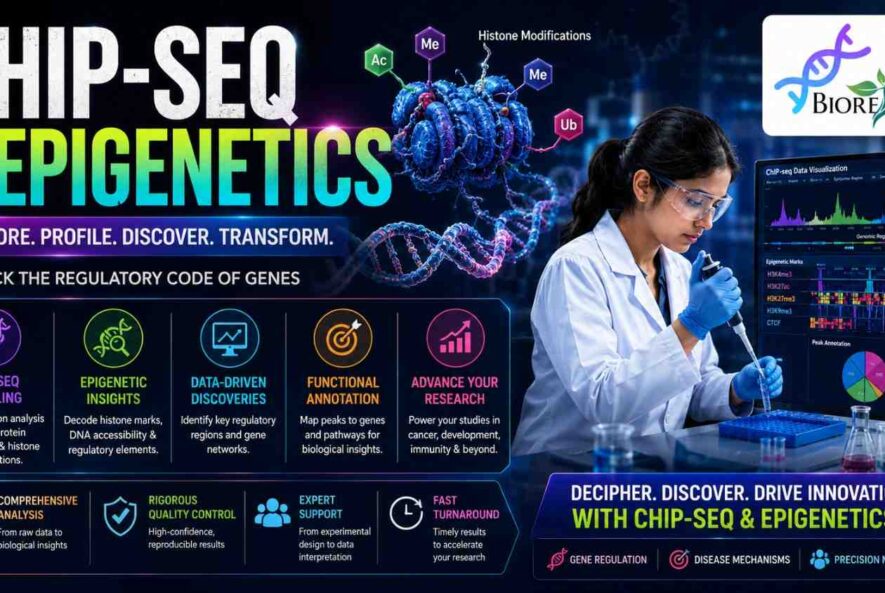
Modern biology is not only about studying DNA sequences. Scientists also want to understand how genes are turned ON or OFF,
why some genes are active in certain cells, and how environmental factors influence gene activity without changing the DNA sequence itself.
This is where Epigenetics and ChIP-Seq become important.
These fields play a major role in biotechnology, cancer research, developmental biology, drug discovery, agriculture, and bioinformatics.
For biotechnology students, bioinformatics learners, internship seekers, exam aspirants, and fresh graduates,
understanding ChIP-Seq and Epigenetics is highly valuable because they are widely used in modern genomics and molecular biology research.
In this article, we will understand Epigenetics, ChIP-Seq workflow, applications, bioinformatics analysis, and real-life examples in a simple and student-friendly way.
What is Epigenetics?
Epigenetics is the study of changes in gene activity that occur without changing the DNA sequence.
- In simple words:
Epigenetics controls whether genes are active or inactive without altering the genetic code.
Every cell in the body contains nearly the same DNA, but liver cells, brain cells, and muscle cells behave differently because different genes are switched ON or OFF.
Epigenetic mechanisms regulate this process.
- Major epigenetic mechanisms include:
- DNA methylation
- Histone modification
- Chromatin remodeling
- Non-coding RNA regulation
- These mechanisms control gene expression.
- Why is Epigenetics Important?
Epigenetics is important because gene activity changes during:
- Development
- Disease progression
- Aging
- Environmental stress
- Drug response
Epigenetic regulation influences many biological processes.
- Disease Research
Scientists study epigenetics in:
- Cancer
- Diabetes
- Neurological disorders
- Autoimmune diseases
Abnormal epigenetic changes can contribute to disease development.
- Developmental Biology
Epigenetics helps explain how identical DNA produces different cell types.
- Environmental Biology
Environmental factors such as:
- Diet
- Pollution
- Stress
- Smoking
can influence epigenetic patterns.
What is ChIP-Seq?
ChIP-Seq (Chromatin Immunoprecipitation Sequencing) is a powerful technique used to study protein-DNA interactions across the genome.
In simple words:
ChIP-Seq helps scientists identify where proteins bind to DNA inside cells.
Researchers commonly use ChIP-Seq to study:
- Transcription factor binding sites
- Histone modifications
- Chromatin organization
- Gene regulation mechanisms
- ChIP-Seq combines:
- Chromatin Immunoprecipitation (ChIP)
- Next-Generation Sequencing (NGS)
This allows genome-wide analysis of regulatory events.
Why is ChIP-Seq Important?
ChIP-Seq is important because proteins control gene regulation.
Scientists want to understand:
- Which genes are regulated?
- Which proteins control them?
- Where do regulatory proteins bind?
ChIP-Seq provides answers to these questions.
Gene Regulation Studies
Researchers study transcription factors controlling gene expression.
Epigenetic Mapping
Scientists investigate histone modification patterns across genomes.
Disease Mechanism Research
ChIP-Seq helps identify abnormal regulatory changes associated with disease.
ChIP-Seq Workflow: Step-by-Step Explanation
Understanding the ChIP-Seq workflow is important for biotechnology and bioinformatics students.
Step 1: Sample Preparation
Researchers collect biological samples such as:
- Cell cultures
- Tissue samples
- Tumor cells
- Plant tissues
Cells containing chromatin are prepared for analysis.
Step 2: Crosslinking
Proteins bound to DNA are chemically fixed.
This step preserves natural protein-DNA interactions.
Step 3: Chromatin Fragmentation
DNA-protein complexes are broken into smaller fragments.
Common methods include:
- Sonication
- Enzymatic digestion
Fragmentation prepares chromatin for immunoprecipitation.
Step 4: Immunoprecipitation
- This is the key step of ChIP-Seq.
- Researchers use specific antibodies to isolate target proteins along with their associated DNA fragments.
- Examples of target proteins:
- Transcription factors
- Histone proteins
- Regulatory proteins
Step 5: DNA Purification
After immunoprecipitation, associated DNA fragments are purified.
The recovered DNA represents protein-binding regions.
Step 6: Library Preparation and Sequencing
Purified DNA undergoes:
- Adapter ligation
- Library preparation
- Next-Generation Sequencing
Common sequencing platforms include:
- Illumina sequencing
- Ion Torrent sequencing
Step 7: Bioinformatics Analysis
Sequencing data undergoes computational analysis.
Major analysis steps include:
- Quality control
- Read alignment
- Peak calling
- Annotation
- Visualization
Bioinformatics is essential for interpreting ChIP-Seq datasets.
Bioinformatics Analysis in ChIP-Seq
Bioinformatics plays a major role in ChIP-Seq studies.
Several computational tools are used.
Quality Control
Researchers examine sequencing quality.
Common tools:
- FastQC
- MultiQC
Read Alignment
Sequencing reads are mapped to a reference genome.
Popular tools:
- Bowtie2
- BWA
Peak Calling
Peak calling identifies regions with strong protein-DNA binding signals.
Common software:
- MACS2
- SICER
Peak Annotation
Scientists determine:
- Nearby genes
- Regulatory regions
- Functional significance
This step links protein binding to biological interpretation.
Real-Life Example: Cancer Epigenetics Research
- One of the strongest real-life applications of ChIP-Seq and Epigenetics is cancer research.
- Cancer cells often show abnormal epigenetic regulation.
- Scientists use ChIP-Seq to analyze:
- Histone modification patterns
- Transcription factor binding
- Chromatin changes in tumors
Example:
Researchers may compare:
- Normal cells
- Cancer cells
ChIP-Seq identifies regulatory changes affecting cancer-associated genes.
Real-life impact:
Scientists can discover:
- Cancer biomarkers
- Drug targets
- Gene regulatory pathways
This supports precision oncology and personalized medicine.
Real-Life Example: Stem Cell Differentiation
- Stem cells can develop into multiple cell types.
- Researchers use ChIP-Seq to understand how gene regulation changes during differentiation.
- Scientists investigate:
- Histone modifications
- Transcription factor binding patterns
- Chromatin remodeling events
Example:
A stem cell developing into a neuron activates neuron-specific genes while suppressing unrelated genes.
ChIP-Seq helps identify the regulatory proteins controlling this transition.
This research supports regenerative medicine.
Real-Life Example: COVID-19 Immune Regulation
Epigenetics became important during infectious disease research.
Scientists investigated how viral infection influenced immune gene regulation.
Researchers used epigenetic analysis to study:
- Immune signaling pathways
- Cytokine regulation
- Host immune responses
Gene activation and repression patterns were linked to disease severity.
Real-life benefit:
Understanding immune regulation supports therapeutic development.
Real-Life Example: Agricultural Biotechnology
ChIP-Seq and Epigenetics are important in plant biotechnology.
Researchers study how plants respond to environmental stress.
Example:
Scientists compare:
- Normal rice plants
- Drought-stressed rice plants
ChIP-Seq identifies regulatory proteins and epigenetic marks associated with drought response genes.
Applications include:
- Crop improvement
- Stress tolerance breeding
- Climate-resilient agriculture
This is highly valuable for food security research.
Applications of ChIP-Seq and Epigenetics
These technologies have broad applications across life sciences.
Medical Biotechnology
Applications include:
- Cancer epigenomics
- Drug target discovery
- Disease biomarker research
- Personalized medicine
Developmental Biology
Scientists investigate:
- Cell differentiation
- Embryonic development
- Gene regulation pathways
Agricultural Biotechnology
Applications include:
- Crop stress biology
- Yield improvement
- Disease resistance studies
Functional Genomics
Researchers study genome-wide regulatory mechanisms.
Career Opportunities in ChIP-Seq and Epigenetics
Learning epigenetics and ChIP-Seq creates multiple career opportunities.
Research Laboratories
Possible roles include:
- Molecular Biology Research Assistant
- Genomics Associate
- Epigenetics Research Trainee
Bioinformatics Careers
Career opportunities include:
- Bioinformatics Analyst
- Epigenomics Data Scientist
- Computational Biology Researcher
Pharmaceutical and Biotechnology Industry
Companies working in:
- Precision medicine
- Drug discovery
- Genomics diagnostics
require professionals skilled in regulatory genomics.
Higher Education and Competitive Exams
These topics are valuable for:
- MSc Biotechnology entrances
- GATE Biotechnology
- CSIR-NET Life Sciences
- Research fellowships
Knowledge of ChIP-Seq strengthens genomics and molecular biology preparation.
Challenges of ChIP-Seq and Epigenetics
Despite their importance, certain limitations exist.
Complex Data Analysis
ChIP-Seq generates large sequencing datasets requiring computational analysis.
Antibody Quality Issues
Poor antibody specificity may influence experimental accuracy.
Interpretation Challenges
Understanding epigenetic regulation requires strong biological knowledge.
Future Scope of ChIP-Seq and Epigenetics
The future of epigenomics is highly promising.
Emerging trends include:
- Single-cell epigenomics
- AI-driven genomic analysis
- Precision medicine
- Clinical epigenetics
- Advanced chromatin biology research
As genomics advances, ChIP-Seq and epigenetic analysis will continue expanding across biotechnology, healthcare, and research.
Suggested Internal Links for BioResire
- Whole-Genome Sequencing: Complete Guide
- RNA-Seq Analysis Explained
- Variant Calling and Annotation Explained
- Introduction to Bioinformatics for Biotechnology Students
- Next-Generation Sequencing (NGS) Basics
FAQs
- What is ChIP-Seq used for?
ChIP-Seq is used to study protein-DNA interactions, transcription factor binding, histone modifications, and gene regulation.
- What is Epigenetics?
Epigenetics studies gene activity changes that occur without altering the DNA sequence.
- Why are ChIP-Seq and Epigenetics important?
They help scientists understand gene regulation, disease mechanisms, development, and environmental responses.
- Which technologies are used in ChIP-Seq?
ChIP-Seq combines Chromatin Immunoprecipitation with Next-Generation Sequencing technologies.
- Are ChIP-Seq and Epigenetics important for biotechnology students?
Yes. These topics are highly relevant in genomics, molecular biology, cancer biology, bioinformatics, and biotechnology careers.
Conclusion
ChIP-Seq and Epigenetics are powerful areas of modern biotechnology and genomics.
Epigenetics explains how gene activity changes without altering DNA sequences, while ChIP-Seq helps scientists study protein-DNA interactions across the genome.
From cancer research and stem cell biology to agricultural biotechnology and infectious disease studies,
these technologies provide valuable insights into gene regulation and cellular behavior.
For biotechnology students, bioinformatics learners, internship seekers, and fresh graduates
understanding ChIP-Seq and Epigenetics is highly beneficial for research, sequencing analysis, and future life-science careers.
As epigenomics and regulatory biology continue expanding, expertise in these areas will become increasingly important in biotechnology and bioinformatics.
Call to action
Don’t wait for opportunities – start preparing today
- Build your skills
- Gain real – world experience
- Stay consistent
Join bioresire and become job – ready for the biotechnology industry
Email :info@bioresire.inTop of Form
Phone /whatsapp : 6301352398
BioResire quote: “your carrer path becomes clear when your efforts becomeconsistent