Modern genomics has introduced several powerful sequencing technologies that help scientists study diseases, genes, and biological systems more efficiently
While Whole-Genome Sequencing (WGS) studies the entire genome, researchers often use more targeted approaches such as
Exome Sequencing (Exome-Seq) and Panel Sequencing (Panel-Seq).
These methods are widely used in biotechnology, medicine, clinical genetics, bioinformatics, and research laboratories.
For biotechnology students, bioinformatics learners, internship seekers, exam aspirants, and fresh graduates,
understanding Exome-Seq and Panel-Seq is important because these technologies play a major role in
disease diagnosis, precision medicine, and genomic research.
In this article, we will understand Exome Sequencing, Panel Sequencing, their workflows, applications,
differences, and real-life examples in a simple and student-friendly way.
What is Exome Sequencing (Exome-Seq)?
Exome Sequencing (Whole Exome Sequencing or WES) is a sequencing technique used to analyze the exome of an organism.
The exome refers to all protein-coding regions (exons) present in the genome.
Although exons make up only 1–2% of the human genome, they contain a large percentage of disease-causing mutations.
In simple words:
Exome-Seq focuses only on the protein-coding parts of DNA rather than sequencing the complete genome.
Scientists mainly use Exome Sequencing to identify mutations linked to genetic diseases.
Why is Exome Sequencing Important?
Exome Sequencing is important because many disease-associated mutations occur within coding regions.
Compared with Whole-Genome Sequencing, Exome-Seq offers:
- Lower sequencing cost
- Faster analysis
- Focused mutation detection
- Efficient disease investigation
This makes it highly useful in medical genetics and genomics research.
Genetic Disease Identification
Scientists use Exome-Seq to identify:
- Rare genetic disorders
- Inherited diseases
- Developmental disorders
- Neurological disorders
Cancer Genomics
Researchers analyze cancer-associated gene mutations using Exome Sequencing.
This helps discover:
- Tumor mutations
- Disease pathways
- Therapeutic targets
Clinical Diagnostics
Hospitals increasingly use Exome-Seq for difficult clinical cases where standard laboratory tests fail to provide answers.
Exome Sequencing Workflow: Step-by-Step Explanation
Understanding the Exome-Seq workflow is important for biotechnology and bioinformatics students.
Step 1: Sample Collection
Researchers collect biological samples such as:
- Blood
- Saliva
- Tissue samples
DNA is isolated from the collected material.
Step 2: DNA Extraction
Genomic DNA is purified from cellular material.
High-quality DNA is essential for accurate sequencing results.
Step 3: Library Preparation
DNA fragments are generated and sequencing adapters are attached.
This creates a sequencing library.
Step 4: Exome Capture
This is the key step unique to Exome-Seq.
Special probes capture only exonic regions from the genome.
Non-coding DNA regions are largely removed.
Step 5: Sequencing
Captured exonic DNA undergoes sequencing using NGS platforms.
Common technologies include:
- Illumina sequencing
- Ion Torrent sequencing
Step 6: Bioinformatics Analysis
Researchers analyze sequencing data using computational tools.
Important steps include:
- Read alignment
- Variant calling
- Mutation detection
- Functional annotation
Bioinformatics plays a major role in Exome-Seq analysis.
Real-Life Example of Exome Sequencing
Rare Genetic Disease Diagnosis
One of the most common real-life uses of Exome Sequencing is rare disease diagnosis.
Example:
A child may show unexplained symptoms such as:
- Developmental delay
- Muscle weakness
- Neurological abnormalities
- Traditional laboratory testing may not identify the cause.
- Doctors can perform Whole Exome Sequencing to analyze coding regions and detect disease-causing mutations.
Real-life impact:
Families receive:
- Accurate diagnosis
- Genetic counseling
- Better treatment planning
Exome-Seq has helped diagnose thousands of previously unexplained genetic disorders worldwide.
Cancer Research Example
Scientists use Exome-Seq to study mutations in tumor cells.
Researchers compare:
- Healthy tissue DNA
- Tumor DNA
This helps identify cancer-specific mutations involved in tumor growth.
Results support:
- Precision medicine
- Drug target discovery
- Personalized treatment strategies
Applications of Exome Sequencing
Exome-Seq has applications across multiple fields.
Medical Biotechnology
Applications include:
- Rare disease studies
- Genetic diagnostics
- Personalized medicine
- Cancer mutation analysis
Genomics Research
Scientists use Exome-Seq to study:
- Gene function
- Mutation patterns
- Disease pathways
Clinical Genetics
- Hospitals use Exome Sequencing for clinical decision-making in complex disease cases.
- What is Panel Sequencing (Panel-Seq)?
- Panel Sequencing (Panel-Seq) is a targeted sequencing approach used to analyze
- a selected group of genes associated with a specific disease or biological condition.
- Unlike Exome-Seq, which studies all coding genes, Panel-Seq focuses on only predefined genes of interest.
- In simple words:
Panel-Seq sequences a small gene set related to a
particular clinical or research question.
For example:
A cancer panel may sequence only cancer-associated genes.
Why is Panel Sequencing Important?
Panel-Seq is important because it provides highly targeted analysis.
Advantages include:
- Lower cost
- Faster turnaround time
- Focused disease testing
- High sequencing depth
Because fewer genes are analyzed, data interpretation becomes easier.
Panel Sequencing Workflow
The Panel-Seq workflow shares similarities with Exome-Seq but focuses on selected genes.
Step 1: Sample Collection
Researchers collect samples such as:
- Blood
- Tumor tissue
- Saliva
Step 2: DNA Extraction
DNA is purified from biological samples.
Step 3: Target Gene Selection
Researchers select specific genes linked to the disease being studied.
Examples:
- Breast cancer genes
- Cardiac disorder genes
- Neurological disorder genes
Step 4: Library Preparation and Target Capture
Selected genes are enriched using specialized probes.
Only target genes proceed for sequencing.
Step 5: Sequencing
Sequencing is performed using NGS platforms.
Step 6: Bioinformatics Analysis
Researchers perform:
- Variant detection
- Mutation analysis
- Clinical interpretation
Real-Life Example of Panel Sequencing
Breast Cancer Genetic Testing
- One of the best real-life examples of Panel Sequencing is breast cancer gene testing.
- Researchers may analyze genes such as:
- BRCA1
- BRCA2
- TP53
- Instead of sequencing the entire genome, Panel-Seq focuses only on genes strongly linked to hereditary breast cancer.
- Real-life impact:
Doctors can:
- Assess cancer risk
- Guide patient monitoring
- Support treatment planning
This makes Panel-Seq highly useful in clinical oncology.
Cardiac Disease Example
Panel Sequencing is also used for inherited heart disorders.
Scientists analyze panels containing genes associated with:
- Cardiomyopathy
- Arrhythmia
- Sudden cardiac death syndromes
This helps clinicians diagnose inherited cardiac conditions.
Applications of Panel Sequencing
Panel-Seq is widely used across biotechnology and healthcare.
Clinical Diagnostics
Applications include:
- Cancer testing
- Neurological disorders
- Cardiac disease analysis
- Genetic screening
Precision Medicine
Panel sequencing helps guide personalized therapies based on genetic findings.
Research Laboratories
Scientists use targeted gene panels for focused biological investigations.
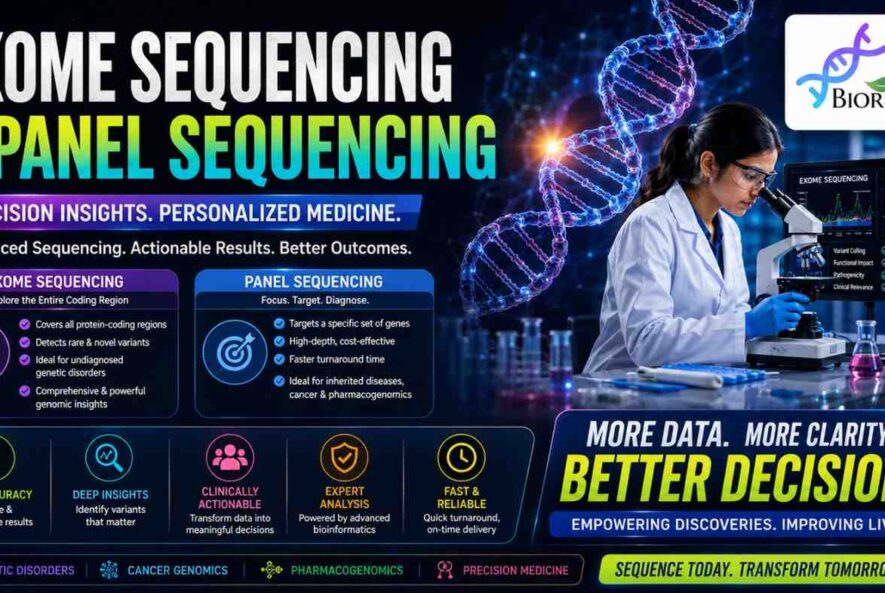
Exome Sequencing vs Panel Sequencing
Understanding the difference between Exome-Seq and Panel-Seq is important.
Exome Sequencing
- Studies all protein-coding genes
- Broader mutation analysis
- Higher data volume
- Useful for unexplained diseases
Panel Sequencing
- Studies selected target genes
- Faster and cheaper analysis
- Focused clinical testing
- Easier interpretation
Choice depends on clinical goals and research needs.
Career Opportunities in Exome-Seq and Panel-Seq
Knowledge of sequencing technologies creates valuable career opportunities.
Possible career paths include:
Research Laboratories
Roles:
- Genomics Research Assistant
- Molecular Biology Associate
- Sequencing Technician
Bioinformatics Careers
Career options:
- Bioinformatics Analyst
- Variant Analysis Specialist
- Genomic Data Scientist
Healthcare and Biotechnology Industry
Industries working in:
- Clinical genomics
- Precision medicine
- Genetic diagnostics
actively recruit sequencing professionals.
Higher Education and Competitive Exams
These topics are relevant for:
- MSc Biotechnology entrances
- GATE Biotechnology
- CSIR-NET Life Sciences
- Genomics research fellowships
Future Scope of Exome-Seq and Panel-Seq
The future of targeted sequencing technologies is promising.
Emerging areas include:
- Precision medicine
- Clinical genomics
- AI-based mutation analysis
- Personalized healthcare
- Advanced disease diagnostics
As sequencing technologies continue improving, Exome-Seq and Panel-Seq will remain important tools in biotechnology and medicine.
Suggested Internal Links for BioResire
- Whole-Genome Sequencing: Complete Guide
- RNA-Seq Analysis Explained
- Introduction to Bioinformatics for Biotechnology Students
- Next-Generation Sequencing (NGS) Basics
- Career Opportunities in Genomics and Computational Biology
FAQs
- What is Exome Sequencing used for?
Exome Sequencing is used for identifying mutations in protein-coding genes associated with genetic diseases and cancer.
- What is Panel Sequencing used for?
Panel Sequencing is used to analyze selected genes related to specific diseases such as cancer, cardiac disorders, or neurological conditions.
- What is the difference between Exome-Seq and Panel-Seq?
Exome-Seq studies all coding genes, while Panel-Seqanalyzes only predefined target genes.
- Is bioinformatics important in Exome-Seq and Panel-Seq?
Yes. Bioinformatics is essential for mutation analysis, variant calling, and interpretation of sequencing data.
- Are Exome-Seq and Panel-Seq important for biotechnology students?
Yes. These technologies are highly relevant for genomics, molecular biology, clinical diagnostics, and bioinformatics careers.
Conclusion
Exome Sequencing and Panel Sequencing are powerful genomic technologies
that help scientists investigate genetic mutations, diagnose diseases,
and support precision medicine.
Exome-Seq provides broad analysis of all coding genes, while Panel-Seq
offers focused examination of selected disease-related genes.
For biotechnology students, bioinformatics learners, internship seekers, and
fresh graduates, understanding these sequencing
approaches is highly valuable for research, healthcare, and biotechnology careers.
As genomics continues expanding, knowledge of targeted sequencing technologies
will become increasingly important in modern life sciences.
Call to action
Don’t wait for opportunities – start preparing today
- Build your skills
- Gain real – world experience
- Stay consistent
Join bioresire and become job – ready for the biotechnology industry
Email : info@bioresire.inTop of Form
Phone /whatsapp : 6301352398
BioResire quote: “your carrer path becomes clear when your efforts becomeconsistent .