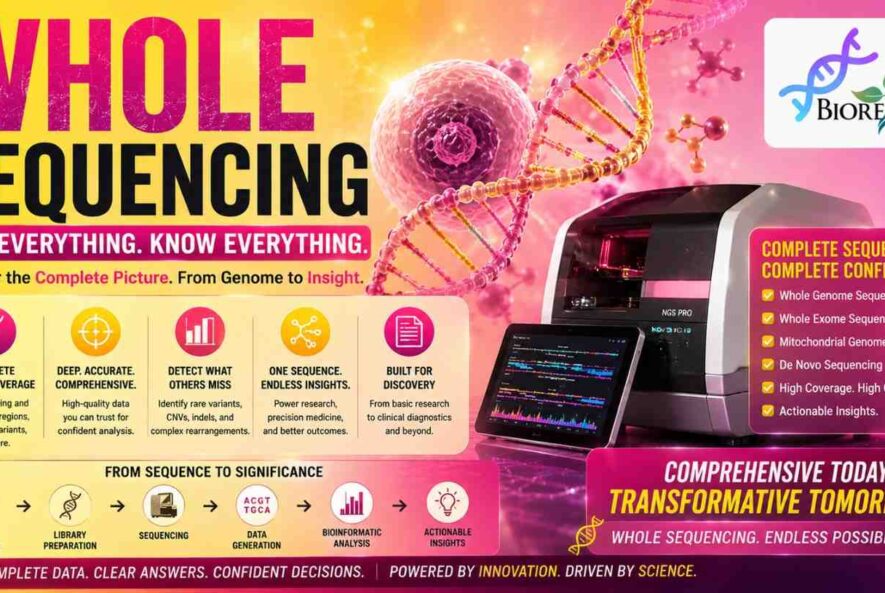
Whole-Genome Sequencing (WGS) has become one of the most important technologies in modern biotechnology, medicine, and bioinformatics. Scientists can now study the complete genetic blueprint of an organism with high accuracy and speed. From identifying disease-causing mutations to improving crop varieties and studying microbial evolution, Whole-Genome Sequencing is transforming life science research.
For biotechnology students, bioinformatics learners, internship seekers, exam aspirants, and fresh graduates, understanding Whole-Genome Sequencing is highly valuable because genomics is becoming a major part of research, healthcare, agriculture, and biotechnology industries.
In this article, we will understand the Whole-Genome Sequencing process, technologies, applications, career relevance, and future scope in a simple and student-friendly way.
What is Whole-Genome Sequencing?
Whole-Genome Sequencing (WGS) is a laboratory technique used to determine the complete DNA sequence of an organism’s genome.
A genome contains all genetic material present in an organism, including:
- Genes
- Coding DNA regions
- Non-coding DNA regions
- Regulatory sequences
- Mitochondrial DNA in some organisms
Unlike targeted sequencing methods that analyze only selected genes, Whole-Genome Sequencing studies the entire genome.
In simple words, WGS helps scientists answer the question:
“What does the complete genetic information of an organism look like?”
Whole-Genome Sequencing can be performed on:
- Humans
- Plants
- Animals
- Bacteria
- Viruses
- Fungi
Because it studies the full genome, WGS provides deeper biological information compared with limited sequencing approaches.
Why is Whole-Genome Sequencing Important?
The importance of Whole-Genome Sequencing comes from its ability to provide comprehensive genetic information.
Traditional genetic testing often focuses on a few genes. However, many biological traits and diseases involve multiple DNA regions. Whole-Genome Sequencing gives researchers a complete view of genetic variation.
Disease Diagnosis
One major application of WGS is disease diagnosis.
Scientists and doctors use genome sequencing to identify:
- Rare genetic disorders
- Inherited diseases
- Cancer-related mutations
- Genetic abnormalities
For example, children with unexplained genetic disorders may undergo Whole-Genome Sequencing to detect hidden mutations that standard tests fail to identify.
Infectious Disease Monitoring
Whole-Genome Sequencing is extremely useful in tracking pathogens.
Researchers use WGS for:
- Viral mutation analysis
- Outbreak investigation
- Antibiotic resistance detection
- Transmission tracking
Genome sequencing has become an important tool in infectious disease surveillance.
Biotechnology Research
In biotechnology laboratories, Whole-Genome Sequencing supports:
- Gene discovery
- Functional genomics
- Synthetic biology
- Molecular pathway analysis
Scientists can understand how genes function and how organisms respond to environmental changes.
Agricultural Improvement
Genome sequencing helps improve agricultural biotechnology.
Applications include:
- Crop breeding
- Disease-resistant plants
- Drought-tolerant crops
- Yield improvement programs
This makes WGS important for food security and sustainable agriculture.
Whole-Genome Sequencing Process: Step-by-Step Explanation
Understanding the Whole-Genome Sequencing process is essential for biotechnology and bioinformatics students.
Although workflows vary between laboratories, the general process follows several key stages.
Step 1: Sample Collection
The first step involves collecting biological samples.
Common samples include:
- Blood
- Saliva
- Tissue
- Plant material
- Microbial cultures
Scientists obtain DNA from these biological materials.
Step 2: DNA Extraction
DNA extraction involves isolating genomic DNA from cellular components such as proteins and lipids.
Good DNA quality is important because sequencing accuracy depends on:
- DNA purity
- DNA concentration
- Minimal contamination
Poor-quality DNA can negatively affect sequencing results.
Step 3: Library Preparation
During library preparation, DNA is fragmented into smaller pieces.
Special sequencing adapters are added to the DNA fragments so sequencing machines can recognize and process them.
This step is critical for successful sequencing.
Step 4: DNA Sequencing
The prepared DNA library is loaded into sequencing instruments.
Most laboratories use Next-Generation Sequencing (NGS) technologies for Whole-Genome Sequencing.
Common sequencing platforms include:
- Illumina sequencing
- Oxford Nanopore sequencing
- PacBio sequencing
These technologies generate millions of DNA reads for analysis.
Step 5: Bioinformatics Analysis
Raw sequencing data alone is not useful without computational analysis.
Bioinformatics tools help researchers perform:
- Sequence alignment
- Genome assembly
- Mutation detection
- Variant analysis
- Functional annotation
This step explains why bioinformatics and genome sequencing are closely connected.
Students interested in computational biology often work extensively with genomic datasets.
Technologies Used in Whole-Genome Sequencing
Several advanced sequencing technologies support modern genome sequencing.
Sanger Sequencing
Sanger sequencing was one of the earliest DNA sequencing techniques.
Advantages:
- High accuracy
- Reliable for small DNA regions
Limitations:
- Low throughput
- Expensive for complete genomes
Because of these limitations, it is less suitable for large-scale Whole-Genome Sequencing.
Next-Generation Sequencing (NGS)
NGS revolutionized genomics by enabling rapid sequencing of massive DNA volumes.
Advantages include:
- High throughput
- Faster sequencing
- Lower cost per sample
NGS is widely used in:
- Clinical genomics
- Cancer genomics
- Microbial genomics
- Biotechnology research
Third-Generation Sequencing
Newer sequencing methods provide long DNA reads.
Examples include:
- Oxford Nanopore Technology
- PacBio SMRT Sequencing
Advantages:
- Long-read sequencing
- Better genome assembly
- Improved structural variant detection
These technologies continue to expand modern genome sequencing techniques.
Applications of Whole-Genome Sequencing in Biotechnology
The applications of Whole-Genome Sequencing are growing rapidly across multiple fields.
Medical Biotechnology
Whole-Genome Sequencing supports personalized medicine.
Doctors can analyze patient genomes to:
- Predict disease susceptibility
- Select targeted therapies
- Improve treatment decisions
Cancer genomics strongly benefits from WGS-based analysis.
Microbial Biotechnology
Microorganisms are important in biotechnology industries.
Scientists use WGS to study:
- Industrial bacterial strains
- Probiotics
- Metabolic pathways
- Antibiotic resistance genes
For example, genome sequencing can help improve microbial strains used in biofertilizer production.
Agricultural Biotechnology
Genome sequencing is widely used in crop improvement research.
Applications include:
- Pest resistance studies
- Nutritional enhancement
- Crop breeding programs
- Stress tolerance research
This helps develop stronger and more productive crops.
Evolutionary Biology
Whole-Genome Sequencing is valuable in studying:
- Genetic diversity
- Species evolution
- Comparative genomics
- Population genetics
Researchers compare genomes to understand evolutionary relationships among organisms.
Whole-Genome Sequencing in Bioinformatics
Whole-Genome Sequencing generates extremely large datasets.
Without bioinformatics, analyzing genome data would be difficult.
Important bioinformatics tasks include:
Genome Assembly
DNA fragments are assembled into complete genome sequences.
Variant Calling
Scientists identify genetic variations such as:
- SNPs
- Insertions
- Deletions
- Structural variants
Functional Annotation
Researchers determine the biological functions of genes and genome regions.
Students learning bioinformatics should become familiar with:
- FASTQ files
- Genome browsers
- Alignment tools
- Variant analysis software
These skills are highly valuable for internships and research careers.
Career Opportunities in Whole-Genome Sequencing
Learning Whole-Genome Sequencing can open many career opportunities.
Research Laboratories
Possible roles include:
- Research Assistant
- Molecular Biology Trainee
- Genomics Laboratory Technician
Bioinformatics Careers
Genome sequencing has increased demand for computational professionals.
Career roles include:
- Bioinformatics Analyst
- Genomic Data Scientist
- Computational Biology Associate
Pharmaceutical and Healthcare Industries
Companies working on precision medicine and diagnostics require professionals skilled in genomics and sequencing technologies.
Agricultural Biotechnology Industry
Crop genetics and genome-based breeding create opportunities for biotechnology graduates.
Higher Education and Competitive Exams
Whole-Genome Sequencing is relevant for:
- MSc Biotechnology entrance preparation
- GATE Biotechnology
- CSIR-NET
- Research fellowships
Students preparing for life-science examinations should understand genome sequencing basics.
Challenges of Whole-Genome Sequencing
Despite its benefits, Whole-Genome Sequencing has certain limitations.
Large Data Volume
Genome datasets are massive and require strong computational infrastructure.
Complex Data Interpretation
Analyzing genomic information requires specialized biological and bioinformatics knowledge.
Ethical and Privacy Concerns
Human genome sequencing raises important questions related to:
- Genetic privacy
- Data protection
- Informed consent
These issues are important in modern clinical genomics.
Future Scope of Whole-Genome Sequencing
The future of Whole-Genome Sequencing is highly promising.
Important emerging trends include:
- AI-driven genomic analysis
- Personalized medicine
- Precision agriculture
- Faster pathogen monitoring
- Clinical genomics expansion
As sequencing technologies become cheaper and faster, WGS is expected to become more accessible across healthcare, biotechnology, and research industries.
For biotechnology and bioinformatics students, genomic literacy will become an increasingly valuable professional skill.
Suggested Internal Links for BioResire
- Next-Generation Sequencing (NGS): Beginner’s Guide
- Introduction to Bioinformatics for Biotechnology Students
- DNA Sequencing Techniques Explained
- Career Opportunities in Genomics and Computational Biology
- Molecular Biology Skills Required for Biotechnology Internships
FAQs
- What is Whole-Genome Sequencing used for?
Whole-Genome Sequencing is used in disease diagnosis, agriculture, microbial research, biotechnology, personalized medicine, and evolutionary studies.
- Is Whole-Genome Sequencing important for biotechnology students?
Yes. WGS is highly important for biotechnology, genomics, molecular biology, and bioinformatics careers.
- Which technology is commonly used for Whole-Genome Sequencing?
Next-Generation Sequencing (NGS) platforms such as Illumina, PacBio, and Oxford Nanopore are commonly used.
- Does Whole-Genome Sequencing require bioinformatics knowledge?
Yes. Bioinformatics is important for sequence analysis, genome assembly, mutation detection, and data interpretation.
- What is the difference between Whole-Genome Sequencing and targeted sequencing?
whole-Genome Sequencing analyzes the entire genome, while targeted sequencing studies only selected genes or genomic regions.
Real-Life Examples of Whole-Genome Sequencing
COVID-19 Variant Tracking
One of the biggest real-life applications of Whole-Genome Sequencing (WGS) was during the COVID-19 pandemic.
Scientists used WGS to:
- Identify new SARS-CoV-2 variants
- Track virus mutations
- Monitor transmission patterns
- Study how variants spread between countries
For example, variants such as:
- Delta variant
- Omicron variant
were identified using genome sequencing technologies.
This helped governments and healthcare systems make decisions related to:
- Vaccination strategies
- Public health measures
- Travel restrictions
- Outbreak control
This is one of the best examples showing how Whole-Genome Sequencing directly impacts global healthcare.
Cancer Diagnosis and Personalized Medicine
Doctors now use Whole-Genome Sequencing in cancer research and treatment.
Example:
A cancer patient’s tumor DNA can be sequenced to identify specific mutations responsible for cancer growth.
Based on these mutations, doctors may choose:
- Targeted therapies
- Personalized medicines
- Better treatment plans
This approach is called precision medicine or personalized medicine.
Rare Genetic Disease Detection
Many children suffer from rare genetic disorders that are difficult to diagnose through normal laboratory tests.
Whole-Genome Sequencing helps identify hidden mutations responsible for diseases such as:
- Muscular dystrophy
- Inherited neurological disorders
- Rare metabolic disorders
Real-life benefit:
Families can receive:
- Early diagnosis
- Better treatment planning
- Genetic counseling
Food Safety and Bacterial Outbreak Investigation
Genome sequencing is used in food industries and public health laboratories.
Example:
If many people become sick after eating contaminated food, scientists sequence bacterial genomes to identify:
- The source of contamination
- How bacteria spread
- Whether outbreaks are connected
This helps prevent large-scale foodborne disease outbreaks.
Agricultural Biotechnology Example
Scientists sequence crop genomes to improve agricultural productivity.
Example:
Rice and wheat genomes have been sequenced to identify genes related to:
- Drought resistance
- Disease resistance
- Higher yield
This helps develop stronger crop varieties for future food security.
Microbial Biotechnology Example
Industries using beneficial bacteria often apply Whole-Genome Sequencing to improve microbial strains.
Example:
Researchers may sequence probiotic bacteria or biofertilizer-producing microbes to understand:
- Growth efficiency
- Metabolic pathways
- Beneficial gene clusters
This improves industrial biotechnology production systems.
Human Genome Project
One of the most famous examples of genome sequencing is the Human Genome Project.
This international scientific project successfully mapped and sequenced the entire human genome.
Impact of the Human Genome Project:
- Revolutionized genetics research
- Improved disease understanding
- Accelerated biotechnology advancements
- Opened the field of personalized medicine
It became the foundation for modern genomics and bioinformatics research.Top of FormBottom of Form
Conclusion
Whole-Genome Sequencing has become one of the most powerful technologies in biotechnology, medicine, agriculture, and bioinformatics. By decoding complete genomes, scientists can better understand diseases, microbial systems, crop genetics, and evolutionary biology.
For biotechnology students, life-science learners, internship seekers, and fresh graduates, understanding Whole-Genome Sequencing is not only academically useful but also professionally valuable.
As genomics continues to shape the future of life sciences, gaining knowledge in genome sequencing technologies, bioinformatics analysis, and genomic applications can help students stay industry-ready and research-focused.
Want to learn more about biotechnology, genomics, bioinformatics, internships, and life-science careers? Follow BioResire for practical, student-friendly scientific content.
Call to action
Don’t wait for opportunities – start preparing today
- Build your skills
- Gain real – world experience
- Stay consistent
Join bioresire and become job – ready for the biotechnology industry
Email : info@bioresire.inTop of Form
Phone /whatsapp : 6301352398
BioResire quote: “your carrer path becomes clear when your efforts becomeconsistent .’’