Introduction
One of the most common questions MSc Biotechnology students face after graduation is:
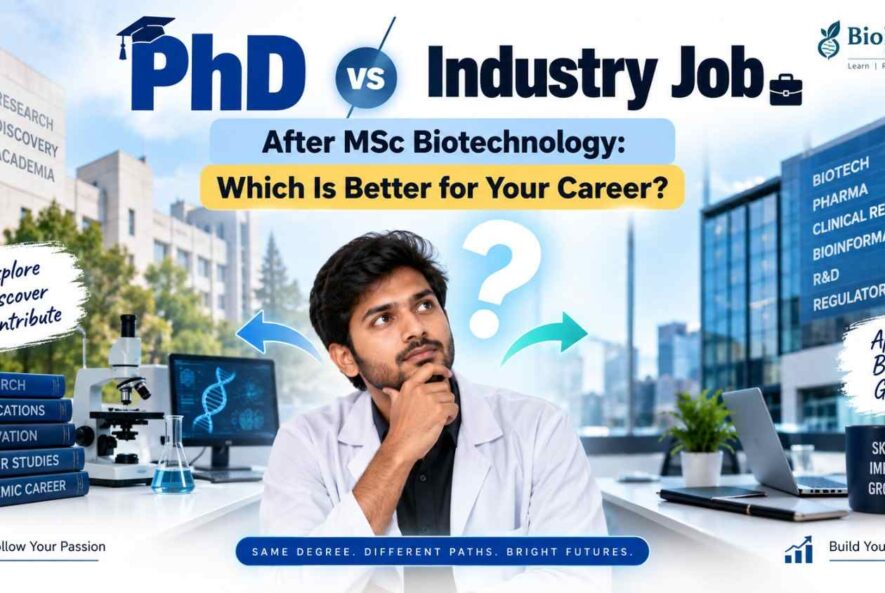
Should I pursue a PhD or join an industry job?
This decision can feel confusing because both paths offer valuable opportunities, different experiences, and unique career growth. Some students are passionate about research and scientific discovery, while others are interested in practical industry work, financial independence, and faster professional exposure.
Many students also feel pressure from family, peers, or society while making this decision. Some believe a PhD is the only path to success in biotechnology, while others think starting a job immediately is more practical.
The truth is that there is no single “correct” choice for everyone.
The best path depends on:
- Career goals
• Interests and strengths
• Financial priorities
• Preferred work environment
• Long-term vision
Another important thing students must understand is that careers today are becoming more flexible. Many professionals move between research and industry throughout their careers.
For example:
- Some students work in industry first and later pursue a PhD
• Some PhD scholars later move into biotechnology companies
• Some professionals combine research with industrial applications
This shows that career growth is not always linear.
The key is not choosing the “most popular” option. it is choosing the option that matches your interests, strengths, and long-term goals.
Why Students Feel Confused
Many MSc Biotechnology students struggle with this decision because:
- They are unsure about their interests
• They lack awareness about industry roles
• They fear making the wrong decision
• They compare themselves with others
• They are influenced by social pressure
As a result, students often feel stressed and uncertain about their future.
Understanding the Two Career Paths
After MSc Biotechnology, students generally choose between:
- Pursuing a PhD
• Joining the biotechnology or healthcare industry
Both paths have advantages, challenges, and long-term growth opportunities.
Option 1: Pursuing a PhD After MSc Biotechnology
A PhD focuses on advanced research, scientific analysis, innovation, and specialization.
Students spend several years:
- Conducting experiments
• Solving research problems
• Publishing scientific papers
• Developing deep subject expertise
Advantages of Pursuing a PhD
- Strong research specialization
• Opportunity to contribute to scientific discoveries
• Eligibility for academic and research scientist roles
• Development of advanced analytical skills
• Global research opportunities
Challenges of a PhD
- Long-term commitment
• Research pressure and uncertainty
• Requires patience and consistency
• Career growth may take longer initially
Who Is Best Suited for a PhD?
Students who:
- Enjoy research and scientific questioning
• Like deep analysis and experimentation
• Are curious and patient
• Want academic or advanced research careers
Average Stipend / Salary During PhD
- India: ₹31,000 – ₹45,000+ stipend depending on fellowship and institution
Career Opportunities After PhD
- Research Scientist
• Assistant Professor
• Senior Research Associate
• Industry Scientist
• Bioinformatics Researcher
Option 2: Industry Job After MSc Biotechnology
Industry roles focus more on practical applications, products, processes, and business-oriented biotechnology work.
Students can work in:
- Biotechnology companies
• Pharmaceutical industries
• Clinical research organizations
• Diagnostics companies
• Healthcare industries
Advantages of Joining Industry Early
- Financial independence
• Early practical exposure
• Faster professional experience
• Opportunity to understand real-world applications
• Industry networking and growth opportunities
Challenges of Industry Jobs
- Work pressure and deadlines
• Skill-based competition
• Need for continuous upskilling
Who Is Best Suited for Industry Roles?
Students who:
- Prefer practical and application-based work
• Want faster career exposure
• Enjoy teamwork and industrial environments
• Want financial independence earlier
Average Salary After MSc Biotechnology
- India: ₹3 – ₹8 LPA for freshers depending on role and skills
Popular Industry Roles
- QC Analyst
• Research Associate
• Clinical Research Coordinator
• Production Associate
• Scientific Writer
• Pharmacovigilance Associate
Can Students Work First and Pursue PhD Later?
Yes. Many students gain industry experience before pursuing a PhD.
This helps them:
- Understand practical applications
• Build financial stability
• Gain clarity about research interests
• Develop professional skills
There is no rule that students must choose one path permanently.
What Students Are Realizing Today
Students are gradually understanding that:
- Both paths have value
• Skills matter more than labels
• Career growth is flexible
• Clarity is more important than speed
• Industry and research are interconnected
This awareness is helping students make more balanced career decisions.
How BioResire Reflects This Career Decision Process
One important observation from student experiences is that many students do not lack talent—they lack clarity and structured guidance. Many MSc Biotechnology students are capable and hardworking, but they often feel confused because they are unsure which path matches their interests, strengths, and long-term goals.
Approaches like BioResire focus on helping students:
- Understand both career paths realistically
• Identify strengths and interests
• Explore industry and research opportunities
• Build analytical and practical skills
• Improve confidence in decision-making
Instead of pushing students toward one option, the focus is on helping them understand themselves and their goals.
Students are encouraged to ask:
- Do I enjoy research and scientific exploration?
• Do I prefer practical industry work?
• What type of environment suits me?
• What skills should I build for my preferred path?
This approach helps students make informed decisions instead of emotionally pressured decisions.
Another important aspect is helping students understand that there is no universally “better” option between PhD and industry. The better option is the one that aligns with the student’s interests, work style, and long-term career vision.
Helping Students Understand the Reality of Both Paths
Many students make decisions based on assumptions instead of realistic understanding.
Students are guided to understand:
- What daily research work actually involves
• What industry roles and responsibilities look like
• What challenges exist in both paths
• What growth opportunities each path offers
This realistic understanding helps reduce confusion and unrealistic expectations.
For example:
- A PhD involves long-term research, analysis, patience, and scientific problem-solving
• Industry roles involve practical applications, teamwork, deadlines, and business-oriented goals
Understanding these differences helps students choose more wisely.
Connecting Interests with Career Paths
Another major focus is helping students connect their personality and interests with suitable career directions.
For example:
- Students who enjoy scientific questioning and deep analysis may enjoy research careers
• Students who prefer practical applications and dynamic work environments may enjoy industry roles
• Students interested in communication and education may explore scientific writing or training-related careers
This helps students see that different strengths can lead to different successful career paths.
Reducing Pressure and Fear
Many students feel pressured because they think choosing one path means permanently closing all other options.
Structured guidance helps students understand that:
- Career paths are flexible
• Skills can transfer between research and industry
• Learning continues throughout careers
• Career growth happens gradually
This reduces fear and helps students think more calmly and clearly.
Encouraging Skill-Based Preparation
Students are also encouraged to focus on skill-building rather than only degrees or titles.
Important skills include:
- Communication skills
• Analytical thinking
• Problem-solving ability
• Practical understanding
• Adaptability and continuous learning
These skills are valuable in both academia and industry.
Helping Students Build Long-Term Vision
Another important aspect is helping students think beyond immediate decisions.
Instead of focusing only on:
- Salary
• Social pressure
• Comparisons with others
students are encouraged to think about:
- Long-term growth
• Work satisfaction
• Learning opportunities
• Career flexibility
• Personal interests and strengths
This helps students make more balanced decisions.
Building Confidence Through Clarity
When students understand their goals and options more clearly, their confidence improves naturally.
They become more comfortable:
- Discussing career plans
• Preparing for interviews or research opportunities
• Building relevant skills
• Exploring future possibilities
Confidence grows when confusion reduces.
The Role of Gradual Exploration
Career clarity does not happen instantly.
Students are encouraged to:
- Explore both industry and research environments
• Learn about different roles
• Develop skills step by step
• Reflect on their interests regularly
Even small efforts can create strong clarity over time.
Changing the Student Mindset
One of the biggest transformations happens in mindset.
Students move from:
- “I must choose quickly” → “I should choose wisely”
• “One wrong decision will ruin everything” → “Careers can evolve over time”
• “I am confused” → “I can build clarity gradually”
• “Others know better than me” → “I should understand myself first”
This mindset shift helps students feel more in control of their future.
Real-Life Perspective
Consider two students.
Student A chooses a PhD only because of external pressure, even though they are not interested in long-term research.
Student B explores both research and industry, understands personal strengths, and then chooses accordingly.
Student B usually feels more confident, motivated, and satisfied with the decision.
The difference is not intelligence—it is self-awareness and informed decision-making.
Important Skills Needed in Both Paths
Regardless of whether students choose a PhD or industry job, certain skills remain important:
- Communication skills
• Problem-solving ability
• Analytical thinking
• Adaptability
• Practical understanding
• Consistency and discipline
These skills improve long-term career growth in both academia and industry.
Common Mistakes Students Make
- Choosing based on pressure instead of interest
• Assuming one path is superior to the other
• Ignoring skill development
• Delaying career planning
• Comparing themselves excessively with others
Avoiding these mistakes helps students make better decisions..
The Bigger Transformation
When students approach career decisions with understanding, they move from:
Confusion → Clarity
Pressure → Confidence
Fear → Direction
Random decisions → Informed choices
They begin to take control of their future instead of feeling lost.
Conclusion
Both PhD and industry jobs offer valuable opportunities after MSc Biotechnology.
The best choice depends on:
- Your interests
• Your long-term goals
• Your preferred work style
• Your willingness for research or practical application
In simple terms, neither a PhD nor an industry job is automatically “better.” The best path is the one that matches your interests, strengths, and career vision.
Call to Action
Don’t wait for opportunities—start preparing today.
- Build your skills
- Gain real-world experience
- Stay consistent
Join BioResire and become job-ready for the biotechnology industry.
Email: info@bioresire.in
Phone / WhatsApp: 6301352398
BioResire Quote:
“The right career path is built through clarity, skills, and consistent growth.”