
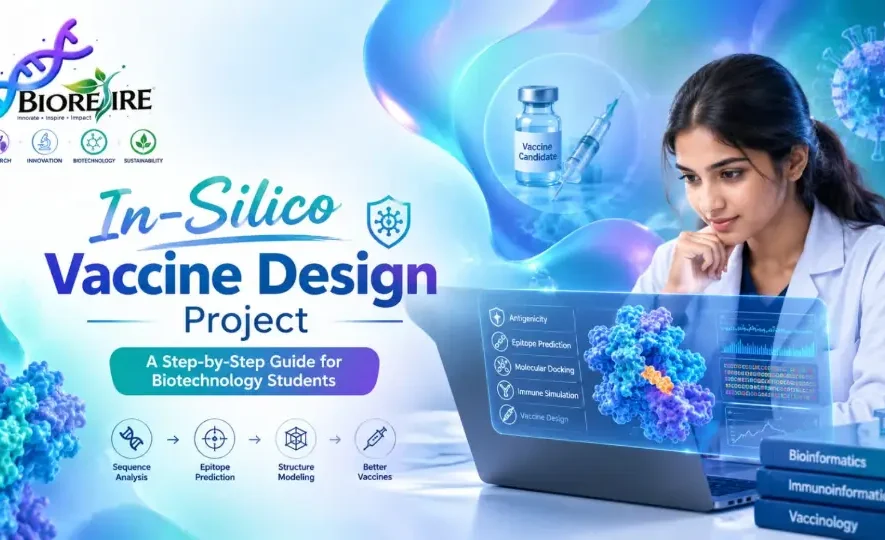
In Silico Vaccine Design: A Complete Guide to Methods, Tools, and Applications
Introduction to In Silico Vaccine Design
In silico vaccine design is a modern computational approach used to identify, analyze, and evaluate potential vaccine candidates with the help of bioinformatics, immunoinformatics, molecular modeling, and computational biology. Unlike conventional vaccine development, which often begins with laboratory-based experiments, in silico vaccine design uses genomic and protein sequence data to predict which components of a pathogen may trigger a protective immune response.
This approach has become an important part of modern vaccine research because it allows scientists to screen large numbers of potential antigens before selecting candidates for experimental testing. Computational methods can help researchers prioritize promising targets, investigate immune recognition, and compare different vaccine designs more efficiently
The growing availability of pathogen genome sequences, protein databases, artificial intelligence tools, and advanced computational algorithms has expanded the applications of in silico vaccine design. Researchers use these methods to investigate vaccine candidates against viruses, bacteria, parasites, and certain cancers.
However, computational predictions alone cannot establish that a vaccine is safe or effective in humans. Laboratory experiments, preclinical studies, and appropriately designed clinical trials remain essential for confirming the performance of a proposed vaccine candidate.
What Is In Silico Vaccine Design?
In silico vaccine design refers to the use of computer-based techniques to identify and evaluate potential vaccine components. The term in silico means that an analysis is performed using computational systems rather than exclusively through experiments in a laboratory.
This process commonly integrates three related fields:
- Bioinformatics: Analyzes biological sequences, genes, proteins, and genomic datasets.
- Immunoinformatics: Uses computational methods to study immune responses and predict potential B-cell and T-cell epitopes.
- Structural bioinformatics: Examines protein structures and molecular interactions to understand how vaccine candidates might behave in biological systems.
A major concept associated with this approach is reverse vaccinology. Instead of beginning with a cultured pathogen and experimentally testing its components one by one, reverse vaccinology starts with genomic information and uses computational analysis to identify proteins that may be suitable vaccine targets.
The selected targets can then be evaluated for antigenicity, conservation, accessibility to the immune system, and other relevant characteristics. This information helps researchers make more informed decisions about which candidates deserve further investigation.
Importance of In Silico Vaccine Design in Modern Research
Traditional vaccine development has contributed enormously to public health, but identifying suitable antigens can be difficult, particularly when pathogens exhibit considerable genetic diversity or complex interactions with the host immune system.
In silico vaccine design addresses some of these challenges by providing a systematic way to analyze biological information.
1. Faster identification of potential antigens
Computational tools can analyze extensive genomic and proteomic datasets to identify proteins that may stimulate immune recognition. This can reduce the number of candidates that need to be investigated experimentally.
2. Reduced early-stage research costs
Laboratory testing of every possible antigen can be expensive and time-consuming. Computational screening helps researchers prioritize promising candidates before committing resources to experimental studies.
3. Identification of conserved regions
Some pathogens evolve rapidly, leading to changes in their surface proteins. Sequence conservation analysis helps identify regions that remain relatively stable across different strains. Such regions may be useful when investigating vaccine candidates intended to provide broader protection.
4. Support for rational vaccine design
Researchers can combine information about antigenicity, epitope recognition, protein structure, and population diversity to compare alternative vaccine candidates systematically.
5. Potential applications in emerging diseases
When genomic information becomes available for a newly identified pathogen, computational analysis can help researchers begin evaluating potential vaccine targets without waiting for every candidate to be isolated and tested individually.
These advantages make in silico methods valuable for early-stage discovery, although their usefulness depends on data quality, algorithm performance, and experimental confirmation.
1. Reverse Vaccinology
Reverse vaccinology is a genome-based approach for identifying potential vaccine antigens. It begins with the genetic information of a pathogen rather than relying exclusively on the traditional process of isolating and testing individual proteins.
Researchers examine the pathogen’s genome and predicted proteome to identify proteins with characteristics that may make them suitable vaccine targets. Relevant characteristics can include cellular localization, conservation, biological function, and potential exposure to the host immune system.
The resulting candidates undergo additional computational assessment before experimental validation.
2. Immunoinformatics
Immunoinformatics applies computational methods to immunological questions. In vaccine research, it is particularly important for predicting how pathogen-derived peptides may interact with immune-system components.
It can support the identification of candidate epitopes, analysis of human leukocyte antigen (HLA) diversity, and comparison of predicted immune recognition across different populations.
3. Epitope-Based Vaccine Design
An epitope is a specific molecular region recognized by an antibody or an immune-cell receptor, directly or through antigen presentation.
Epitope-based vaccine research focuses on selected antigenic regions rather than necessarily using an entire pathogen protein or organism. Multiple candidate epitopes may be investigated together to explore whether they can support complementary immune responses.
Nevertheless, predicting an epitope does not automatically demonstrate that it will produce protective immunity. Its biological context and experimental performance must also be evaluated.
4. Structural Vaccinology
Structural vaccinology uses three-dimensional molecular information to investigate how antigens interact with antibodies, receptors, and other biological molecules.
Protein structure prediction, structural visualization, and molecular interaction analysis can help researchers examine whether a proposed antigen has a plausible molecular configuration for further development.
Structural predictions should be interpreted cautiously because a modeled structure may differ from the protein’s actual conformation in a biological environment.
Step-by-Step Workflow of In Silico Vaccine Design
A typical computational vaccine discovery workflow includes several interconnected stages. The exact order and methods vary depending on the pathogen, the intended vaccine platform, and the type of immune response being investigated.
Screen candidate proteins for conservation, localization, and potential immunological relevance.
Investigate candidate B-cell and T-cell epitopes using appropriate prediction methods.
Evaluate antigenicity, specificity, potential safety concerns, and population coverage.
Assess predicted protein structures and plausible molecular interactions where relevant.
Test promising candidates through appropriate laboratory, preclinical, and clinical studies.
Step 1: Collection of genomic and proteomic data
The first stage involves collecting reliable biological sequence data from established repositories. Researchers may obtain genome sequences, annotated genes, and protein sequences from resources such as NCBI GenBank, RefSeq, or UniProt.
The selected dataset should be relevant to the research objective and should account for sequence quality, available annotations, and genetic variation.
Accurate input data are important because incomplete sequences or incorrect annotations can influence every subsequent computational prediction.
Step 2: Identification of potential vaccine antigens
The next stage focuses on identifying proteins that may be suitable targets for immune recognition.
Researchers may consider:
- Protein conservation across relevant pathogen strains.
- Cellular localization and accessibility to the host immune system.
- Known or predicted biological functions.
- Evidence of antigenicity or immune recognition.
- Similarity to host proteins, where relevant to evaluating potential cross-reactivity.
Computational screening can narrow a large collection of proteins into a smaller set of candidates for further assessment. However, no single prediction score should be treated as definitive proof of vaccine potential.
Step 3: B-cell and T-cell epitope prediction
Epitope prediction is one of the most important parts of immunoinformatics-based vaccine research.
B-cell epitopes are regions recognized by antibodies or B-cell receptors. Some are continuous amino acid sequences, while others depend on amino acids brought together by the protein’s three-dimensional folding.
T-cell epitopes are generally peptides presented by major histocompatibility complex (MHC) molecules. In humans, these molecules are called human leukocyte antigens, or HLA.
MHC class I presentation is commonly associated with CD8+ cytotoxic T-cell responses, whereas MHC class II presentation is commonly associated with CD4+ helper T-cell responses.
Computational tools can estimate peptide–MHC binding and identify candidate regions for additional investigation. Yet, peptide binding is only one part of T-cell recognition and does not independently establish a protective immune response.
After candidate antigens or epitopes have been identified, researchers evaluate their predicted biological properties.
Antigenicity prediction estimates whether a sequence may have antigenic characteristics. Other computational assessments can examine possible allergenicity, toxicity, sequence similarity to host proteins, and relevant physicochemical properties.
These evaluations are useful for prioritizing candidates, but they have important limitations. For example, a computational prediction of low allergenic potential cannot prove that a vaccine will not cause an allergic reaction.
Likewise, predicted antigenicity does not guarantee that the immune response will be strong, durable, or protective.
Step 5: Structural modeling and molecular interaction analysis
When appropriate, selected vaccine candidates undergo structural analysis. Researchers may use predicted protein structures to investigate folding, accessibility of potential epitopes, and possible interactions with immune-related molecules.
Molecular docking can generate hypotheses about how two molecular structures might interact. Molecular dynamics simulations can then investigate aspects of their modeled behavior over time.
These methods can help compare candidate structures and identify questions for further testing. However, a favorable docking score or apparently stable simulation is not proof of biological binding, vaccine effectiveness, or clinical safety.
Step 6: Experimental validation
Computational research generates hypotheses and prioritizes candidates. Experimental studies determine whether those predictions hold up in biological systems.
Depending on the research question, validation may involve protein expression, biochemical characterization, immune-recognition assays, cellular studies, and appropriately designed preclinical research. Candidates that meet relevant requirements may subsequently be evaluated in clinical trials.
This transition from computational prediction to experimental verification is essential to responsible vaccine development.
Several databases and computational platforms support different stages of vaccine research. The most appropriate choice depends on the analysis being performed, the available input data, and the limitations of the selected method.
| Tool or database | Main application |
|---|---|
| NCBI | Access to genomic and protein sequence data |
| UniProt | Protein sequences, annotations, and functional information |
| IEDB | Immune epitope information and prediction resources |
| VaxiJen | Prediction of antigenic potential |
| BepiPred | Prediction of candidate B-cell epitopes |
| AlphaFold | Protein structure prediction |
| PyMOL | Visualization and inspection of molecular structures |
| C-ImmSim | In silico modeling of selected immune-response features |
These tools have different purposes and should not be treated as interchangeable. For example, sequence databases provide biological information, epitope tools estimate immune recognition, and structural visualization software helps examine molecular models.
In silico vaccine design has applications across several areas of biomedical research.
Viral vaccine research
Computational approaches can help identify conserved proteins and potential immune targets in viruses. They can also support comparative analysis of viral variants and investigation of how sequence changes might influence predicted immune recognition.
Bacterial vaccine development
Reverse vaccinology has been particularly important in research involving bacterial pathogens. Genome-wide screening can help identify potential surface-associated or otherwise immunologically relevant proteins for further evaluation.
Parasitic disease research
Parasites often have complex life cycles and interact with their hosts in different ways. Computational screening can help researchers investigate potential targets across different developmental stages.
Cancer vaccine research
In cancer immunology, computational approaches can support the identification of candidate tumor-associated antigens and tumor-specific neoantigens. Such analyses may contribute to research on personalized cancer vaccines and immunotherapies.
The suitability of a computational approach depends on the disease and the biological mechanism being targeted. Success in one research area cannot automatically be generalized to another.
Understanding both the benefits and limitations of computational vaccine research is essential for evaluating its scientific value.
| Advantages | Limitations |
|---|---|
| Speeds up early-stage candidate screening | Predictions can produce false positives and false negatives |
| Helps prioritize potential antigens | Depends on the quality of input data |
| Supports the analysis of multiple pathogen strains | May not fully capture pathogen evolution |
| Enables computational comparison of candidates | Predicted immune recognition may not translate into protection |
| Can reduce unnecessary early-stage experiments | Laboratory and clinical validation remain necessary |
One major challenge is the complexity of the human immune system. Immune responses vary between individuals because of genetic diversity, previous exposure to pathogens, age, health status, and other biological factors.
Another challenge is that computational models simplify biological processes. Even advanced artificial intelligence systems cannot perfectly represent every interaction occurring in living organisms.
Therefore, the most reliable approach combines computational screening with biological evidence, independent assessment, and experimental validation.
The future of in silico vaccine design is closely connected to advances in artificial intelligence, machine learning, structural biology, and multi-omics research.
AI-based methods may help researchers analyze complex datasets, identify patterns in antigenic variation, and improve predictions of protein structure and immune recognition. Integrating genomic, proteomic, transcriptomic, and immunological information could also provide a more comprehensive understanding of host–pathogen interactions.
Another promising direction is personalized vaccine research. By accounting for individual differences in tumor mutations or HLA profiles, computational methods may help identify candidate targets suited to specific research or therapeutic contexts.
However, improvements in computational performance do not eliminate the need for rigorous testing. Future progress will depend not only on more sophisticated algorithms but also on high-quality datasets, reproducible research, transparent reporting, and stronger agreement between computational predictions and experimental results.
1. What is in silico vaccine design?
In silico vaccine design is a computational approach that uses bioinformatics, immunoinformatics, and molecular modeling to identify and evaluate potential vaccine candidates before experimental testing.
2. What is the difference between reverse vaccinology and in silico vaccine design?
Reverse vaccinology specifically focuses on identifying potential vaccine antigens using genomic and proteomic information. In silico vaccine design is a broader term that can include reverse vaccinology, epitope prediction, structural modeling, immune simulation, and other computational approaches.
3. Which tools are commonly used for in silico vaccine design?
Commonly used resources include NCBI, UniProt, IEDB, VaxiJen, BepiPred, AlphaFold, PyMOL, and C-ImmSim. Each tool serves a different purpose, and researchers should select tools based on the specific research question.
4. What is the role of immunoinformatics in vaccine development?
Immunoinformatics helps researchers investigate immune recognition, predict B-cell and T-cell epitopes, evaluate peptide–MHC interactions, and assess other features relevant to potential vaccine candidates.
5. Can in silico vaccine design replace laboratory experiments?
No. Computational methods can reduce the number of candidates requiring early-stage experimental evaluation, but they cannot independently demonstrate vaccine safety, immunogenicity, or clinical efficacy.
6. What is a multi-epitope vaccine?
A multi-epitope vaccine is a vaccine concept that combines selected immune-recognized regions from one or more antigens. Computational methods can help researchers evaluate possible combinations, but the resulting candidate must undergo appropriate experimental testing.
7. Why is population coverage important in vaccine design?
Population coverage analysis estimates how broadly selected HLA-restricted T-cell epitopes may be represented across a population. It can help researchers investigate potential differences in immune recognition, but it does not directly measure real-world vaccine effectiveness.
Conclusion
In silico vaccine design is an important component of modern computational biology and vaccine research. By integrating bioinformatics, reverse vaccinology, immunoinformatics, epitope prediction, and structural analysis, researchers can systematically identify and prioritize potential vaccine candidates.
Its principal advantages include efficient candidate screening, the ability to analyze extensive biological datasets, and support for rational vaccine research. At the same time, computational predictions have limitations and should not be interpreted as proof of safety or protective immunity.
As artificial intelligence, structural biology, and immunological databases continue to improve, in silico approaches are likely to play an increasingly valuable role in vaccine discovery. The strongest research outcomes will come from combining computational predictions with reproducible experimental evidence and rigorous clinical evaluation.