Whole Genome Sequencing vs Whole Exome Sequencing: Differences, Applications, and Advantages
Introduction
Whole Genome Sequencing vs Whole Exome Sequencing is an important topic in modern biotechnology, genomics, and bioinformatics. DNA sequencing helps scientists understand genetic information, identify variations in DNA, and investigate the genetic causes of different diseases. With the development of Next-Generation Sequencing (NGS), researchers can analyze millions of DNA fragments simultaneously.
Whole Genome Sequencing (WGS) and Whole Exome Sequencing (WES) are two important DNA sequencing techniques. Both methods help researchers identify genetic variations, but they differ in the regions of DNA they analyze, the amount of data they generate, their costs, and their applications.
Understanding Whole Genome Sequencing vs Whole Exome Sequencing is useful for biotechnology students, bioinformatics learners, and researchers interested in genetics and precision medicine.
What Is Whole Genome Sequencing (WGS)?
Whole Genome Sequencing (WGS) is a technique used to determine the DNA sequence across nearly the entire genome of an organism. It examines both protein-coding and non-coding regions of DNA, depending on sequencing coverage and the technology used.
The human genome contains approximately 3.2 billion DNA base pairs in one haploid genome. DNA consists of four nitrogenous bases: adenine (A), thymine (T), guanine (G), and cytosine (C). The order of these bases carries genetic information that contributes to the development and functioning of an organism.
Unlike targeted sequencing methods, WGS provides a broad view of genetic information across the genome.
How Does Whole Genome Sequencing Work?
The process of Whole Genome Sequencing involves several steps. First, a biological sample, such as blood, saliva, or tissue, is collected according to the research requirements. DNA is then extracted from the sample and checked for quality and quantity.
Next, the DNA is prepared for sequencing through a process called library preparation. The prepared DNA is sequenced using an appropriate sequencing platform.
After sequencing, bioinformatics tools are used to process the reads and align them to a reference genome. Genetic variations are then identified through variant calling and evaluated according to the research objective.
Applications of Whole Genome Sequencing
1. Genetic Disease Research: WGS can help researchers investigate inherited disorders by identifying candidate variants in coding and non-coding regions.
2. Cancer Genomics: Researchers use WGS to investigate genetic changes in cancer cells and study variations that may contribute to cancer development.
3. Infectious Disease Research: WGS can be used to study bacterial and viral genomes, investigate transmission patterns, and monitor genetic changes in infectious organisms.
4. Evolutionary Biology: Scientists compare genomes to understand genetic diversity and evolutionary relationships among organisms.
5. Precision Medicine: Genomic information may help guide certain medical decisions when interpreted alongside clinical evidence.
What Is Whole Exome Sequencing (WES)?
Whole Exome Sequencing (WES) is a DNA sequencing technique that focuses mainly on the exons of genes. Exons are regions that remain in mature RNA after RNA splicing, and many contain the instructions used to produce proteins.
The complete set of exons in a genome is called the exome. Protein-coding regions represent approximately 1–2% of the human genome, but variations in these regions account for many known inherited genetic disorders.
Instead of analyzing nearly the entire genome, WES focuses on selected exonic regions. This makes it useful when researchers want to investigate genetic variations in protein-coding regions.
How Does Whole Exome Sequencing Work?
The process begins with sample collection and DNA extraction. The DNA is prepared for sequencing, and targeted enrichment methods are used to capture selected exonic regions.
These enriched DNA fragments are sequenced using an appropriate sequencing platform. Bioinformatics tools then align the reads to a reference genome and identify genetic variations.
Variant annotation provides information about affected genes and the possible consequences of each variation. Researchers interpret the results according to the disease or research question.
Applications of Whole Exome Sequencing
1. Inherited Genetic Disorders: WES can help identify variants associated with many inherited diseases.
2. Rare Disease Research: Researchers can use WES to investigate possible genetic causes when a condition remains unexplained.
3. Gene Discovery: Exome data can help identify candidate genes associated with particular traits or disorders.
4. Cancer Research: WES can identify coding variants in cancer-related genes and support studies of tumour genetics.
5. Genetic Variation Studies: Researchers use WES to investigate changes in protein-coding regions and their possible biological effects.
Whole Genome Sequencing vs Whole Exome Sequencing: Key Differences
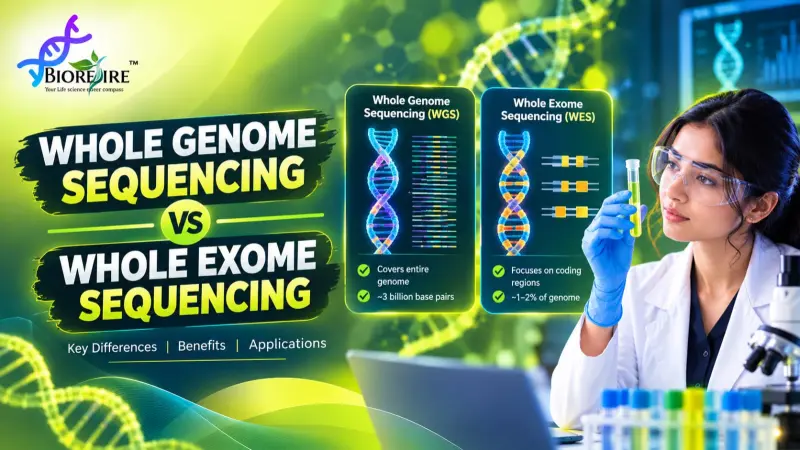
The main difference between Whole Genome Sequencing vs Whole Exome Sequencing is the amount of DNA analyzed. WGS examines nearly the entire genome, while WES focuses mainly on protein-coding exons.
WGS provides broader genomic coverage, including many non-coding regions. WES provides a focused approach that is often useful for studying coding variants associated with genetic disorders.
Important differences include:
1. Target Region: WGS analyzes nearly the entire genome, whereas WES mainly analyzes protein-coding exons.
2. DNA Coverage: WGS includes coding and non-coding regions. WES concentrates on selected exonic regions.
3. Data Generation: WGS generally generates more data than WES.
4. Cost: WGS is generally more expensive, while WES is often more affordable.
5. Data Analysis: WGS may require greater computational resources. WES provides a more focused analysis of coding regions.
6. Non-Coding Variants: WGS can detect many non-coding variants, depending on the method. WES does not comprehensively analyze these regions.
7. Applications: WGS is useful for broad genomic investigations, while WES is useful for focused studies of coding variants.
Advantages of Whole Genome Sequencing
Whole Genome Sequencing provides broad genomic coverage and helps researchers investigate coding and non-coding regions. It can support the detection of several types of genetic variations, including single-nucleotide variants, small insertions and deletions, and many structural variations.
WGS can be useful when the genetic cause of a condition is unknown. Its comprehensive dataset may also be reanalyzed when new genetic discoveries become available.
WGS is widely used in human genetics, cancer research, microbial genomics, evolutionary biology, and population genetics.
Limitations of Whole Genome Sequencing
WGS generally produces large amounts of data, requiring sufficient storage, computational resources, and specialized analysis skills.
Many genetic variations have uncertain biological significance, making interpretation challenging. Some repetitive regions and complex structural changes may also be difficult to analyze accurately.
Advantages of Whole Exome Sequencing
Whole Exome Sequencing focuses on protein-coding regions, where many known disease-associated variants occur. This makes WES useful for investigating suspected inherited genetic disorders.
WES is generally less expensive than WGS because it analyzes a smaller portion of the genome. It also typically generates less data and can reduce storage and computational requirements.
WES can help researchers identify candidate genes and investigate genetic variations associated with particular diseases.
Limitations of Whole Exome Sequencing
WES does not comprehensively analyze most non-coding regions. Variants in regulatory regions, repeat expansions, and certain structural changes may not be detected reliably.
Some exons may have insufficient sequencing coverage. A negative WES result does not rule out a genetic disorder, and additional testing may be necessary depending on the research or clinical situation.
Role of Bioinformatics in WGS and WES
Bioinformatics is essential for analyzing sequencing data generated by WGS and WES. Specialized tools help researchers process sequencing reads, identify genetic variations, and interpret their possible biological effects.
FastQC is used to assess sequencing-read quality. BWA can align sequencing reads to a reference genome. GATK supports genomic variant analysis, while Ensembl Variant Effect Predictor (VEP) helps annotate genetic variants.
These tools support different stages of genomic data analysis. The appropriate workflow depends on the sequencing platform, organism, study design, and research objective.
Learning bioinformatics tools can help biotechnology students develop skills in genomics research, NGS data analysis, and computational biology.
Which Is Better: WGS or WES?
Neither method is always better. The choice depends on the research question, budget, and type of genetic variation being investigated.
WGS may be preferred when broad genomic coverage is needed, including analysis of many non-coding regions and structural variations.
WES may be preferred when the main objective is to identify variants in protein-coding regions, especially when investigating suspected inherited genetic disorders.
In clinical settings, test selection should consider the individual’s symptoms, family history, previous test results, and advice from qualified genetics professionals.
Future Scope of Whole Genome Sequencing and Whole Exome Sequencing
Genomics continues to advance as sequencing technologies, computational methods, and genetic databases improve. WGS and WES are expected to remain important tools in biological research and genomic medicine.
Artificial intelligence and machine learning may help researchers prioritize genetic variants, identify patterns in genomic datasets, and improve data interpretation. However, computational predictions must be evaluated using reliable scientific evidence.
For students, learning genetics, NGS workflows, Python or R, and bioinformatics tools can provide a strong foundation for further studies and research opportunities.
Frequently Asked Questions (FAQs)
1. What is the main difference between WGS and WES?
WGS analyzes nearly the entire genome, including coding and non-coding regions. WES focuses mainly on protein-coding exons.
2. Which is cheaper, WGS or WES?
WES is generally less expensive because it targets a smaller portion of the genome. Actual costs depend on the laboratory and sequencing requirements.
3. Can WES detect all genetic diseases?
No. Some diseases involve non-coding variants, structural changes, repeat expansions, or other genetic changes that WES may not detect reliably.
4. Is WGS more accurate than WES?
Not in every situation. Accuracy depends on sequencing coverage, technology, variant type, and analysis methods.
5. What is the role of NGS in WGS and WES?
Next-Generation Sequencing enables many DNA fragments to be sequenced simultaneously and is commonly used for both approaches.
6. Which technique is useful for bioinformatics students?
Both are useful. WES offers a focused introduction to coding-variant analysis, while WGS provides experience with broader genomic datasets.
7. What percentage of the human genome is covered by WES?
WES targets the exome, which represents approximately 1–2% of the human genome. Actual coverage depends on the enrichment method and sequencing protocol.
Conclusion
Whole Genome Sequencing and Whole Exome Sequencing are important technologies in modern biotechnology, genomics, and bioinformatics. WGS provides a broad view of the genome, whereas WES focuses mainly on protein-coding regions.
Both methods have important applications in genetic disease research, cancer genomics, and biological investigations. Their advantages and limitations should be considered before choosing a sequencing approach.
For life science students, understanding Whole Genome Sequencing vs Whole Exome Sequencing is an important step toward learning genomics, NGS data analysis, and computational biology. These skills can support further education and research opportunities in modern life sciences.