Single-Cell RNA Sequencing: Workflow, Applications, and Career Opportunities
Introduction
Single-cell RNA sequencing (scRNA-seq) is an advanced biotechnology technique used to study gene expression at the individual-cell level. Unlike traditional bulk RNA sequencing, which measures gene expression across a population of cells, single-cell RNA sequencing helps researchers identify differences between individual cells. This technology is transforming cancer research, immunology, developmental biology, drug discovery, and precision medicine. For biotechnology students, bioinformatics learners, and aspiring researchers, understanding scRNA-seq provides valuable knowledge of modern genomics and computational biology.
What Is Single-Cell RNA Sequencing?
Single-cell RNA sequencing is a molecular biology technique that measures RNA transcripts in individual cells to understand their gene expression patterns. Genes contain information that helps cells perform specific functions, but not every gene is active in every cell. For example, neurons express genes associated with nerve signaling, while immune cells express genes involved in recognizing and fighting infections.
ScRNA-seq identifies these differences by analyzing RNA from individual cells rather than combining signals from thousands of cells. This allows researchers to investigate cellular diversity, discover rare cell populations, and understand how cells respond to diseases or treatments.
The technique is particularly useful when a tissue contains multiple cell types with different biological roles. By examining their gene expression profiles, scientists can better understand how these cells contribute to normal biological processes and disease development.
How Does Single-Cell RNA Sequencing Work?
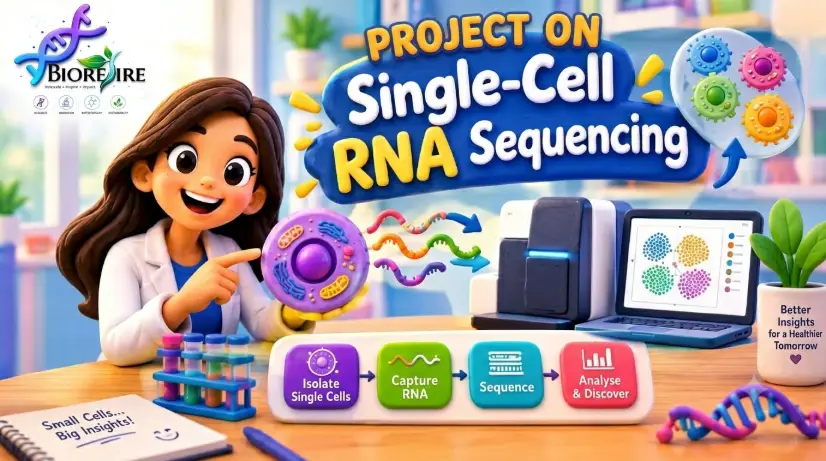
The single-cell RNA sequencing workflow involves laboratory experiments and computational analysis. Each stage contributes to generating reliable gene expression data.
1. Sample Preparation and Cell Isolation
The process begins with collecting biological samples such as blood, tumor tissue, cultured cells, or organ samples. Researchers prepare the samples carefully to preserve cell quality and RNA integrity.
Individual cells are then separated using methods such as droplet-based microfluidics, fluorescence-activated cell sorting, or microwell-based systems. Some experiments use isolated nuclei instead of intact cells, particularly when tissue preservation or sample preparation makes whole-cell analysis difficult.
2. RNA Capture and cDNA Synthesis
After cell isolation, RNA molecules are captured from individual cells. Messenger RNA is commonly analyzed because it provides information about gene activity.
The captured RNA is converted into complementary DNA (cDNA) using reverse transcriptase. Many widely used protocols attach cell-specific barcodes and unique molecular identifiers (UMIs). Cell barcodes identify the cell of origin, while UMIs help distinguish captured RNA molecules and improve transcript counting.
3. Library Preparation and Sequencing
The resulting cDNA is processed into a sequencing library by adding the molecular components required for sequencing. The library is then analyzed using a compatible next-generation sequencing platform.
Sequencing generates millions of reads that contain information about the RNA molecules captured from individual cells. The number and quality of reads influence how accurately researchers can detect gene expression, especially for low-abundance transcripts.
4. Bioinformatics Data Analysis
Bioinformatics converts raw sequencing data into meaningful biological information. Researchers process sequencing reads, quantify gene expression, filter low-quality cells, normalize data, and identify patterns among cells.
Dimensionality reduction and clustering help researchers group cells with similar expression profiles. Scientists then use marker genes and reference datasets to assign possible cell identities. Differential expression analysis can reveal genes associated with specific cell populations or experimental conditions.
Applications of Single-Cell RNA Sequencing
1. Cancer Research
Cancerous tissues contain different populations of tumor cells, immune cells, and supporting cells. Single-cell RNA sequencing helps researchers investigate these populations and understand how they interact.
For example, researchers can compare tumor samples before and after treatment to identify changes in gene expression and explore cellular states associated with treatment resistance. These findings may help generate hypotheses about new therapeutic targets.
2. Immunology and Infectious Diseases
The immune system contains many specialized cells, including T cells, B cells, macrophages, and dendritic cells. ScRNA-seq helps researchers study how these cells respond to infections, inflammation, and vaccination.
It can reveal changes in immune-cell populations and identify genes associated with activation, differentiation, and immune responses.
3. Developmental Biology
During development, cells gradually become specialized and perform different functions. Single-cell transcriptomics helps researchers study gene expression changes during this process.
Scientists can use these data to investigate cell differentiation, identify developmental cell populations, and explore potential relationships between cell states.
4. Drug Discovery and Precision Medicine
Pharmaceutical researchers can use scRNA-seq to examine how different cell populations respond to candidate drugs. It can help identify biological pathways affected by treatment and investigate differences in cellular responses.
In precision medicine research, single-cell analysis may help researchers understand disease variation between patients and identify potential biomarkers. However, findings require appropriate validation before being used to guide clinical decisions.
Bioinformatics Tools Used in scRNA-seq
Bioinformatics tools are essential for analyzing the large datasets generated by single-cell RNA sequencing.
- Seurat: An R-based toolkit used for quality control, clustering, visualization, and downstream single-cell analysis.
- Scanpy: A Python-based framework for analyzing and visualizing large single-cell datasets.
- Cell Ranger: Software for processing data from supported 10x Genomics single-cell assays.
- STARsolo: A tool for alignment and gene-expression quantification in supported single-cell workflows.
Students should also learn R or Python, basic statistics, Linux command-line operations, data visualization, and gene expression analysis.
For practical experience, beginners can explore publicly available single-cell datasets from resources such as the Gene Expression Omnibus (GEO) and Single Cell Expression Atlas. A beginner project could involve identifying immune-cell populations, visualizing marker-gene expression, and documenting the results using reproducible code.
Real-Life Example of Single-Cell RNA Sequencing
Example: Understanding Cancer Drug Resistance
Imagine a patient with lung cancer who initially responds well to treatment. After a few months, the cancer begins growing again. Researchers want to understand why some cancer cells survive the treatment while others are destroyed.
Single-cell RNA sequencing (scRNA-seq) helps researchers investigate this problem by analyzing gene expression in individual cells from tumor samples collected before and after treatment.
Using scRNA-seq, researchers can identify different cancer cell populations and examine which genes are active in treatment-resistant cells. Bioinformatics tools such as Seurat and Scanpy help analyze the data, identify cell clusters, and compare gene-expression patterns.
For example, researchers may discover a group of cancer cells with increased expression of genes associated with alternative growth pathways or drug resistance. They can investigate these pathways through further laboratory experiments to identify potential therapeutic targets.
Real-world importance: Single-cell RNA sequencing helps scientists understand tumor heterogeneity, investigate treatment resistance, and develop new research strategies for personalized cancer medicine. However, the findings require further validation before they can be used to guide patient treatment.
Another example: In infectious disease research, scRNA-seq can help scientists study immune cells from infected individuals, identify activated immune-cell populations, and understand how different cells respond to infection.
Key takeaway: Single-cell RNA sequencing connects biotechnology, molecular biology, and bioinformatics to solve real-world research problems and improve our understanding of human diseases.
Advantages and Limitations of Single-Cell RNA Sequencing
Advantages
Single-cell RNA sequencing provides detailed information about gene expression in individual cells. It helps researchers identify rare cell populations, investigate cellular heterogeneity, study disease mechanisms, and explore potential therapeutic targets.
It also supports the development of comprehensive cellular reference atlases that improve our understanding of tissues and biological systems.
Limitations
Despite its advantages, scRNA-seq has several limitations. Sample preparation can damage cells or introduce bias, and some RNA transcripts may remain undetected because of technical limitations.
The technique can also require expensive laboratory reagents, sequencing infrastructure, and computational resources. Batch effects between experiments may influence results, while clustering and cell-type annotation require careful interpretation.
Furthermore, RNA expression does not always directly reflect protein abundance or biological activity. Researchers may need additional experiments to validate important findings.
Career Opportunities in Single-Cell Bioinformatics
Single-cell RNA sequencing creates opportunities for students interested in biotechnology, genomics, computational biology, and biomedical research.
Relevant career paths include:
- Bioinformatics Analyst
- Computational Biologist
- Genomics Data Analyst
- Transcriptomics Research Assistant
- Single-Cell Data Scientist
- Biotechnology Research Associate
To prepare for these opportunities, students should build a strong foundation in molecular biology, genetics, and gene expression. Learning R or Python, statistics, sequencing data processing, and visualization can help them develop practical analytical skills.
Students can also strengthen their portfolios by analyzing public datasets and publishing reproducible projects on GitHub. For example, a project that identifies cell clusters, examines marker genes, and compares selected cell populations can demonstrate both technical skills and biological understanding.
Internships, research projects, workshops, and collaborative learning can further help students understand how single-cell technologies are applied in real research environments.
Frequently Asked Questions (FAQs)
1. What is single-cell RNA sequencing used for?
Single-cell RNA sequencing measures gene expression in individual cells. It is used in cancer research, immunology, developmental biology, drug discovery, and studies of cellular diversity.
2. What is the difference between bulk RNA-seq and scRNA-seq?
Bulk RNA-seq measures average gene expression across a population of cells, while scRNA-seq provides cell-level expression information that helps identify different cell populations.
3. Which programming language is best for scRNA-seq analysis?
Both R and Python are widely used. R supports tools such as Seurat, while Python supports Scanpy and several machine-learning frameworks.
4. Can biotechnology students learn single-cell RNA sequencing?
Yes. Biotechnology students can learn the technique by studying genomics, gene expression, basic statistics, and computational tools. Public datasets provide opportunities to practice without performing laboratory experiments.
5. What are the main limitations of scRNA-seq?
Major limitations include experimental cost, sample preparation bias, incomplete transcript detection, batch effects, and computational complexity.
6. Is single-cell RNA sequencing important for future biotechnology careers?
Yes. It is an important research technology in genomics and computational biology. Knowledge of scRNA-seq, programming, and data analysis can support applications for relevant research and bioinformatics positions.
Conclusion
Single-cell RNA sequencing is transforming modern biotechnology by enabling researchers to study gene expression at the individual-cell level. Its applications in cancer research, immunology, drug discovery, and precision medicine make it an important technology in contemporary life science research.
For biotechnology and bioinformatics students, learning single-cell RNA sequencing offers an opportunity to combine biological knowledge with programming, statistics, and computational analysis. Developing practical skills with tools such as Seurat and Scanpy, exploring public datasets, and building research projects can help students prepare for emerging opportunities in genomics.
Start building your bioinformatics skills with BioResire, explore practical research opportunities, and take the next step toward a career in biotechnology and computational biology.
Call to action :
Don’t wait for opportunities – start preparing today
- Build your skills
- Gain real – world experience
- Stay consistent
Join bioresire and become job – ready for the biotechnology industry
Email : info@bioresire.in
Phone /whatsapp : 6301352398
BioResire quote: “your carrer path becomes clear when your efforts become consistent .’’