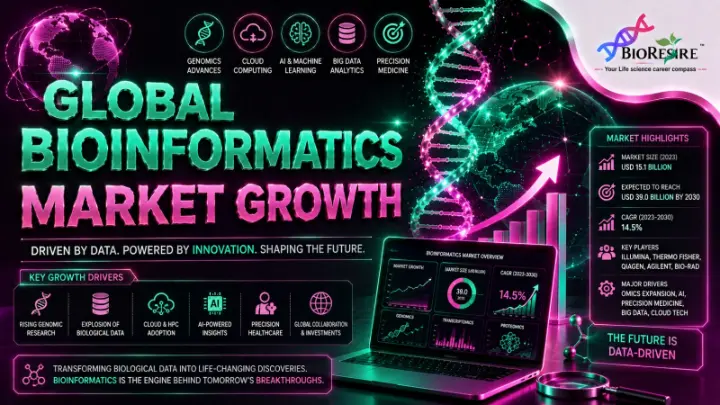
Global Bioinformatics Market Growth: Market Size, Emerging Trends, Career Opportunities and Future Scope
Introduction
The global biotechnology industry is undergoing a major transformation through advancements in genomics, artificial intelligence, next-generation sequencing (NGS), precision medicine and computational biology. As biological research generates increasingly large amounts of data, the demand for technologies that can store, process, analyse and interpret this information continues to increase.
This is where bioinformatics plays an important role.
Bioinformatics combines biology, computer science, mathematics and statistics to analyse biological information. It helps researchers understand DNA sequences, gene expression, protein structures, genetic variations and complex biological processes.
Today, bioinformatics is used in pharmaceutical research, healthcare, genetic testing, agricultural biotechnology, drug discovery and personalised medicine.
The growing importance of these applications is creating demand for bioinformatics software, databases, computational platforms and specialised data analysis services.
According to several market research reports, the global bioinformatics market is expected to experience significant growth over the coming years. This growth is attracting attention from biotechnology companies, pharmaceutical industries, research institutions, technology organisations and students interested in life science careers.
In this article, we explore the global bioinformatics market growth, market size, major growth drivers, emerging technologies, regional developments, industry applications and career opportunities.
1. What Is the Global Bioinformatics Market?
The global bioinformatics market refers to the worldwide commercial ecosystem of software, platforms, databases, computational tools and services used to manage and analyse biological data.
It includes technologies and services that help researchers convert complex biological information into meaningful scientific insights.
The market covers several important areas:
– Bioinformatics software and computational platforms.
– Biological databases and data management systems.
– Genomics and transcriptomics data analysis.
– Proteomics and metabolomics analysis.
– Next-generation sequencing data processing.
– Computational drug discovery.
– Molecular modelling and simulation.
– Cloud-based biological data analysis.
– Artificial intelligence and machine learning applications.
For example, when researchers perform whole-genome sequencing, they generate large datasets containing millions of DNA sequence reads. Bioinformatics tools help process these reads, identify genetic variations, compare sequences and interpret biological information.
As sequencing technologies become more widely used, the need for efficient computational analysis also increases.
2. Global Bioinformatics Market Size and Growth Forecast
The global bioinformatics market has attracted increasing investment because of the expanding use of computational methods in biotechnology, healthcare and pharmaceutical research.
Different market research organisations provide different estimates because their reports may include different products, services, applications and market segments.
Some published estimates provide the following outlook:
Market Research Organisation| 2026 Market Estimate| Forecast Market Size| Forecast Period| CAGR
Grand View Research| USD 23.5 billion| USD 63.7 billion| 2033| 15.3%
MarketsandMarkets| USD 18.63 billion| USD 34.41 billion| 2031| 13.1%
Mordor Intelligence| USD 19.80 billion| USD 35.04 billion| 2031| 12.1%
Note: These are separate market research estimates, not figures that should be combined. Their differences reflect variations in market definitions, coverage and forecasting methodologies.
The common finding across these reports is that the bioinformatics industry is expected to grow substantially.
A compound annual growth rate (CAGR) represents the average annual rate at which a market is projected to grow over a specified period, assuming compounding.
For example, a projected CAGR of 13% indicates an average annual growth rate of approximately 13% over the forecast period. It does not mean that the market will grow by exactly 13% every year.
The forecasts indicate increasing commercial demand for biological data analysis, computational research and specialised bioinformatics services.
3. Major Factors Driving Global Bioinformatics Market Growth
Several scientific, technological and commercial developments are contributing to the growth of the global bioinformatics market.
3.1 Growth of Genomics Research
Genomics is one of the most important application areas of bioinformatics.
Modern sequencing technologies allow researchers to study entire genomes, identify genetic variations and investigate the relationship between genes and biological characteristics.
Bioinformatics tools are required to analyse and interpret these large genomic datasets.
Important applications include:
– Whole-genome sequencing.
– Whole-exome sequencing.
– Genome assembly.
– Variant identification.
– Comparative genomics.
– Functional genomics.
– Genetic disease research.
The growing use of genomics in research and healthcare is increasing demand for specialised computational platforms and analytical services.
3.2 Increasing Adoption of Next-Generation Sequencing
Next-generation sequencing has transformed biological research by enabling high-throughput DNA and RNA sequencing.
Unlike traditional sequencing approaches, NGS can generate enormous amounts of sequence information in a relatively short period.
However, sequencing produces raw data that must be processed and interpreted using computational methods.
Bioinformatics is essential for:
– Quality control of sequencing data.
– Sequence alignment.
– Genome assembly.
– Variant calling.
– Gene expression analysis.
– Differential expression studies.
– Biological interpretation.
As NGS becomes increasingly important in research, diagnostics and drug development, the need for bioinformatics solutions is also expanding.
3.3 Increasing Demand for Precision Medicine
Precision medicine aims to use information about a person’s biological characteristics, including genetic and molecular information, to support more individualised healthcare decisions.
Bioinformatics helps researchers analyse genomic information and identify molecular patterns associated with diseases.
For example, in cancer research, genomic analysis can help identify specific mutations and molecular characteristics that may be relevant to treatment selection.
Applications include:
– Cancer genomics.
– Genetic disorder research.
– Biomarker identification.
– Pharmacogenomics.
– Molecular diagnostics.
– Personalised treatment research.
The increasing interest in precision medicine is creating opportunities for bioinformatics software developers, genomic data analysts and computational biologists.
3.4 Artificial Intelligence and Machine Learning
Artificial intelligence (AI) and machine learning are becoming increasingly important in bioinformatics.
These technologies can help identify patterns in complex biological datasets, make predictions and support research decisions.
Applications include:
– Protein structure prediction.
– Drug-target identification.
– Biomarker discovery.
– Gene expression analysis.
– Disease classification.
– Molecular interaction prediction.
– Biological image analysis.
Machine learning algorithms can analyse large datasets and identify patterns that may be difficult to detect through conventional analysis alone.
The integration of AI with biological research is encouraging the development of advanced computational platforms.
3.5 Growth of Pharmaceutical and Biotechnology Research
Pharmaceutical and biotechnology companies increasingly use computational approaches during research and development.
Drug discovery involves several stages, including target identification, compound screening, molecular analysis and preclinical evaluation.
Bioinformatics can support these activities by helping researchers:
– Identify potential drug targets.
– Analyse protein sequences.
– Study protein structures.
– Perform molecular docking.
– Investigate biological pathways.
– Identify potential biomarkers.
– Analyse genomic and transcriptomic datasets.
The growing importance of data-driven research in pharmaceutical development is contributing to demand for bioinformatics platforms and services.
3.6 Increasing Biological Data Generation
Modern biological technologies generate large amounts of information from DNA sequencing, RNA sequencing, proteomics, metabolomics and other experimental approaches.
Managing this information requires suitable data storage, computational infrastructure and analytical methods.
Bioinformatics helps organise biological datasets and convert them into scientifically useful information.
As research institutions and industries generate more complex biological data, the need for reliable data management and analysis solutions is expected to increase.
3.7 Expansion of Cloud-Based Bioinformatics
Cloud computing allows researchers to access computational resources, storage systems and software through internet-based platforms.
Bioinformatics workflows often require significant computing power, particularly when processing large sequencing datasets.
Cloud-based platforms can support:
– Large-scale genomic data storage.
– Collaborative research.
– Automated analysis pipelines.
– Remote computational access.
– Data sharing.
– Scalable processing resources.
This can reduce the need for individual research laboratories to maintain all computational infrastructure locally.
4. Major Segments of the Bioinformatics Market
The global bioinformatics market can be divided into different segments according to products, services and applications.
4.1 Bioinformatics Software
Bioinformatics software includes computational programmes and platforms used to analyse biological data.
Examples include:
– BLAST.
– Clustal Omega.
– MEGA.
– Galaxy.
– Geneious.
– CLC Genomics Workbench.
– PyMOL.
– AutoDock.
These tools support sequence comparison, genome analysis, protein visualisation, molecular modelling and other research activities.
4.2 Biological Databases
Biological databases store and organise scientific information related to genes, proteins, genomes and molecular structures.
Important databases include:
– NCBI.
– GenBank.
– Ensembl.
– UniProt.
– Protein Data Bank (PDB).
– Gene Expression Omnibus (GEO).
Researchers use these databases to retrieve biological information, compare sequences and study molecular functions.
4.3 Bioinformatics Services
Bioinformatics services provide specialised computational support to pharmaceutical companies, biotechnology organisations, research laboratories and healthcare institutions.
These services may include:
– NGS data analysis.
– Genome assembly.
– RNA-seq analysis.
– Variant interpretation.
– Protein structure analysis.
– Molecular docking.
– Biological data management.
– Custom computational pipeline development.
As research projects become more data-intensive, organisations may use specialised service providers instead of developing every computational capability internally.
4.4 Genomics and Transcriptomics
Genomics focuses on the study of complete genomes, while transcriptomics investigates RNA transcripts and gene expression.
Bioinformatics supports both fields through sequence processing, alignment, expression quantification and biological interpretation.
4.5 Proteomics and Metabolomics
Proteomics involves the large-scale study of proteins, while metabolomics focuses on small-molecule metabolites in biological systems.
Bioinformatics helps researchers analyse these datasets and investigate interactions between different biological systems.
The integration of genomics, transcriptomics, proteomics and metabolomics is known as multi-omics analysis.
5. Regional Growth of the Global Bioinformatics Market
Bioinformatics development is taking place across different regions, supported by research investments, healthcare technologies, pharmaceutical industries and biotechnology innovation.
5.1 North America
North America is an important region in the global bioinformatics market.
The United States has a strong ecosystem of biotechnology companies, pharmaceutical industries, research universities and healthcare technology organisations.
Important growth factors include:
– Advanced genomic research.
– Strong biotechnology investment.
– Pharmaceutical research and development.
– Precision medicine programmes.
– Advanced computational infrastructure.
– Development of AI-based healthcare technologies.
The region also has a strong presence of major biotechnology and life science technology companies.
5.2 Europe
Europe is another important region for bioinformatics research and commercial development.
Countries such as Germany, the United Kingdom, France and Switzerland have established biotechnology, pharmaceutical and academic research ecosystems.
Growth areas include:
– Genomic medicine.
– Pharmaceutical research.
– Computational biology.
– Biomedical data analysis.
– Proteomics.
– Molecular diagnostics.
Research collaboration between universities, hospitals and biotechnology organisations also supports the development of bioinformatics.
5.3 Asia-Pacific
Asia-Pacific is an important growth region for the bioinformatics industry.
Countries such as India, China, Japan, South Korea and Australia are investing in biotechnology, healthcare research and genomic technologies.
Important growth factors include:
– Expanding biotechnology industries.
– Increasing genomic research.
– Growing pharmaceutical manufacturing.
– Healthcare technology development.
– Government-supported research programmes.
– Increasing availability of skilled technical professionals.
The expanding biotechnology ecosystem in Asia-Pacific creates opportunities for bioinformatics research, services and technology development.
5.4 Other Emerging Markets
Latin America, the Middle East and Africa are also developing capabilities in biotechnology, genomic research and healthcare technology.
The growth of research infrastructure and digital healthcare initiatives may support the gradual expansion of bioinformatics applications in these regions.
6. Major Applications of Bioinformatics Across Industries
Bioinformatics is no longer limited to academic research. Its applications extend across several commercial and scientific sectors.
6.1 Pharmaceutical Industry
Bioinformatics supports drug discovery, target identification, molecular modelling and biological data analysis.
Researchers use computational tools to investigate disease-related genes, proteins and molecular interactions.
6.2 Healthcare and Medical Research
Bioinformatics supports the analysis of genetic information and molecular data associated with diseases.
It is used in research involving cancer, inherited disorders, infectious diseases and pharmacogenomics.
6.3 Agricultural Biotechnology
Bioinformatics plays an important role in crop genomics, plant breeding and agricultural research.
Applications include:
– Crop genome analysis.
– Identification of useful genes.
– Molecular marker development.
– Comparative plant genomics.
– Research on stress tolerance.
– Plant pathogen analysis.
These applications can support the development of improved crop varieties.
6.4 Drug Discovery and Development
Computational methods help researchers study biological targets and potential drug molecules.
Molecular docking, protein structure analysis and virtual screening are examples of bioinformatics-related approaches used in drug discovery research.
6.5 Infectious Disease Research
Bioinformatics helps researchers study pathogen genomes, genetic variations and evolutionary relationships.
It can support pathogen identification, genomic surveillance and research into infectious disease mechanisms.
6.6 Environmental Biotechnology
Environmental researchers use bioinformatics to study microbial communities and their functions.
Metagenomics can help investigate microorganisms present in soil, water and other environmental samples.
Applications include microbial diversity studies, environmental monitoring and research into biological waste treatment.
7. Leading Companies in the Global Bioinformatics Industry
Several biotechnology and life science technology companies contribute to the development of bioinformatics software, sequencing technologies, databases and computational services.
Examples include:
– Illumina.
– Thermo Fisher Scientific.
– QIAGEN.
– Agilent Technologies.
– Roche.
– BGI.
– DNAnexus.
– Seven Bridges Genomics.
– Revvity.
– Partek.
These companies operate in different areas of the biotechnology ecosystem, including sequencing platforms, laboratory technologies, genomic data analysis and computational solutions.
Their products and services support research institutions, pharmaceutical companies, diagnostic laboratories and biotechnology organisations.
8. Career Opportunities in the Growing Bioinformatics Market
The expansion of bioinformatics applications is creating different career pathways for candidates with relevant biological and computational knowledge.
However, market growth should not be confused with guaranteed employment. Job availability depends on employer requirements, technical skills, qualifications, practical experience and location.
Some common job roles include:
8.1 Bioinformatics Analyst
Bioinformatics Analysts process and interpret biological datasets using computational tools and databases.
Their responsibilities may include sequence alignment, gene identification, data processing and biological interpretation.
8.2 NGS Data Analyst
NGS Data Analysts work with DNA and RNA sequencing datasets.
They may perform quality control, sequence alignment, variant analysis and gene expression studies.
8.3 Computational Biologist
Computational Biologists use mathematical and computational methods to investigate biological systems.
They may work in genomics, systems biology, protein analysis and computational modelling.
8.4 Genomics Data Analyst
Genomics Data Analysts examine genomic datasets to identify genetic variations and investigate their biological significance.
8.5 Research Associate
Research Associates support bioinformatics and computational biology projects in research institutions, universities and biotechnology companies.
8.6 Bioinformatics Software Developer
These professionals develop software tools, databases and computational pipelines for biological research.
8.7 AI and Computational Biology Specialist
Professionals in this area apply machine learning and computational techniques to biological datasets, protein analysis, drug discovery and biomarker research.
9. Skills Required to Enter the Bioinformatics Industry
Students interested in entering the global bioinformatics market should develop a combination of biological knowledge and computational skills.
Biological Knowledge
Understand the fundamentals of:
– Molecular Biology.
– Genetics.
– Genomics.
– Transcriptomics.
– Proteomics.
– Biochemistry.
– Cell Biology.
Programming Skills
Python: Useful for biological data processing, automation and computational analysis.
R: Important for statistical analysis, gene expression studies and data visualisation.
Linux: Useful for managing files, executing commands and running bioinformatics pipelines.
Bioinformatics Tools
Students should become familiar with tools such as:
– BLAST for sequence similarity searching.
– Clustal Omega for multiple sequence alignment.
– FASTQC for sequencing quality assessment.
– BWA for sequence alignment.
– HISAT2 and STAR for RNA-seq alignment.
– DESeq2 for differential gene expression analysis.
GATK for genomic variant analysis.
AutoDock for molecular docking.
Additional Skills
Statistics and probability.
Data visualisation.
Biological database searching.
Research methodology.
Scientific writing.
Problem-solving.
Data interpretation.
Students do not need to master every tool immediately. They should begin with the fundamentals and develop specialised skills according to their preferred career area.
10. Opportunities for Biotechnology and Life Sciences Students
Students from Biotechnology, Microbiology, Biochemistry, Genetics and other Life Sciences backgrounds can explore bioinformatics as a career option.
An MSc Biotechnology graduate, for example, may have a foundation in molecular biology, genetics and biochemistry.
By developing additional computational knowledge, the student can explore areas such as:
Genomics data analysis.
RNA-seq analysis.
Molecular docking.
Protein structure analysis.
Computational biology.
Biological database management.
NGS data processing.
A practical project or dissertation involving real biological datasets can help students demonstrate their knowledge.
For example, an MSc student can work on a project involving comparative sequence analysis, gene expression data interpretation or molecular docking under appropriate academic supervision.
The combination of life science knowledge and computational skills can help students prepare for specialised opportunities.
11. Future Trends Shaping the Bioinformatics Market
The future of bioinformatics will be influenced by several emerging scientific and technological developments.
1. Multi-Omics Integration
Combining genomics, transcriptomics, proteomics and metabolomics can help researchers understand biological systems more comprehensively.
2. AI-Driven Biological Research
AI-based approaches are increasingly being explored for protein analysis, drug discovery, disease prediction and biological data interpretation.
3. Cloud-Based Bioinformatics
Cloud platforms can support large-scale data processing, storage and collaboration between research organisations.
4. Single-Cell Analysis
Single-cell sequencing allows researchers to investigate biological differences between individual cells.
Bioinformatics is essential for processing and interpreting the resulting datasets.
5. Spatial Biology
Spatial transcriptomics and related technologies help researchers study molecular information while retaining information about its location within tissues.
6. Precision Medicine
The growing use of genomic and molecular information in healthcare research is creating demand for advanced data interpretation technologies.
7. Metagenomics
Metagenomics allows researchers to study genetic material from microbial communities without requiring individual organisms to be cultured.
It has applications in environmental research, agriculture, healthcare and microbiome studies.
8. Automated Data Analysis
Automated pipelines can reduce repetitive manual work, improve reproducibility and support large-scale biological research.
These developments are expected to influence the types of software, services and technical expertise required in the bioinformatics industry.
12. How Students Can Prepare for the Growing Bioinformatics Market
Students should prepare systematically instead of depending only on the expectation that market growth will create employment opportunities.
A practical learning roadmap includes:
Step 1: Understand Molecular Biology and Genetics
Build a strong foundation in DNA, RNA, proteins, gene expression and genetic variation.
Step 2: Learn Python or R
Start with basic programming concepts and gradually practise biological data analysis
Step 3: Explore Biological Databases
Learn how to retrieve information from NCBI, Ensembl, UniProt and PDB.
Step 4: Practise Bioinformatics Tools
Begin with BLAST, sequence alignment and protein structure visualisation.
Step 5: Learn Linux
Develop basic command-line knowledge and practise handling biological datasets.
Step 6: Complete a Practical Project
Choose a project involving sequence analysis, genomics, transcriptomics or molecular docking.
Step 7: Build a Portfolio
Document your projects, methods, results and code using an organised portfolio or GitHub repository.
Step 8: Gain Internship Experience
Explore research internships, dissertation opportunities and bioinformatics training programmes that provide genuine practical exposure.
Step 9: Prepare for Relevant Job Roles
Study job descriptions and identify the technical skills required by biotechnology companies and research organisations.
Conclusion
The global bioinformatics market is expanding as biotechnology, genomics, pharmaceutical research, healthcare and artificial intelligence increasingly depend on biological data analysis.
The growth of next-generation sequencing, precision medicine, cloud computing, multi-omics research and AI-based technologies is creating demand for advanced bioinformatics platforms and specialised services.
North America currently represents an important market, while Asia-Pacific is emerging as a significant growth region for biotechnology and computational research.
For Biotechnology and Life Sciences students, this expansion creates opportunities to explore careers in genomics, NGS analysis, computational biology, drug discovery, transcriptomics and biological data science.
However, market growth alone does not guarantee employment. Students need to combine biological knowledge with programming, statistics, bioinformatics tools and practical research experience.
The future of bioinformatics will depend on the ability to integrate biological understanding with computational innovation. Students who prepare with relevant technical skills and hands-on experience can position themselves to participate in this developing industry.
Frequently Asked Questions (FAQs)
1. What is the global bioinformatics market?
The global bioinformatics market includes software, databases, computational platforms and services used to store, process, analyse and interpret biological data.
2. Is the global bioinformatics market growing?
Yes. Multiple market research organisations project substantial growth, supported by genomics research, NGS adoption, precision medicine, pharmaceutical research and AI-based biological analysis.
3. What is driving bioinformatics market growth?
Major growth drivers include increasing biological data generation, genomics, next-generation sequencing, drug discovery, cloud computing, artificial intelligence and precision medicine.
4. Which region is leading the global bioinformatics market?
North America is identified as the largest regional market in several industry reports. Asia-Pacific is also projected to experience strong growth.
5. What is the role of AI in bioinformatics?
AI and machine learning help analyse biological datasets, identify patterns, predict protein structures, support drug discovery and investigate disease-related information.
6. Which industries use bioinformatics?
Bioinformatics is used in biotechnology, pharmaceuticals, healthcare, agriculture, genomics, diagnostics, environmental research and drug discovery.
7. What are the major career opportunities in bioinformatics?
Common roles include Bioinformatics Analyst, NGS Data Analyst, Computational Biologist, Genomics Data Analyst, Research Associate and Bioinformatics Software Developer.
8. Can MSc Biotechnology students enter bioinformatics?
Yes. MSc Biotechnology graduates can explore relevant roles by developing programming, statistics, biological database and bioinformatics analysis skills, subject to employer eligibility requirements.
9. Which programming languages are important for bioinformatics?
Python and R are widely used for biological data analysis. Linux and shell scripting are also valuable for computational workflows.
10. What is the future scope of bioinformatics?
Future opportunities are associated with multi-omics, AI-driven research, precision medicine, single-cell analysis, genomics, computational drug discovery and cloud-based biological data analysis.