
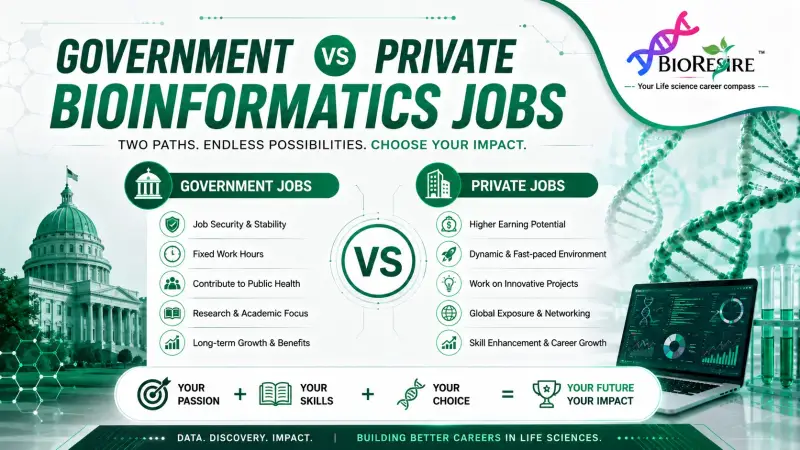
Government vs Private Bioinformatics Jobs in India: Career Opportunities, Salary, Eligibility, Skills and Future Scope
Introduction
Bioinformatics is one of the fastest-developing interdisciplinary fields, combining biology, computer science, mathematics, statistics and data analysis. With the increasing use of DNA sequencing, genomics, proteomics, drug discovery and artificial intelligence, bioinformatics professionals are becoming important in research institutions, pharmaceutical companies, biotechnology industries and healthcare organisations.
In India, students with backgrounds in Biotechnology, Microbiology, Biochemistry, Genetics, Bioinformatics and Computer Science can explore different career opportunities in this field.
However, one common question among students is whether to choose a government bioinformatics job or a private-sector bioinformatics job.
Both sectors offer opportunities, but they differ in recruitment procedures, job responsibilities, work environments, salary structures, career growth and employment stability.
Government organisations generally focus on scientific research, public health, academic projects and national research programmes. Private companies often focus on commercial research, genomic services, pharmaceutical development, healthcare technology and data-driven solutions.
Understanding these differences can help students choose a career path that matches their qualifications, technical skills and long-term goals.
1. What Is a Bioinformatics Job?
A bioinformatics job involves using computational tools, biological databases, programming languages and statistical methods to analyse biological information.
Bioinformatics professionals work with large datasets generated through modern biological techniques, particularly next-generation sequencing (NGS), whole-genome sequencing, RNA sequencing and proteomics.
Their responsibilities may include:
– Analysing DNA and RNA sequencing data.
– Identifying genes, mutations and genetic variations.
– Studying gene expression patterns.
– Performing protein sequence and structure analysis.
– Developing computational pipelines.
– Using biological databases and software tools.
– Supporting drug discovery and disease research.
– Applying machine learning and artificial intelligence to biological datasets.
Bioinformatics is useful in several areas, including cancer research, genetic disorders, infectious diseases, personalised medicine, agriculture, pharmaceutical research and biotechnology.
2. Government Bioinformatics Jobs in India
Government bioinformatics jobs are available through research institutes, universities, national laboratories, medical research organisations and government-funded scientific projects.
These organisations conduct research in genomics, molecular biology, computational biology, healthcare, agriculture and other life-science areas.
Some government research organisations and institutions where bioinformatics-related opportunities may arise include:
– Council of Scientific and Industrial Research (CSIR).
– Department of Biotechnology (DBT).
– Indian Council of Medical Research (ICMR).
– Biotechnology Research and Innovation Council (BRIC) institutes.
– Indian Council of Agricultural Research (ICAR).
– Central universities and government research universities.
– National research laboratories and bioinformatics centres.
The availability of positions depends on institutional requirements, research funding and recruitment notifications.
Common Government Bioinformatics Job Roles
1. Project Associate
Project Associates support research projects funded by government departments or scientific organisations.
Responsibilities include analysing biological datasets, collecting research information, using bioinformatics tools and assisting scientists with project activities.
This role can be suitable for postgraduate students and fresh graduates who meet the specific eligibility criteria.
2. Project Scientist
Project Scientists work on specialised scientific projects involving computational biology, genomics, molecular biology and data analysis.
Their responsibilities may include designing computational approaches, analysing sequencing data, developing research methods and preparing scientific reports.
These positions may require a postgraduate degree, relevant experience or a PhD, depending on the recruitment notification.
3. Research Assistant
Research Assistants support scientists and research teams in laboratory-based and computational research.
Their work may involve biological data management, literature review, sequence analysis, documentation and assistance with ongoing research activities.
4. Junior Research Fellow (JRF)
JRF positions are generally associated with research projects and fellowship programmes.
Candidates may work on topics such as genomics, transcriptomics, molecular modelling, computational biology and disease-related research.
Eligibility may depend on the project requirements and qualifying examinations such as CSIR-UGC NET, DBT-BET or other accepted qualifications.
5. Bioinformatics Scientist
Bioinformatics Scientists perform advanced computational analysis and contribute to scientific research.
They may work with NGS datasets, gene expression analysis, protein modelling, biological databases and computational tools.
Many positions require advanced qualifications, specialised technical knowledge and research experience.
Where to Find Government Bioinformatics Jobs
Students should regularly check official recruitment pages rather than depending only on third-party job websites.
Important sources include:
– CSIR official website and individual CSIR laboratory recruitment pages.
– ICMR employment opportunities.
– DBT and BRIC institute websites.
– ICAR recruitment notifications.
– Government university recruitment portals.
– Research project advertisements published by individual institutes.
For example, ICMR has published recruitment advertisements for positions such as Project Scientist and Scientist roles involving Bioinformatics. Government research institutes also advertise project-based computational biology and bioinformatics positions.
Advantages of Government Bioinformatics Jobs
1. Research-oriented environment
Government research institutions provide opportunities to participate in scientific studies, publish research findings and work with experienced researchers.
2. Exposure to advanced research
Depending on the institute and project, professionals may gain experience in genomics, NGS, molecular modelling, computational biology and disease research.
3. Institutional learning opportunities
Employees may get opportunities to attend scientific workshops, conferences, training programmes and research discussions.
4. Opportunities for higher studies
Research experience can support future applications for PhD programmes, fellowships and specialised scientific positions.
5. Potential employment stability
Regular government positions may offer greater employment stability and structured service benefits compared with many short-term private or project-based roles.
However, it is important to distinguish permanent government appointments from temporary research-project positions. A government-funded project job does not automatically provide permanent employment.
Challenges of Government Bioinformatics Jobs
– Recruitment notifications may be released irregularly.
– Selection procedures can be competitive.
– Some positions require NET qualifications, PhD degrees or relevant experience.
– Project-based jobs may have fixed employment periods.
– Opportunities may be limited to specific research locations.
– Permanent scientific positions may require several years of academic and research preparation.
Therefore, students should carefully check the essential qualifications, desirable skills, age limits and job duration mentioned in every notification.
3. Private Bioinformatics Jobs in India
Private-sector bioinformatics jobs are available in biotechnology companies, pharmaceutical industries, genomic laboratories, healthcare technology organisations, contract research organisations (CROs) and bioinformatics service companies.
Private organisations use bioinformatics to support commercial research, drug development, genetic testing, clinical research, diagnostics and biotechnology product development.
India has growing biotechnology and pharmaceutical ecosystems, particularly in cities such as Bengaluru, Hyderabad, Pune, Chennai and other major research and technology centres.
Common Private Bioinformatics Job Roles
1. Bioinformatics Analyst
Bioinformatics Analysts process and interpret biological datasets using computational tools and programming languages.
Their work may include sequence alignment, gene identification, variant analysis and biological data interpretation.
2. NGS Data Analyst
NGS Data Analysts work with sequencing data generated through modern sequencing platforms.
Their responsibilities may include quality control, read alignment, variant calling, differential gene expression and interpretation of sequencing results.
3. Computational Biologist
Computational Biologists develop and apply computational methods to understand biological systems.
They may work on genomics, transcriptomics, systems biology, protein interactions and disease-related datasets.
4. Genomics Data Analyst
Genomics Data Analysts study genome-related information to identify genetic variations, mutations and disease-associated patterns.
They may support diagnostic laboratories, genomic research companies and personalised medicine programmes.
5. Drug Discovery Bioinformatics Associate
These professionals support drug discovery using computational approaches.
Their responsibilities may include molecular docking, protein structure analysis, target identification, virtual screening and molecular modelling.
6. Scientific Data Analyst
Scientific Data Analysts work with biological and healthcare datasets using programming, statistics and data visualisation techniques.
They help research and development teams interpret complex data and prepare useful reports.
7. Bioinformatics Software Developer
Bioinformatics Software Developers create computational tools, databases and automated pipelines for biological data analysis.
This role generally requires programming knowledge, software development skills and an understanding of biological applications.
Types of Private Companies Hiring Bioinformatics Professionals
Private-sector opportunities can be found in different categories:
– Pharmaceutical and biotechnology companies.
– Genomics and sequencing companies.
– Molecular diagnostics laboratories.
– Drug discovery and research organisations.
– Healthcare analytics companies.
– Contract research organisations.
– Bioinformatics software companies.
– Artificial intelligence and biotechnology startups.
Examples of companies and organisations to explore include Biocon, Syngene, Eurofins, MedGenome, Strand Life Sciences, Genotypic Technology and other life-science research and technology organisations.
Job availability and eligibility vary between employers. Students should check individual company career pages for current openings.
Advantages of Private Bioinformatics Jobs
1. Wider range of job roles
Private companies offer opportunities in NGS analysis, genomics, drug discovery, healthcare analytics, software development and computational biology.
2. Industry exposure
Professionals can understand how bioinformatics is applied in commercial research, pharmaceutical development, diagnostics and healthcare services.
3. Opportunities to develop technical skills
Employees may work with real-world datasets, computational pipelines, databases, cloud platforms and specialised software.
4. Faster role-based career movement
In some organisations, professionals can move into advanced technical or team-lead positions by developing relevant skills and demonstrating strong performance.
5. Opportunities across industries
Bioinformatics skills can be useful in biotechnology, pharmaceuticals, healthcare technology, genomics and scientific software development.
6. Exposure to international projects
Some private companies work with international clients, research institutions and pharmaceutical organisations, offering exposure to global research and industry practices.
Challenges of Private Bioinformatics Jobs
– Work pressure may vary depending on project deadlines.
– Some entry-level roles involve repetitive data processing.
– Salary and benefits differ significantly between companies.
– Continuous technical learning is necessary.
– Certain specialised positions require prior industry experience.
– Startups and project-based organisations may have less predictable employment stability.
Students should evaluate the company, job description, learning opportunities and employment conditions before accepting an offer.
4. Government vs Private Bioinformatics Jobs: Key Differences
Understanding the differences between government and private-sector employment can help students make informed career decisions.
Comparison| Government Sector| Private Sector
Main focus| Research and public-sector scientific programmes| Industry research, products and services
Recruitment| Official notifications and selection procedures| Company applications and interviews
Job availability| Depends on vacancies and project funding| Depends on company requirements
Employment type| Permanent, contractual or project-based| Permanent, contractual or project-based
Work environment| Research institutes and universities| Companies, laboratories and technology teams
Career growth| Often follows institutional rules and qualifications| Depends on performance, skills and company structure
Research exposure| Strong in research-focused institutes| Depends on company and department
Technical exposure| Depends on research facilities and projects| Depends on tools, projects and technology
Job stability| Higher in regular permanent posts| Varies by employer and employment contract
Higher studies| Research experience may support academic progression| Industry experience may support specialised or advanced roles
Neither sector is automatically better. The right choice depends on the candidate’s interests, qualifications, financial requirements and long-term career plans.
5. Government vs Private Bioinformatics Salary in India
Salary is an important factor when choosing between government and private bioinformatics careers.
However, there is no single fixed salary for all bioinformatics professionals. Compensation depends on educational qualifications, technical skills, experience, job responsibilities, institution, company and employment type.
Government Sector Salary
Government bioinformatics salaries depend on the position and recruitment category.
For example:
– Project Assistant and entry-level project positions follow the remuneration mentioned in the advertisement.
– Project Associate positions follow the applicable fellowship or project remuneration rules.
– Project Scientist positions may offer higher consolidated remuneration depending on qualifications and funding.
– Permanent scientific positions follow the applicable institutional or government pay structure.
Candidates should check whether the advertised amount includes HRA, other allowances or consolidated project remuneration.
Private Sector Salary
Private-sector salaries depend on the organisation, location, technical requirements and experience level.
Freshers may begin in junior analyst, research associate, data processing or bioinformatics support roles.
Professionals with experience in NGS pipelines, Python, R, Linux, cloud computing, machine learning and computational biology may qualify for more specialised roles.
Advanced positions such as Senior Bioinformatics Analyst, Computational Biologist, Bioinformatics Scientist and Bioinformatics Team Lead generally require deeper technical knowledge and relevant experience.
Important: Students should not choose a career based only on online salary estimates. Always compare the actual job description, offered compensation, work responsibilities and learning opportunities.
6. Eligibility for Government and Private Bioinformatics Jobs
Educational eligibility varies according to the job role.
Commonly accepted qualifications may include:
– BSc Biotechnology.
– BSc Microbiology.
– BSc Biochemistry.
– MSc Biotechnology.
– MSc Bioinformatics.
– MSc Computational Biology.
– MSc Genetics.
– MSc Life Sciences.
– MCA or relevant Computer Science qualifications for computational positions.
Can MSc Biotechnology Students Apply?
Yes. MSc Biotechnology graduates can apply for several bioinformatics-related positions when the recruitment notification accepts Biotechnology or a related Life Sciences qualification.
However, having an MSc Biotechnology degree alone may not be sufficient for every technical position.
Students should develop additional computational skills, including:
– Basic programming.
– Biological sequence analysis.
– NGS data analysis.
– Biological database searching.
– Statistical analysis.
– Linux command-line operations.
– Research data interpretation.
Some advanced positions may require an MSc in Bioinformatics, a PhD, relevant work experience or specialised computational training.
Always read the essential qualification section of the recruitment advertisement before applying.
7. Essential Skills Required for Bioinformatics Jobs
Whether students choose government or private employment, technical knowledge is essential.
1. Programming Languages
Python: Used for biological data processing, automation, sequence analysis and computational workflows.
R: Used for statistical analysis, gene expression studies, data visualisation and transcriptomics.
Perl: May be useful for certain legacy bioinformatics scripts and data-processing tasks.
2. Biological Databases
Students should understand how to retrieve and analyse information from:
– NCBI.
– GenBank.
– Ensembl.
– UniProt.
– PDB.
– Gene Expression Omnibus (GEO).
3. Bioinformatics Tools
Important tools include:
– BLAST for sequence similarity searching.
– Clustal Omega for multiple sequence alignment.
– FASTQC for sequencing quality control.
– BWA for sequence alignment.
– GATK for genomic variant analysis.
– HISAT2 and STAR for RNA-seq alignment.
– DESeq2 for differential gene expression analysis.
– AutoDock for molecular docking.
The tools required depend on the selected specialisation.
4. Linux and Command-Line Skills
Linux is widely used in computational biology and bioinformatics workflows.
Students should learn basic commands, file handling, directory management, shell scripting and software installation.
5. Statistics and Data Analysis
Knowledge of probability, descriptive statistics, hypothesis testing, correlation, regression and data visualisation helps professionals interpret biological results.
6. Artificial Intelligence and Machine Learning
AI and machine learning are increasingly used in drug discovery, protein analysis, biomarker identification and biological data interpretation.
Students can develop additional knowledge in machine learning after building a foundation in programming, statistics and biology.
8. How Freshers Can Get Bioinformatics Jobs in India
Freshers often face difficulties because many employers prefer candidates with practical experience.
However, students can improve their employability through a structured preparation plan.
Step 1: Build a strong biological foundation
Understand molecular biology, genetics, genomics, DNA sequencing, RNA sequencing and protein structure.
Step 2: Learn Python or R
Start with basic programming concepts such as variables, loops, functions, data structures and file handling.
Step 3: Practise biological databases
Learn to retrieve nucleotide, protein and gene information from NCBI, UniProt and Ensembl.
Step 4: Complete practical projects
Work on small projects such as:
DNA sequence analysis.
BLAST-based sequence comparison.
Multiple sequence alignment.
RNA-seq data analysis.
Protein structure visualisation.
Molecular docking.
Gene expression data interpretation.
Step 5: Prepare a technical portfolio
Maintain project descriptions, analysis reports, code and relevant documentation in a professional portfolio or GitHub repository.
Step 6: Complete an internship or dissertation
A research internship can provide practical exposure to biological datasets, computational tools and scientific workflows.
Step 7: Prepare a focused resume
Mention programming languages, bioinformatics tools, research projects, internships and practical skills clearly.
Step 8: Apply through appropriate channels
For government jobs, follow official institute recruitment notifications. For private jobs, monitor company career pages, LinkedIn and relevant job portals.
9. Which Is Better for MSc Biotechnology Students?
For MSc Biotechnology students, both government and private bioinformatics careers are possible.
The decision should depend on the type of work the student wants to pursue.
Choose Government Research Opportunities If:
You are interested in scientific research.
You want to work in research institutes or universities.
You are planning to pursue a PhD.
You enjoy genomics, molecular biology and computational research.
You are comfortable with competitive recruitment and project-based opportunities.
Choose Private Bioinformatics Opportunities If:
You want to enter the biotechnology or pharmaceutical industry.
You are interested in NGS data analysis and computational workflows.
You want practical industry experience.
You are willing to continuously improve your programming skills.
You want to explore different technical roles and career specialisations.
Can Students Start in the Private Sector and Move to Government Research?
Yes. Students can gain relevant experience in private companies and later apply for eligible government research positions.
For example, a candidate with experience in NGS data analysis, Python, R and genomics may apply for suitable project positions when the recruitment criteria match their qualifications.
Similarly, candidates with government research experience can move into private biotechnology and pharmaceutical organisations.
The important factor is building relevant skills and experience rather than limiting career planning to one sector.
10. Future Scope of Bioinformatics Jobs in India
The future of bioinformatics is connected to the growth of genomics, precision medicine, biotechnology, healthcare research and artificial intelligence.
Several areas are creating opportunities for specialised professionals.
Genomics and NGS: Increasing use of sequencing technologies creates a need for professionals who can process and interpret large-scale genomic datasets.
Precision Medicine: Genetic and molecular information can support research into personalised treatment approaches and disease classification.
Drug Discovery: Computational methods help researchers study drug targets, protein structures and potential drug interactions.
Transcriptomics: RNA sequencing and gene expression analysis are important for understanding biological processes and disease mechanisms.
Structural Bioinformatics: Protein structure prediction, molecular modelling and protein interaction analysis support modern biological research.
AI in Biotechnology: Machine learning and AI can help analyse complex biological datasets and develop computational prediction models.
Agricultural Bioinformatics: Genome analysis and molecular breeding approaches can support crop improvement and agricultural research.
Both government and private organisations can contribute to these areas through research, technology development and industry applications.
11. How to Find Bioinformatics Job Opportunities
Students should use reliable sources to identify genuine vacancies.
Government Job Sources
CSIR official recruitment pages.
ICMR employment opportunities.
DBT and BRIC institute websites.
ICAR recruitment portals.
Government university career pages.
Individual research institute project advertisements.
Private Job Sources
LinkedIn Jobs.
Naukri.
Indeed.
Company career pages.
Biotechnology and pharmaceutical recruitment portals.
Genomics and bioinformatics company websites.
Before applying, verify the job advertisement, eligibility, application deadline, employment type and official contact details.
Avoid paying recruitment fees to unverified individuals or organisations promising guaranteed employment.
Conclusion
Government and private bioinformatics jobs in India offer different career opportunities for Biotechnology and Life Sciences graduates.
Government research institutions provide opportunities to participate in scientific research, national research programmes and academic projects. Private companies offer opportunities in genomics, pharmaceutical research, NGS analysis, drug discovery, healthcare technology and computational biology.
Government employment may be attractive to students interested in research and long-term institutional careers, while private-sector employment may suit candidates interested in industry applications, technical development and practical project experience.
For MSc Biotechnology students, the best approach is to develop a strong foundation in molecular biology, Python, R, Linux, biological databases and NGS data analysis. Completing research projects, internships and practical training can further improve job readiness.
Ultimately, success in bioinformatics depends not only on the degree but also on the ability to understand biological problems and solve them using computational techniques.
Frequently Asked Questions (FAQs)
1. Are bioinformatics jobs available in government organisations in India?
Yes. Government research organisations, medical research institutes, universities and government-funded projects may recruit bioinformatics professionals for scientific and technical positions.
2. Are private bioinformatics jobs better than government jobs?
Neither is universally better. Government research roles may suit candidates interested in academic and scientific research, while private-sector roles may suit candidates interested in industry applications and technical development.
3. Can MSc Biotechnology students get bioinformatics jobs?
Yes. MSc Biotechnology graduates can apply for relevant positions when they meet the advertised eligibility criteria. Programming, NGS analysis and computational biology skills can improve their opportunities.
4. Is coding compulsory for bioinformatics?
Programming is an important skill in many bioinformatics roles. Python and R are particularly useful for biological data analysis and computational workflows.
5. Which programming language is best for bioinformatics?
Python and R are excellent starting points. Learning Linux and basic shell scripting is also valuable.
6. Can freshers apply for bioinformatics jobs?
Yes. Freshers can apply for suitable entry-level positions, internships, trainee roles and project positions. Practical projects and internships can strengthen their applications.
7. Is a PhD compulsory for government bioinformatics jobs?
No. Some project and technical positions accept candidates with a relevant master’s degree. However, senior scientific and specialised research roles may require a PhD or substantial experience.
8. Which cities have bioinformatics career opportunities in India?
Bengaluru, Hyderabad, Pune, Chennai, Delhi NCR and other research and biotechnology centres offer opportunities. Actual vacancies depend on employer requirements.
9. Does bioinformatics have a future in India?
Bioinformatics has applications in genomics, drug discovery, healthcare research, diagnostics, agriculture and AI-driven biological analysis. These areas provide opportunities for professionals with relevant skills.
10. What is the best way to start a bioinformatics career?
Start with molecular biology, genetics, Python or R, Linux, biological databases and sequence analysis. Then complete practical projects, internships or a relevant dissertation and apply for suitable entry-level roles.