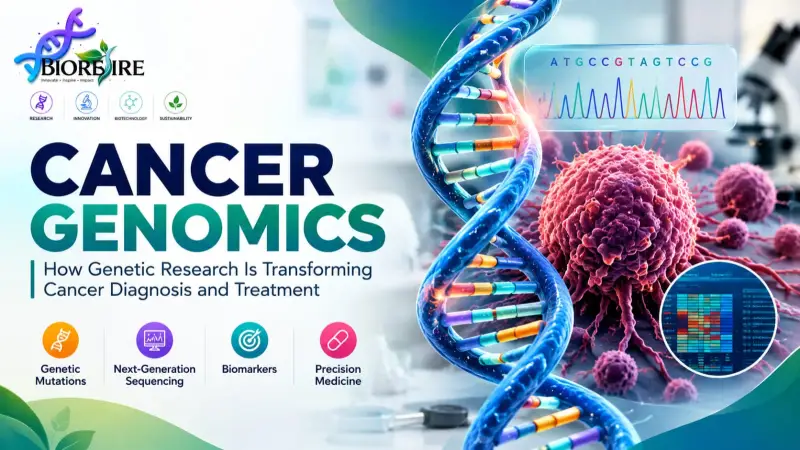
Cancer Genomics: Mutations, Next-Generation Sequencing and Precision Medicine
Introduction
Cancer is a complex disease in which abnormal cells grow and divide without normal control. Genetic changes can affect the processes that regulate cell growth, DNA repair, and cell survival. Studying these changes helps researchers understand how cancer develops and why different tumours may behave differently. Cancer genomics focuses on analysing genetic alterations associated with cancer and interpreting how they influence biological processes.
Advances in DNA sequencing, molecular biology, and bioinformatics have made cancer genomics an important field in biomedical research. Researchers can investigate mutations, identify potential biomarkers, compare tumour samples, and explore how genomic findings may support precision medicine. These methods do not provide every answer, and a genetic change does not automatically indicate that a particular treatment will work. Results must be interpreted using scientific evidence and, in clinical settings, appropriate professional guidance.
For biotechnology and bioinformatics students, cancer genomics connects genetics, cell biology, data analysis, and modern medical research. Learning the basic concepts provides a useful foundation for understanding sequencing workflows and exploring public genomic datasets.
What Is Cancer Genomics?
Cancer genomics is the study of genetic changes across cancer cells or tumours. It may examine changes in DNA sequence, chromosome structure, gene copy number, and other features of the genome. The aim is to understand the molecular differences associated with cancer development, progression, and response to treatment.
Several types of genomic alterations are important:
– Single-nucleotide variants: Changes in one DNA base.
– Insertions and deletions: Addition or loss of DNA bases.
– Copy number changes: Gains or losses of sections of DNA.
– Chromosomal rearrangements: Changes in how chromosome segments are organised.
– Gene amplification: An increase in the number of copies of a particular gene.
Researchers interpret these findings in context. Some alterations contribute to cancer biology, some may be incidental, and others remain uncertain until more evidence becomes available.
How Genetic Mutations Can Contribute to Cancer
A mutation is a change in DNA. Mutations may arise during normal DNA replication, through exposure to certain environmental factors, or from inherited genetic variation. Many mutations do not cause cancer. However, alterations affecting key cellular control systems can contribute to cancer when they accumulate over time.
Oncogenes
Proto-oncogenes normally help cells grow, divide, and respond to signals. Certain alterations can make these genes overactive, turning them into oncogenes. Overactive oncogenes may encourage cells to keep growing even when normal control signals would slow them down. Some cancers contain alterations in genes in the RAS family or other growth-signalling pathways.
Tumour Suppressor Genes
Tumour suppressor genes help prevent uncontrolled cell division. They may regulate the cell cycle, support DNA repair, or activate cell death when damage is severe. TP53 is a well-studied example because its protein helps cells respond to stress and DNA damage. When tumour suppressor function is lost, damaged cells may gain opportunities to survive and multiply.
DNA Repair Genes
Cells use specialised systems to repair DNA damage. If a DNA repair pathway is impaired, additional changes can accumulate. BRCA1 and BRCA2 are involved in repairing particular types of DNA damage. Some inherited variants in these genes can increase the risk of certain cancers, while particular tumour alterations may also be relevant to treatment assessment. The meaning of a variant depends on the exact change and the evidence available.
Cancer usually develops through a combination of molecular and cellular changes rather than one mutation alone. Cancer genomics helps researchers study these changes together.
Germline and Somatic Mutations
Genetic variants can be described as germline or somatic, depending on where they occur.
Germline variants are present in reproductive cells and may be passed from a parent to a child. A person who inherits a particular risk-associated variant may have an increased chance of developing certain cancers, but inheritance does not mean cancer is inevitable.
Somatic variants develop during a person’s lifetime in individual cells. They are found in the affected tissue or tumour and are generally not passed on to children. Somatic changes can accumulate as cells divide and may contribute to the development or progression of a tumour.
Distinguishing germline from somatic findings matters because the implications for family risk, testing, and treatment may differ. A tumour test alone may not always establish whether a variant is inherited. Additional testing and professional interpretation may be needed when inherited risk is suspected.
The Role of Next-Generation Sequencing in Cancer Genomics
Next-generation sequencing (NGS) allows laboratories to read millions of DNA fragments in parallel. Compared with approaches that examine one selected region at a time, NGS can investigate multiple genes or broader genomic regions in one workflow. It is widely used in research and in some clinical testing settings.
A simplified NGS workflow includes the following stages:
1. Sample selection: Researchers select an appropriate sample according to the study question and ethical requirements.
2. DNA extraction: DNA is isolated using a method suitable for the sample type.
3. Library preparation: DNA fragments are prepared with adapters needed for sequencing.
4. Sequencing: An instrument generates sequence reads.
5. Quality control: The data are checked for quality and possible technical problems.
6. Bioinformatics analysis: Reads may be aligned to a reference genome and analysed for possible variants.
7. Interpretation: Findings are reviewed alongside scientific evidence and relevant sample information.
Different sequencing strategies answer different questions. Targeted gene panels focus on selected genes, whole-exome sequencing examines most protein-coding regions, and whole-genome sequencing surveys a much broader portion of the genome. The best approach depends on the research aim, sample quality, available resources, and analytical requirements.
Applications of Cancer Genomics
Understanding Cancer Development
By comparing genomic patterns across samples, researchers can investigate changes linked to cancer initiation and progression. They may study pathways that control cell division, repair DNA, or help cells respond to stress. Such research can improve understanding of how cancers differ at the molecular level.
Identifying Biomarkers
A biomarker is a measurable feature that provides information about a biological process or disease. Some genomic alterations can act as biomarkers in particular cancer types. Researchers investigate whether a marker can help classify a tumour, estimate likely behaviour, or identify a possible treatment option. Not every candidate biomarker is validated or useful in every setting.
Supporting Precision Medicine
Precision medicine considers characteristics of a disease when evaluating possible care options. In cancer, genomic testing may identify alterations associated with particular targeted therapies or clinical trials. The result must be interpreted in the context of cancer type, the patient’s overall clinical situation, evidence for the treatment, and local guidelines. A genomic result alone does not guarantee treatment success.
Investigating Treatment Resistance
Some tumours change over time, and certain cell populations may survive treatment. Researchers can compare samples collected at different time points to investigate genetic changes associated with resistance. These studies may help identify mechanisms worth investigating in future research, although not every observed change directly explains resistance.
Studying Tumour Heterogeneity
Cells within a tumour are not always genetically identical. This variation is called tumour heterogeneity. Different regions of the same tumour may contain different alterations, and metastases may differ from the original tumour. Cancer genomics helps researchers investigate these differences and understand why a single sample may not represent every cancer cell.
Why Bioinformatics Is Important
Cancer genomics produces large datasets that require computational processing. Bioinformatics combines biology, computer science, and statistics to turn sequencing information into interpretable results. A typical analysis may include quality checks, sequence alignment, variant calling, annotation, visualisation, and pathway analysis.
Tools used in different parts of genomic workflows include FastQC for sequence quality checks, BWA for read alignment, and GATK for selected variant-analysis tasks. Ensembl, NCBI, and the UCSC Genome Browser provide useful genomic information and annotation resources. Tool choice depends on the type of data and the research question; no single tool performs every stage of analysis.
Students can begin by learning basic genetics, command-line concepts, statistics, and either R or Python. They should also practise documenting software versions, parameters, and data sources so that an analysis can be reviewed and repeated. Computational findings need careful interpretation and should not be described as clinical conclusions without suitable validation.
Public Databases for Cancer Genomics Research
Public datasets can help students practise research methods without collecting new biological samples. They must still follow the relevant data-use conditions and protect any sensitive information.
The Cancer Genome Atlas
The Cancer Genome Atlas (TCGA) includes molecular and clinical data from multiple cancer types. Researchers use these resources to investigate genomic alterations and explore relationships between molecular features and clinical characteristics. Users should read dataset descriptions and understand the limitations of the sample groups before drawing conclusions.
National Center for Biotechnology Information
NCBI provides biological databases, sequence resources, and literature-search tools. Students can use these resources to find gene information, published studies, and relevant sequence records.
Ensembl Genome Browser
Ensembl offers genome annotations, gene information, transcripts, and variant-related resources for many organisms. It can help users locate genes and explore their genomic context.
Gene Expression Omnibus
The Gene Expression Omnibus (GEO) is a repository for functional genomics data, including many gene-expression datasets. Students can use suitable datasets to compare gene activity between sample groups, provided they account for study design and data quality.
Cancer Genomics Project Ideas for Students
A small, clearly defined project can help learners practise scientific reasoning and data analysis.
Project 1: Gene Expression Comparison
Choose an appropriate public dataset and compare the expression of selected genes between cancer and control samples. Students can learn data cleaning, visualisation, basic statistical testing, and cautious interpretation. The project should clearly state the dataset source and limitations.
Project 2: Explore Mutations in a Selected Gene
Use reliable public resources and research papers to examine reported variants in a cancer-associated gene. The goal can be to summarise the gene’s normal function, the types of alterations reported, and the evidence supporting their possible significance. Students should not label a variant harmful without adequate evidence.
Project 3: Compare a Gene Across Cancer Types
Use a suitable dataset to examine how the expression of a selected gene differs across cancer types. This introduces comparative analysis and helps students understand why biological context matters.
Project 4: Review DNA Repair Genes
Prepare a literature-based project on selected DNA repair genes, their cellular functions, and how their alterations have been studied in cancer. A structured evidence table can summarise the study question, methods, key finding, and limitations of each paper.
Project 5: Learn the NGS Analysis Workflow
Use a suitable educational dataset to practise basic sequence quality control and understand the stages of alignment and variant analysis. A beginner project should focus on workflow understanding and reproducibility rather than making medical claims.
Challenges and Limitations
Cancer genomics offers powerful research methods, but it also has limitations. First, not every detected variant has a known biological effect. Some findings are difficult to classify because evidence is limited or inconsistent. Second, tumour heterogeneity means that a sample may not capture every cell population in a cancer.
Data quality is another important factor. Poor sample quality, sequencing errors, contamination, and inappropriate analytical settings can affect results. Researchers must use suitable quality-control steps and document their methods. Comparing studies can also be challenging when samples, platforms, and analysis pipelines differ.
Privacy and ethics are essential because genomic information can be sensitive. Researchers must follow applicable consent, privacy, access, and data-sharing requirements. Finally, research findings need appropriate validation before they are used to guide clinical decisions. These challenges make transparent methods and careful interpretation especially important.
Career Scope in Cancer Genomics
Cancer genomics brings together molecular biology, genetics, sequencing, data analysis, and biomedical research. Depending on their qualifications and practical experience, students may explore entry-level opportunities such as research assistant, molecular biology trainee, genomics research assistant, bioinformatics trainee, genomic data analyst trainee, NGS laboratory trainee, or clinical research assistant.
Useful skills include genetics, molecular biology, DNA and RNA techniques, sequencing concepts, basic statistics, public-database searching, and scientific writing. Students interested in computational work can build skills in R or Python and practise analysing public datasets. Those interested in laboratory roles can focus on sample preparation, DNA extraction, PCR, quality control, and sequencing workflows.
Job titles and eligibility vary by organisation. Some roles require specialised training, programming ability, laboratory experience, or further qualifications. A portfolio containing a well-documented student project can help demonstrate practical learning, but it does not replace the qualifications required for a particular role.
Future Directions
Research in cancer genomics continues to develop alongside improvements in sequencing, computational methods, and molecular diagnostics. Scientists are increasingly interested in combining genomic data with gene-expression, epigenetic, protein, and clinical information to build a more complete picture of tumour biology.
Artificial intelligence and machine learning may help researchers detect patterns in large datasets and prioritise candidates for further study. However, models can be affected by biased or incomplete training data and must be evaluated carefully. Another active research area is circulating tumour DNA, which can sometimes provide information about tumour-associated alterations from blood samples. Its performance and clinical usefulness depend on the cancer, the assay, and the purpose of testing.
These developments create opportunities for interdisciplinary collaboration among biotechnologists, bioinformaticians, statisticians, and clinicians. The central requirement remains the same: research findings must be interpreted transparently and supported by appropriate evidence.
Frequently Asked Questions
What is cancer genomics?
Cancer genomics is the study of genetic alterations in cancer cells to understand tumour biology and investigate potential biomarkers and treatment approaches.
How is NGS used in cancer genomics?
NGS reads many DNA fragments in parallel and can help researchers identify variants and other genomic changes in a sample.
What is the difference between cancer genetics and cancer genomics?
Cancer genetics often focuses on individual genes and their roles, while cancer genomics studies a broader set of genomic alterations. The two fields overlap.
Can biotechnology students study cancer genomics?
Yes. Students can begin with genetics, molecular biology, sequencing concepts, public databases, and beginner-friendly data-analysis projects.
Does every cancer mutation need treatment?
No. Some variants are not known to drive cancer, and others have uncertain significance. Clinical decisions require appropriate interpretation and evidence.
Which skills are useful for cancer genomics?
Genetics, molecular biology, sequencing fundamentals, statistics, bioinformatics tools, data interpretation, and scientific communication are useful starting points.
Conclusion
Cancer genomics helps researchers study the genetic alterations associated with cancer and investigate how these changes affect tumour behaviour. By combining sequencing technologies, bioinformatics, and public genomic resources, scientists can explore cancer development, potential biomarkers, treatment resistance, and precision medicine.
For students, the field offers a practical connection between biotechnology and computational research. Building a strong foundation in genetics, learning the NGS workflow, exploring reliable databases, and completing a carefully documented project are useful first steps. Scientific accuracy is essential: genomic findings must be interpreted in context, and research results should not be treated as a diagnosis or a guaranteed prediction of treatment response.