
Introduction
Genetic engineering is one of the most powerful and transformative areas in modern biology. It has changed how we understand genes, how we treat diseases, and how we improve crops and biological systems. Many students hear about genetic engineering in biotechnology, but often do not fully understand what it actually means or how it is used in real life. At its core, genetic engineering is about modifying the genetic material of an organism to achieve a desired outcome. It allows scientists to add, remove, or change specific genes in a controlled way. This has opened new possibilities in medicine, agriculture, and research. In this blog, you will understand what genetic engineering is, its core concepts, techniques, applications, and how it is shaping the future of life sciences.
What is Genetic Engineering?
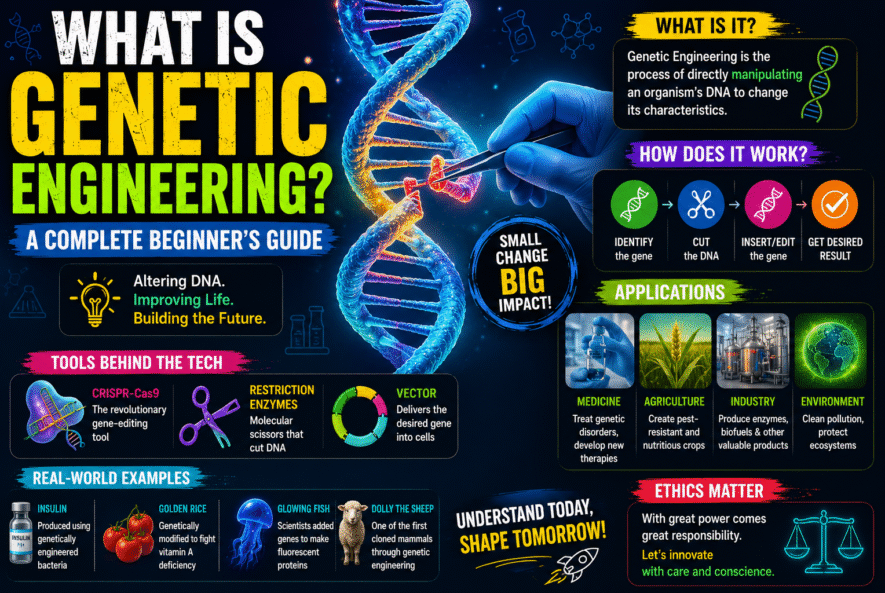
Genetic engineering is a branch of biotechnology that involves the direct manipulation of an organism’s DNA to alter its characteristics. It allows scientists to change the genetic makeup of an organism in order to produce desired traits or functions. In simple terms, it is the process of modifying genes to improve or change how an organism behaves or functions. Unlike traditional breeding methods, genetic engineering is precise and targeted. It focuses on specific genes rather than the entire organism. This makes it faster, more efficient, and more reliable.
Basic Concept of Genetic Engineering
The main idea behind genetic engineering is that DNA carries instructions for all biological functions. By changing these instructions, we can change the traits of an organism. This may involve inserting a new gene, deleting an unwanted gene, or modifying an existing gene. For example, if a plant lacks resistance to pests, scientists can introduce a gene that provides protection. Similarly, in medicine, defective genes can be replaced or corrected to treat diseases. Understanding how genes function and how they can be manipulated is the foundation of genetic engineering.
Key Components in Genetic Engineering
DNA
DNA is the central molecule involved in genetic engineering. It contains the genetic code that determines the structure and function of an organism. Manipulating DNA is the primary goal in this field.
Genes
Genes are specific segments of DNA that carry instructions for making proteins. These proteins determine traits such as color, growth, and resistance to diseases. Genetic engineering focuses on modifying these genes.
Vectors
Vectors are tools used to transfer genes from one organism to another. Common vectors include plasmids, viruses, and artificial DNA carriers. They help deliver the desired gene into the target organism.
Enzymes
Special enzymes such as restriction enzymes and ligases are used to cut and join DNA. These enzymes make it possible to isolate and insert specific genes.
Important Techniques in Genetic Engineering
Genetic engineering relies on a set of powerful techniques that allow scientists to manipulate DNA in a precise and controlled way. These techniques form the backbone of modern biotechnology and are widely used in research, medicine, agriculture, and industry. Understanding how these methods work helps students connect theory with real-world applications and builds a strong conceptual foundation.
Recombinant DNA Technology
This technique involves combining DNA from different sources to create a new DNA sequence. It is one of the most widely used methods in genetic engineering.
In this process, a specific gene of interest is identified and isolated using restriction enzymes. This gene is then inserted into a vector, such as a plasmid, and introduced into a host organism like bacteria. The host organism then replicates and expresses the inserted gene.
Recombinant DNA technology is used to produce important products such as insulin, growth hormones, and vaccines. It is also used in gene therapy and research to study gene function. This technique laid the foundation for many modern advancements in biotechnology.
Gene Cloning
Gene cloning is the process of making multiple copies of a specific gene. This helps in studying genes and producing useful proteins.
The process begins by isolating the desired gene and inserting it into a vector. The vector is then introduced into a host cell, where it replicates along with the host’s DNA. As the cells divide, multiple copies of the gene are produced.
Gene cloning is important for understanding gene structure and function. It is also used in the production of proteins such as insulin and enzymes used in industry. By creating multiple copies, scientists can analyze genes more effectively and use them for various applications.
CRISPR-Cas9 Technology
CRISPR is a modern gene-editing tool that allows precise modification of DNA. It is faster, more accurate, and widely used in research and medicine.
This technology works like molecular scissors. The Cas9 enzyme cuts DNA at a specific location guided by a piece of RNA. Once the DNA is cut, scientists can add, remove, or modify genetic material.
CRISPR has revolutionized genetic engineering because of its simplicity and efficiency. It is being used in research to study gene functions, in medicine for developing gene therapies, and in agriculture to improve crop traits. It holds great potential for treating genetic diseases in the future.
PCR (Polymerase Chain Reaction)
PCR is used to amplify DNA, meaning it creates multiple copies of a DNA segment. It is essential for genetic analysis and research.
PCR involves repeated cycles of heating and cooling, which allow DNA strands to separate and replicate. Within a short time, a small amount of DNA can be amplified into millions of copies.
This technique is widely used in diagnostics, forensic science, and research. For example, PCR is used in disease detection, including viral infections like COVID-19. It is also used in DNA fingerprinting and genetic testing.
Applications of Genetic Engineering
Medicine
Genetic engineering is widely used in medicine for producing insulin, vaccines, and gene therapy. It helps treat genetic disorders by correcting defective genes.
Agriculture
In agriculture, genetically modified crops are developed to improve yield, resistance to pests, and tolerance to environmental conditions. This helps in increasing food production.
Industrial Biotechnology
Genetic engineering is used in industries to produce enzymes, biofuels, and other useful products. It improves efficiency and reduces costs.
Research and Development
Scientists use genetic engineering to study gene function, understand diseases, and develop new technologies. It plays a major role in scientific advancement.
Advantages of Genetic Engineering
Genetic engineering offers several benefits. It allows precise modification of genes, improves crop productivity, and helps in developing new treatments for diseases. It also enables the production of important biological products such as insulin and vaccines. The ability to target specific genes makes it a powerful tool in modern science.
Challenges and Ethical Concerns
Despite its advantages, genetic engineering also raises ethical and safety concerns. Issues such as genetic modification of humans, environmental impact, and long-term effects are widely debated. There is also concern about misuse of technology and lack of regulation. It is important to use genetic engineering responsibly and ensure proper guidelines are followed.
Real-Life Examples
Genetic engineering is already being used in many areas. Insulin used by diabetic patients is produced using genetically modified bacteria. Genetically modified crops like Bt cotton are widely used in agriculture. Gene therapy is being developed to treat diseases like cancer and genetic disorders. These examples show how genetic engineering is improving lives.
Skills Required to Learn Genetic Engineering
To understand and work in genetic engineering, students should focus on strong concepts in molecular biology and genetics. Practical laboratory skills are important, along with analytical thinking and problem-solving ability. Knowledge of bioinformatics and data analysis can also be helpful. Communication and research skills play a key role in explaining and applying knowledge.
Common Mistakes Students Make
Many students try to memorize definitions without understanding concepts. Some ignore practical aspects and focus only on theory. Others do not connect genetic engineering with real-world applications. Lack of revision and practice also makes learning difficult. To overcome this, students should focus on understanding, practice regularly, and use visual aids.
How to Study Genetic Engineering Effectively
To learn genetic engineering effectively, focus on understanding processes rather than memorizing steps. Use diagrams and flowcharts to visualize techniques. Practice questions and revise regularly. Connect concepts with real-life applications to improve understanding. Watching animations and practical demonstrations can also help in learning complex topics.
Internal Link Suggestions
The Smart Way to Study Life Sciences
Top Skills Every Biotechnology Student Must Master
Why Bioinformatics is the Future of Life Sciences
FAQs
- What is genetic engineering in simple words
It is the process of modifying DNA to change the traits of an organism. - Is genetic engineering difficult
It may seem complex at first, but with proper understanding it becomes easier. - Where is genetic engineering used
It is used in medicine, agriculture, research, and industry. - What are examples of genetic engineering
Insulin production, genetically modified crops, and gene therapy. - What skills are needed for genetic engineering
Strong biology concepts, lab skills, and analytical thinking.
Conclusion
Genetic engineering is a powerful field that allows us to modify life at the molecular level. It plays a major role in medicine, agriculture, and scientific research. Understanding genetic engineering helps students build a strong foundation for careers in biotechnology and related fields. It is not just about changing genes, but about solving real-world problems using science.
Call to Action
Don’t wait for oppurtunities
- Start building your understanding today.
- Focus on concepts, practice regularly, and stay curious.
Join BioResire and take your first step toward mastering genetic engineering.
Email: info@bioresire.in
Phone / WhatsApp: 6301352398
BioResire Quote:
Changing genes is powerful, but understanding them is what truly creates impact.