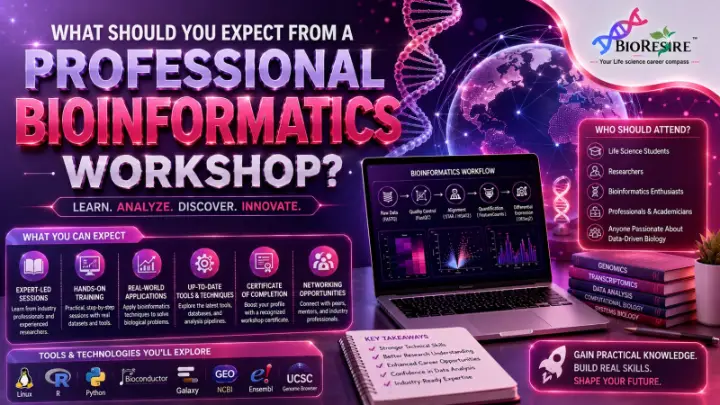
What Should You Expect from a Professional Bioinformatics Workshop? A Complete Guide for Students and Researchers
Introduction
Bioinformatics is one of the fastest-growing interdisciplinary fields, combining biology, computer science, mathematics, statistics, and data science to understand complex biological information. With the rapid development of genome sequencing, molecular biology, artificial intelligence, and computational drug discovery, bioinformatics skills are becoming increasingly important for biotechnology students, life science graduates, and research scholars.
However, understanding bioinformatics through textbooks and theoretical lectures alone may not be sufficient to develop practical skills. Students need opportunities to work with computational tools, analyze biological datasets, understand research applications, and solve real-world scientific problems.
This is where a professional bioinformatics workshop becomes valuable.
A well-organized bioinformatics workshop provides structured learning, practical demonstrations, expert guidance, and exposure to commonly used research tools. It helps participants understand how computational techniques are applied to biological research and prepares them for further academic and professional development.
But what should you actually expect from a professional bioinformatics workshop?
In this article, we will explore the important topics, practical activities, learning experiences, and career benefits that students and researchers should look for before joining a bioinformatics workshop.
What Is a Professional Bioinformatics Workshop?
A professional bioinformatics workshop is a structured training programme designed to introduce participants to computational methods, biological databases, analytical software, and practical applications used in modern biological research.
These workshops are generally organized for:
– BSc Biotechnology students.
– MSc Biotechnology students.
– Microbiology students.
– Genetics and Molecular Biology students.
– Bioinformatics students.
– PhD research scholars.
– Life science graduates.
– Researchers interested in computational biology.
Depending on the training programme, workshops may cover basic bioinformatics concepts, sequence analysis, genomics, proteomics, molecular docking, NGS analysis, and artificial intelligence applications.
The main objective is to help participants understand how biological information can be collected, processed, analyzed, and interpreted using computational tools.
1. Strong Foundation in Bioinformatics Fundamentals
<IMAGE_PLACEHOLDER_1>
The first thing you should expect from a professional bioinformatics workshop is a clear introduction to fundamental concepts.
Before working with advanced computational tools, participants should understand the basic principles of bioinformatics and its importance in biological research.
Important concepts include:
– Introduction to bioinformatics.
– Relationship between biology and computer science.
– Biological sequence analysis.
– DNA, RNA, and protein databases.
– Sequence alignment.
– Genome and protein analysis.
– Applications of computational biology.
A good workshop should explain these concepts in simple language, especially for beginners who have a biotechnology or life science background but limited programming experience.
Understanding the fundamentals makes it easier to learn advanced analytical techniques.
2. Hands-On Training with Bioinformatics Tools
<IMAGE_PLACEHOLDER_2>
Practical training is one of the most important components of a professional bioinformatics workshop.
Instead of only listening to theoretical explanations, participants should get opportunities to understand how bioinformatics software and online platforms work.
Some commonly used tools include:
NCBI BLAST: Used to identify similarities between biological sequences.
Clustal Omega: Used for multiple sequence alignment.
MEGA: Used for evolutionary analysis and phylogenetic tree construction.
UCSC Genome Browser: Used to explore genomic information.
UniProt: Provides protein sequence and functional information.
PyMOL: Used for three-dimensional protein structure visualization.
AutoDock Vina: Used for molecular docking studies.
Participants should understand the purpose of each tool, its basic workflow, the input data required, and how to interpret the output.
3. Understanding Biological Databases
<IMAGE_PLACEHOLDER_3>
Biological databases are essential resources in bioinformatics. They provide access to information about genes, proteins, genomes, molecular structures, and scientific research.
A professional workshop should introduce participants to important biological databases and explain how to retrieve relevant information.
Some important databases include:
– NCBI – Nucleotide and sequence information.
– GenBank – DNA sequence records.
– UniProt – Protein sequence and functional information.
– PDB – Three-dimensional biological structures.
– Ensembl – Genome information and annotation.
– GEO – Gene expression datasets.
– KEGG – Biological pathways and functional information.
Participants should learn how to search for biological information, retrieve sequences, understand database records, and use the information for research purposes.
This knowledge is useful for academic projects, dissertation work, and scientific investigations.
4. Introduction to Sequence Alignment and Analysis
<IMAGE_PLACEHOLDER_4>
Sequence alignment is a fundamental technique in bioinformatics. It helps researchers compare DNA, RNA, or protein sequences to identify similarities and differences.
A professional workshop should explain both pairwise and multiple sequence alignment.
Important topics include:
– Global sequence alignment.
– Local sequence alignment.
– Pairwise alignment.
– Multiple sequence alignment.
– Sequence similarity.
– Sequence identity.
– BLAST analysis.
Participants should understand how to submit sequences, select appropriate databases, interpret alignment scores, and identify biologically meaningful similarities.
Sequence analysis is widely used in evolutionary biology, molecular genetics, microbial identification, and comparative genomics.
5. Practical Introduction to Genomics and NGS
<IMAGE_PLACEHOLDER_5>
Next-Generation Sequencing (NGS) has transformed biological research by allowing scientists to generate large amounts of DNA and RNA sequencing data.
A professional bioinformatics workshop may introduce participants to the basic principles of NGS and its computational applications.
Important topics include:
– Introduction to sequencing technologies.
– FASTA and FASTQ file formats.
– Sequence quality control.
– Read trimming.
– Genome alignment.
– Variant identification.
– RNA sequencing analysis.
– Genome assembly.
Participants should understand how raw sequencing data are processed and why computational analysis is necessary.
NGS knowledge is useful for students interested in genomics, transcriptomics, molecular diagnostics research, and computational biology.
6. Introduction to Python and R Programming
<IMAGE_PLACEHOLDER_6>
Programming is an important part of modern bioinformatics. Python and R are widely used to analyze biological datasets and perform computational research.
A beginner-friendly workshop should introduce programming concepts through biological examples.
Python topics may include:
– Variables and data types.
– Lists and dictionaries.
– Loops and conditional statements.
– Functions.
– File handling.
– Biopython basics.
R programming topics may include:
– Data structures.
– Data manipulation.
– Statistical analysis.
– Biological data visualization.
– Gene expression analysis.
Participants do not necessarily need to become programming experts during a short workshop. However, they should understand the basic applications and know how to continue learning independently.
7. Molecular Docking and Structural Bioinformatics
<IMAGE_PLACEHOLDER_7>
Structural bioinformatics is an important area of computational biology that focuses on understanding the three-dimensional structures of proteins and other biological molecules.
Molecular docking is commonly used in computational drug discovery to study the potential interaction between small molecules and target proteins.
A workshop covering this area may introduce:
– Protein structure retrieval.
– Protein preparation.
– Ligand preparation.
– Molecular docking.
– Protein-ligand interaction analysis.
– Binding pose visualization.
– Interpretation of docking results.
Tools such as AutoDock Vina, PyMOL, and ChimeraX may be demonstrated.
This area is particularly useful for students interested in pharmaceutical research, drug discovery, and computational chemistry.
8. Real-Time Research Applications and Case Studies
A professional bioinformatics workshop should connect theoretical knowledge with actual research applications.
Participants should understand how computational methods are used to address biological questions.
Some examples include:
Disease-Associated Gene Identification: Studying genes associated with particular diseases using biological databases and published datasets.
Microbial Identification: Comparing microbial DNA sequences to identify organisms.
Protein Function Analysis: Exploring protein sequences and predicting possible biological functions.
Drug Discovery Research: Investigating protein-ligand interactions using molecular docking.
Gene Expression Analysis: Studying changes in gene expression using transcriptomic datasets.
Case studies help participants understand how bioinformatics tools contribute to scientific research.
9. Guidance from Experienced Trainers
The quality of a bioinformatics workshop depends significantly on the trainers and the way the subject is explained.
Participants should expect trainers to:
– Explain concepts clearly.
– Demonstrate computational tools.
– Provide step-by-step instructions.
– Discuss practical research applications.
– Clarify technical doubts.
– Explain common mistakes.
– Recommend suitable learning resources.
Trainers should also explain the limitations of computational predictions and why biological validation may be necessary.
A good learning environment encourages questions, discussions, and active participation.
10. Practical Assignments and Project Exposure
<IMAGE_PLACEHOLDER_8>
Practical assignments help participants apply the concepts learned during a workshop.
Depending on the workshop duration, participants may be given small exercises or guided project activities.
Examples include:
1. DNA sequence analysis using NCBI.
2. Protein sequence comparison using BLAST.
3. Multiple sequence alignment using Clustal Omega.
4. Phylogenetic tree construction using MEGA.
5. Protein structure visualization using PyMOL.
6. Molecular docking using AutoDock Vina.
7. Basic biological data analysis using Python.
Participants should ideally receive clear instructions, sample datasets, and guidance on interpreting their results.
A completed practical exercise can also become a useful starting point for a larger academic project.
11. Learning Materials, Certificates, and Post-Workshop Support
A professional workshop should provide clear information about the learning resources and participation benefits.
Depending on the organizer and programme, participants may receive:
– Digital learning materials.
– Practical demonstration files.
– Software installation instructions.
– Sample biological datasets.
– Reference papers.
– Workshop participation certificates.
– Recommended books and online resources.
– Further learning guidance.
Before registering, participants should verify whether certificates are included, whether additional charges apply, and whether post-workshop support is available.
A certificate can document participation, but practical knowledge and project experience are more important when building a professional profile.
12. Career Guidance and Future Learning Opportunities
A bioinformatics workshop can also help students understand the different career paths available in this field.
Some potential career directions include:
– Bioinformatics Analyst.
– Computational Biologist.
– Genomics Analyst.
– NGS Data Analyst.
– Research Assistant.
– Structural Bioinformatics Researcher.
– Computational Drug Discovery Researcher.
– Biological Data Analyst.
Participants should also learn which additional skills are needed for these roles, such as Python, R, Linux, statistics, NGS analysis, machine learning, and database management.
A short workshop cannot guarantee employment. However, it can provide an introduction to the field and help students identify the skills they need to develop.
Online vs Offline Bioinformatics Workshops: Which Is Better?
Both online and offline workshops can provide valuable learning experiences. The right choice depends on the training format, practical requirements, and participant preferences.
Factor| Online Workshop| Offline Workshop
Accessibility| Join remotely| Attend a physical location
Learning format| Live demonstrations| In-person demonstrations
Interaction| Online discussions| Direct interaction
Practical training| Screen-based exercises| Depends on lab facilities
Flexibility| Often more convenient| Requires travel
Networking| Virtual connections| Face-to-face networking
For computational bioinformatics, online workshops can be effective because many tools are available through web platforms or software installations.
However, the quality of practical training matters more than whether the workshop is online or offline.
How to Choose the Right Bioinformatics Workshop
Before registering for a workshop, students should carefully evaluate its content and training quality.
Consider the following points:
1. Workshop Curriculum: Check whether the programme covers relevant topics and practical applications.
2. Trainer Experience: Understand the trainer’s academic, research, and industry background.
3. Hands-On Sessions: Confirm whether practical demonstrations or guided exercises are included.
4. Software and Tools: Check which bioinformatics tools will be covered.
5. Learning Materials: Ask whether study materials and practical datasets are provided.
6. Duration: Ensure that the workshop duration is sufficient for the topics being taught.
7. Certificate Details: Verify certificate eligibility, issuing organization, and any additional charges.
8. Participant Feedback: Look for genuine feedback from previous participants.
Choosing a workshop based on its actual learning value is better than selecting one based only on advertisements or certificate promises.
Who Should Attend a Bioinformatics Workshop?
A professional bioinformatics workshop can be beneficial for different categories of learners.
BSc Students: Students can understand the fundamentals of computational biology and explore new areas of life science research.
MSc Biotechnology Students: Postgraduate students can develop skills useful for dissertation projects, research activities, and future career opportunities.
Microbiology Students: Bioinformatics can help microbiology students explore microbial genomics, sequence analysis, and comparative genomics.
Research Scholars: PhD scholars can learn computational methods that support their research projects.
Life Science Graduates: Graduates can explore computational biology and understand the technical skills required for specialized positions.
Frequently Asked Questions (FAQs)
1. What is the main purpose of a bioinformatics workshop?
The main purpose is to introduce participants to computational methods, biological databases, analytical tools, and practical applications used in biological research.
2. Do I need programming knowledge to attend a bioinformatics workshop?
No. Beginner-level workshops may not require prior programming experience. However, basic Python, R, and Linux knowledge can be helpful for advanced training.
3. Which tools are commonly taught in bioinformatics workshops?
Commonly demonstrated tools include NCBI BLAST, Clustal Omega, MEGA, UniProt, PyMOL, AutoDock Vina, and other specialized software depending on the curriculum.
4. Are bioinformatics workshops useful for MSc Biotechnology students?
Yes. They can help MSc Biotechnology students understand computational analysis, explore research tools, and identify skills relevant to dissertation projects and careers.
5. Can a bioinformatics workshop help with dissertation projects?
Yes. A workshop can introduce useful tools and methods for sequence analysis, genomics, molecular docking, and biological data analysis. However, students should develop additional skills for independent dissertation research.
6. What should I learn after completing a bioinformatics workshop?
Students can continue learning Python, R, Linux, statistics, NGS data analysis, machine learning, and structural bioinformatics according to their interests.
7. Does a bioinformatics workshop guarantee a job?
No. A workshop provides learning exposure and practical introduction. Employment depends on qualifications, technical proficiency, project experience, and employer requirements.
Conclusion
A professional bioinformatics workshop should offer more than theoretical lectures. It should introduce participants to biological databases, computational tools, sequence analysis, genomics, programming, and real-world research applications.
For biotechnology students, life science graduates, and research scholars, these workshops can provide an opportunity to explore the growing field of computational biology and understand how modern biological research uses data-driven approaches.
Before choosing a workshop, evaluate its curriculum, trainer expertise, practical sessions, learning materials, and overall educational value.
The most valuable outcome is not simply receiving a certificate. It is gaining practical knowledge, understanding computational workflows, and developing the confidence to apply bioinformatics tools to biological research.
Learn the concepts, practice the tools, explore real biological datasets, and take your first step towards a career in bioinformatics.