
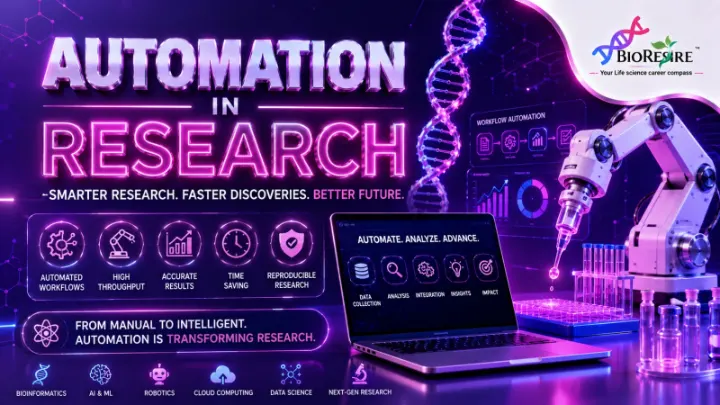
Automation in Research: Applications, Technologies, Benefits and Future Opportunities
Research plays an important role in scientific discovery, technological development, healthcare, biotechnology, and pharmaceutical innovation. Traditional research methods often involve repetitive laboratory procedures, manual data collection, sample preparation, and time-consuming analysis. As scientific technologies continue to advance, automation is becoming an important part of modern research.
Automation in research refers to the use of machines, computer systems, robotics, software, and artificial intelligence (AI) to perform research activities with reduced manual intervention. It helps researchers improve workflow efficiency, manage large amounts of data, minimise repetitive errors, and focus more on scientific investigation.
From automated laboratory equipment to AI-powered data analysis, automation is transforming how experiments are designed, performed, and interpreted.
In this blog, we will explore the meaning of research automation, its major technologies, applications in biotechnology and life sciences, advantages, challenges, and career opportunities for students.
What Is Automation in Research?
Automation in research is the process of using technology to perform specific scientific tasks that would otherwise require repeated manual effort.
It involves integrating laboratory instruments, robotics, computer software, sensors, and data management systems to improve research workflows.
For example, in a traditional laboratory, a researcher may manually transfer samples, measure reagents, record observations, and analyse experimental results. In an automated laboratory, robotic liquid-handling systems can transfer precise volumes of liquids, instruments can collect measurements, and software can record and organise experimental data.
Automation does not mean that human researchers are no longer required. Scientists continue to play an essential role in planning experiments, selecting appropriate methods, evaluating results, and making scientific decisions.
Why Is Automation Important in Scientific Research?
Modern scientific research generates large amounts of biological, chemical, and experimental data. Managing these activities manually can require considerable time and effort.
Automation helps researchers handle repetitive procedures and organise complex workflows more efficiently.
Some important reasons for adopting automation include:
– Time efficiency: Automated systems can perform repetitive procedures with less manual involvement.
– Improved consistency: Standardised workflows help reduce variations between repeated procedures.
– Data management: Software systems help organise, store, and retrieve experimental information.
– Reduced manual errors: Automated measurements and sample handling can reduce certain human errors.
– Research productivity: Researchers can spend more time on experimental planning and scientific interpretation.
– Reproducibility: Documented and standardised procedures can make experiments easier to repeat and evaluate.
Automation can improve efficiency and reproducibility, although equipment validation, proper protocols, and human supervision remain necessary. “Source” (https://pmc.ncbi.nlm.nih.gov/articles/PMC7691657/)
Major Technologies Used in Research Automation
Several technologies work together to automate scientific research. Each technology performs a different function depending on the research requirement.
1. Laboratory Robotics
Laboratory robotics involves using robotic systems to perform repetitive laboratory operations.
Robots can be programmed to handle samples, transfer materials, move laboratory plates, and assist with experimental workflows.
For example, robotic systems are used in high-throughput screening, molecular biology, pharmaceutical research, and sample preparation.
Applications:
– Automated sample handling.
– Reagent transfer.
– Laboratory plate movement.
– High-throughput experimental workflows.
2. Artificial Intelligence (AI)
Artificial intelligence is used to analyse data, identify patterns, support predictions, and assist researchers in different stages of scientific investigation.
AI-based systems can process large datasets and help researchers identify relationships that may be difficult to recognise through manual analysis.
In biological research, AI can support protein structure studies, medical image analysis, drug discovery, and genomic data interpretation.
Applications:
– Biological data analysis.
– Protein structure prediction.
– Drug discovery research.
– Scientific literature assistance.
– Pattern recognition.
AI-generated results must be checked against reliable scientific evidence before being accepted.
3. Machine Learning
Machine learning is a branch of artificial intelligence that enables computer systems to identify patterns in data and improve their performance through training.
Researchers use machine learning algorithms to analyse experimental datasets, classify biological samples, and make predictions based on available information.
Applications:
– Disease classification research.
– Gene expression analysis.
– Drug response prediction.
– Biological image classification.
– Predictive modelling.
4. Laboratory Information Management Systems (LIMS)
A Laboratory Information Management System is software designed to manage laboratory samples, experimental records, workflows, and associated data.
LIMS helps laboratories organise sample information and track activities throughout laboratory processes.
Applications:
– Sample tracking.
– Laboratory record management.
– Data organisation.
– Workflow monitoring.
– Quality management.
5. Automated Laboratory Instruments
Automated laboratory instruments perform specific experimental operations with limited manual intervention.
Examples include automated pipetting systems, analytical instruments, automated microscopes, and sample preparation equipment.
These instruments are useful in laboratories that process large numbers of samples or perform repeated experimental procedures.
Applications of Automation in Research
Automation is used across several scientific disciplines. Its applications depend on the type of research, available technology, and experimental requirements.
1. Automation in Biotechnology Research
Biotechnology involves the application of biological systems, organisms, and cellular processes to develop useful products and technologies.
Automation supports biotechnology research by simplifying repetitive experimental procedures and improving workflow organisation.
Examples include:
– Automated DNA extraction.
– PCR sample preparation.
– Liquid handling.
– Microbial growth monitoring.
– Automated laboratory measurements.
– High-throughput screening.
For example, automated liquid-handling systems can transfer reagents into multiple wells of a microplate. This is useful in experiments that require repeated and consistent liquid transfers.
2. Automation in Molecular Biology
Molecular biology focuses on DNA, RNA, proteins, and the molecular mechanisms of living organisms.
Automation supports several molecular biology techniques by reducing manual handling and standardising experimental steps.
Important applications:
– DNA and RNA extraction.
– PCR preparation.
– DNA sequencing workflows.
– Gel documentation and image analysis.
– Protein sample preparation.
Automated systems can help laboratories process multiple samples efficiently while maintaining consistent procedures.
3. Automation in Microbiology
Microbiology research involves studying microorganisms such as bacteria, fungi, viruses, and other microscopic organisms.
Automation can support microbial research through automated monitoring, sample handling, and image-based analysis.
Applications include:
– Automated microbial growth monitoring.
– Colony counting using image analysis.
– Sample preparation.
– Fermentation monitoring.
– Microbial identification workflows.
For example, automated colony-counting software can analyse images of microbial plates and help researchers estimate colony numbers.
4. Automation in Pharmaceutical Research
Pharmaceutical research involves discovering, developing, and evaluating potential medicines.
Automation helps researchers perform screening procedures, manage experimental data, and investigate drug-related properties.
Applications include:
– High-throughput compound screening.
– Automated sample preparation.
– Drug interaction analysis.
– Laboratory data management.
– Computational drug discovery.
Robotic systems can help researchers test many compounds under standardised experimental conditions. However, computational predictions and screening results require further scientific validation.
5. Automation in Clinical and Medical Research
Clinical and medical research generates different types of information, including laboratory results, medical images, and clinical observations.
Automation supports selected research and laboratory workflows through digital data processing and standardised procedures.
Applications include:
– Medical image analysis.
– Automated laboratory testing.
– Research data organisation.
– Statistical analysis.
– Digital sample tracking.
Human review, data privacy, and appropriate clinical validation remain essential when working with medical information.
6. Automation in Bioinformatics Research
Bioinformatics combines biology, computer science, and data analysis to study biological information.
Automation is particularly useful when researchers need to process large amounts of genomic, transcriptomic, and proteomic data.
Applications include:
– DNA sequence analysis.
– Automated sequence alignment workflows.
– Gene expression analysis.
– Protein data processing.
– Biological database searching.
– Genomic data visualisation.
For example, researchers can create computational workflows that retrieve sequence data, perform quality checks, compare sequences, and organise the resulting information.
Examples of Automated Research Workflows
Understanding practical examples helps students see how automation works in research laboratories.
Example 1: Automated DNA Extraction
Traditional DNA extraction involves several manual steps, including sample preparation, cell lysis, DNA purification, and DNA recovery.
Automated extraction systems can perform defined sample-processing steps using programmed protocols.
Example 2: Automated PCR Preparation
Automated liquid-handling equipment can prepare reaction mixtures and distribute samples into PCR plates.
This helps laboratories manage multiple reactions using standardised procedures.
Example 3: Automated Microscopy
Automated microscopy systems can capture images, adjust imaging parameters, and support image analysis.
These systems are useful in cell biology, microbiology, and biomedical research.
Example 4: AI-Based Biological Data Analysis
AI and machine learning tools can help researchers analyse large datasets, identify patterns, and generate predictions.
For example, machine learning can support the classification of biological images or the analysis of gene expression patterns.
Advantages of Automation in Research
Automation provides several benefits when it is appropriately selected and implemented.
1. Saves time: Repetitive laboratory procedures can be performed with less manual effort.
2. Improves consistency: Standardised protocols help maintain consistency across repeated experiments.
3. Increases processing capacity: Automated systems can handle multiple samples and experimental operations.
4. Supports accurate measurements: Properly calibrated instruments can improve measurement consistency.
5. Improves data organisation: Digital systems help researchers store and retrieve experimental records.
6. Reduces repetitive workload: Researchers can focus more on experimental design and interpretation.
7. Supports laboratory safety: Automated handling can reduce direct human exposure to certain hazardous materials when properly designed.
Challenges and Limitations of Research Automation
Although automation provides important advantages, it also has limitations. Researchers must understand these challenges before introducing automated systems into laboratory workflows.
1. High Initial Investment
Advanced robotic equipment, automated instruments, and specialised software can require significant investment.
Small academic laboratories may find it difficult to purchase and maintain such systems.
2. Technical Knowledge Requirements
Operating automated systems requires appropriate training. Researchers need to understand the equipment, software, protocols, and troubleshooting procedures.
3. Equipment Maintenance
Automated instruments require regular maintenance, calibration, and performance checks.
Technical failures can interrupt experimental workflows and affect research timelines.
4. Protocol Compatibility
Not every research procedure can be easily automated. Some experiments require flexible handling, specialised techniques, or continuous human observation.
5. Data Quality and Security
Automated systems can generate large amounts of data, but poor-quality inputs may produce unreliable outputs.
Digital research records also require appropriate access controls, backups, and data protection measures.
6. Dependence on Technology
Excessive dependence on automated systems can become a problem when equipment fails or software produces unexpected results.
Human supervision and scientific understanding are therefore essential.
Role of Artificial Intelligence in the Future of Research Automation
Artificial intelligence is expanding the possibilities of research automation.
AI-based systems can assist with literature searching, data analysis, experimental planning, image interpretation, and scientific workflow management.
An emerging development is the concept of self-driving laboratories. These systems combine laboratory equipment, robotics, software, and computational methods to automate several stages of an experimental process.
In some advanced workflows, an automated system can analyse experimental results and help select the next experiment based on predefined objectives.
However, such systems still require appropriate scientific oversight, validation, and quality control. “Source” (https://pmc.ncbi.nlm.nih.gov/articles/PMC12368842/)
The integration of AI into scientific research also creates important responsibilities involving data quality, transparency, privacy, and the verification of generated information. “Source” (https://pmc.ncbi.nlm.nih.gov/articles/PMC11804648/)
Skills Students Should Develop to Work with Research Automation
Students interested in research automation can develop a combination of biological, computational, and technical skills.
1. Basic Laboratory Skills: Knowledge of pipetting, sample preparation, DNA extraction, PCR, and laboratory safety.
2. Computer Skills: Understanding data handling, spreadsheets, and scientific software.
3. Programming Knowledge: Learning Python or R can help students automate data processing and biological analysis.
4. Data Analysis: Understanding basic statistics, graphs, and scientific interpretation.
5. Instrumentation Knowledge: Learning the principles and operation of automated laboratory instruments.
6. Problem-Solving Skills: Identifying errors, troubleshooting equipment, and evaluating experimental results.
Students can start with basic laboratory automation concepts and gradually explore advanced technologies.
Career Opportunities in Research Automation
Research automation combines multiple scientific and technical disciplines. Students with relevant knowledge can explore opportunities in different sectors.
Some related career roles include:
– Research Assistant.
– Laboratory Automation Technician.
– Biotechnology Research Associate.
– Bioinformatics Analyst.
– Laboratory Instrumentation Specialist.
– Scientific Data Analyst.
– Automation Application Specialist.
– Research Software Associate.
Relevant opportunities may be available in biotechnology companies, pharmaceutical industries, research institutions, diagnostic laboratories, and technology-based scientific organisations.
The required qualifications vary according to the position. Practical laboratory experience, computational knowledge, instrument handling, and problem-solving skills can strengthen a candidate’s profile.
Conclusion
Automation in research is transforming scientific workflows by combining laboratory instruments, robotics, software, and artificial intelligence. It helps researchers manage repetitive procedures, improve workflow consistency, organise experimental data, and explore complex scientific questions.
From DNA extraction and PCR preparation to bioinformatics analysis and automated microscopy, research automation has applications across biotechnology, microbiology, molecular biology, pharmaceutical science, and medical research.
For students, understanding automation provides an opportunity to connect traditional laboratory knowledge with modern scientific technologies. Developing practical laboratory skills, computational knowledge, and data analysis abilities can help prepare students for research-oriented careers.
Automation does not replace scientific thinking. It supports researchers in working more efficiently, exploring new possibilities, and advancing scientific discovery.