## Introduction
Building a strong resume is an important step for students who want to start a career in biotechnology. Whether you are pursuing BSc Biotechnology, MSc Biotechnology, Microbiology, Biochemistry, Genetics, or another life science degree, academic qualifications alone may not fully demonstrate your practical abilities.
Employers and research supervisors may also want to understand what you can do, which techniques you have practiced, how you approach scientific problems, and whether you can apply your knowledge in a practical setting.
This is where an internship can make a difference. A relevant biotechnology internship can help you gain practical experience, develop technical skills, participate in research activities, and identify the areas in which you want to build your career.
However, completing an internship does not automatically make a resume impressive. You need to understand what you learned, document your responsibilities accurately, and explain how your experience relates to the position you are applying for.
In this guide, you will learn how an internship can strengthen your biotechnology resume, which skills are worth highlighting, how to describe your experience professionally, and how to avoid common resume mistakes.
## What Is a Biotechnology Internship?
A biotechnology internship is a temporary training or work experience in which students gain exposure to practical activities related to biotechnology and life sciences.
Depending on the organization, an internship may take place in a research laboratory, pharmaceutical company, diagnostic centre, biotechnology startup, university department, or computational biology group.
Students may participate in laboratory procedures, research documentation, data analysis, quality control, biological database searching, or other activities relevant to the organization.
Common internship areas include:
– Molecular biology and genetics.
– Microbiology and microbial biotechnology.
– Biochemistry and protein analysis.
– Cell culture and cellular biology.
– Pharmaceutical and industrial biotechnology.
– Bioinformatics and computational biology.
– Quality control and quality assurance.
– Research documentation and scientific writing.
Not every internship provides hands-on experience in all these areas. The skills you gain depend on the assigned work, available equipment, supervision, and duration of the program.
A useful internship should help you develop skills or knowledge that you can explain clearly during an interview.
## 1. An Internship Adds Practical Experience to Your Resume
One of the biggest benefits of an internship is the opportunity to connect classroom learning with practical work.
During your degree, you may study DNA replication, gene expression, microbial growth, protein structure, and laboratory methods. An internship may help you understand how some of these concepts are applied in real research or industry settings.
For example, a student who studies molecular biology may gain supervised experience in PCR preparation, gel electrophoresis, or sample documentation, depending on the internship.
A student interested in bioinformatics may learn to retrieve biological sequences, use BLAST, organize datasets, or interpret computational results.
This experience gives you specific examples to discuss in your resume and interviews.
Instead of writing only “Interested in biotechnology research,” you may be able to describe a project you completed, the methods you practiced, and the scientific question you investigated.
**Resume tip:** Include practical experience only when you have genuinely performed or participated in the activity. Clearly distinguish hands-on work from classroom learning or theoretical familiarity.
## 2. You Can Highlight Technical Skills
Technical skills are important for many biotechnology roles. An internship may help you learn new methods or improve your understanding of techniques introduced during your degree.
### Laboratory skills
Depending on the project, students may receive supervised training in:
– Micropipetting and solution preparation.
– PCR and gel electrophoresis.
– Microbial culture techniques.
– Aseptic handling and laboratory safety.
– Microscopy and sample preparation.
– Basic biochemical assays.
– Laboratory record maintenance.
These are examples, not a list of skills every biotechnology intern acquires.
### Bioinformatics skills
Students working on computational projects may learn:
– Biological database searching.
– DNA and protein sequence analysis.
– BLAST result interpretation.
– Basic data visualization.
– Introductory Python or R.
– Biological data organization.
– Literature searching using scientific databases.
### Industry-related skills
Internships in pharmaceutical or biotechnology companies may provide exposure to standard operating procedures, quality documentation, instrument handling, data recording, and laboratory workflows.
When adding these skills to your resume, describe your actual level of proficiency. If you observed a technique rather than performing it, do not present it as independent hands-on experience.
## 3. An Internship Helps You Demonstrate Research Experience
Research experience can strengthen applications for research assistant positions, dissertation projects, and further academic study.
During a research internship, you may learn how to define a research question, review scientific literature, follow a methodology, collect or analyze data, and discuss findings with a supervisor.
For example, a biotechnology student might work on a project related to microbial growth, enzyme activity, gene expression, or biological sequence analysis.
A bioinformatics student might investigate a biological question using public datasets and computational tools.
Even a small project can be useful when you understand its purpose and can explain your contribution.
Your resume should communicate:
1. The project topic.
2. The scientific question or objective.
3. The methods or tools you used.
4. Your specific contribution.
5. The outcome or skills developed.
Avoid claiming that your work discovered a new treatment or proved a biological mechanism unless the evidence genuinely supports that conclusion.
## 4. You Learn to Work in a Professional Environment
An internship may introduce you to professional expectations that are not always obvious in classroom settings.
These include punctuality, communication, following instructions, maintaining records, protecting confidential information, and completing assigned work within deadlines.
In a laboratory, accurate documentation and attention to detail are especially important. Incorrect labels, incomplete records, or failure to follow safety instructions can affect the quality of research.
In computational projects, organized files, reproducible analysis steps, and clear documentation help other researchers understand the work.
You can reflect these experiences in your resume through specific examples rather than vague statements.
For instance, if accurate, you could mention maintaining laboratory records, organizing research data, or documenting a sequence analysis workflow.
Professional skills become more convincing when you connect them to an actual responsibility.
## 5. An Internship Makes Your Project Experience More Meaningful
Employers and research supervisors often want to know what you did during a project, not just its title.
An internship can help you develop a clearer understanding of the research process and provide examples of your contribution.
Consider this example.
**Weak resume statement:**
Worked on a biotechnology project.
**Stronger resume statement:**
Assisted with a supervised biotechnology project by preparing samples, maintaining experimental records, and documenting observations according to laboratory instructions.
The second statement is more informative because it identifies specific responsibilities.
For a computational project, an appropriate example might be:
Used NCBI and BLAST to compare biological sequences and prepared a report summarizing the results and limitations.
Use examples like these only if they accurately describe your work. Replace generic descriptions with your actual project details and methods.
## 6. An Internship Can Help You Build a Professional Network
During an internship, you may interact with scientists, faculty members, research scholars, laboratory technicians, project coordinators, or industry professionals.
These interactions can help you understand different career paths and learn what skills are valued in particular research areas.
A supervisor who knows your work may also be able to provide feedback or, where appropriate, a recommendation for a future application.
However, a recommendation is not guaranteed. It depends on your performance, the supervisor’s policies, and the nature of your professional relationship.
To build positive professional relationships:
– Ask relevant questions.
– Follow laboratory instructions.
– Communicate clearly about your progress.
– Accept feedback professionally.
– Respect confidentiality and data ownership.
– Thank supervisors and colleagues for their guidance.
A professional network is most valuable when it is built through genuine work and respectful communication.
## 7. An Internship Helps You Choose a Career Direction
Biotechnology includes many different career paths. Students may be interested in research, pharmaceutical production, diagnostics, quality control, clinical research, bioinformatics, regulatory affairs, or further academic study.
An internship can help you understand the day-to-day work involved in a particular area.
For example, a student interested in molecular biology may discover that they enjoy experimental research. Another student may prefer analyzing biological datasets and working with computational tools.
An industry internship may introduce you to documentation and quality procedures, while a research internship may emphasize experimental design and interpretation.
This experience can help you choose relevant elective subjects, future projects, training programs, and job applications.
Your resume becomes stronger when the experience you highlight matches the role you want to pursue.
## 8. You Can Demonstrate Data Analysis and Problem-Solving
Biotechnology work often involves interpreting results, identifying errors, and deciding what to investigate next.
An internship may give you an opportunity to practice these skills under supervision.
You might learn to compare experimental observations, organize data in spreadsheets, prepare graphs, check sequence matches, or identify possible reasons for unexpected results.
For example, if a computational analysis produces an unexpected result, you may need to check the input file, method, database, or analysis settings before drawing a conclusion.
These experiences can help you demonstrate analytical thinking.
When describing this skill on your resume, provide a concrete example of what you analyzed or how you contributed to solving a problem.
Avoid claiming independent responsibility for decisions that were actually made by your supervisor or research team.
## 9. An Internship Can Improve Your Confidence in Interviews
A resume may help you obtain an interview, but you also need to explain the experience listed on it.
A meaningful internship gives you examples to use when answering questions about technical skills, teamwork, problem-solving, and research interests.
For instance, an interviewer may ask:
– Which techniques did you use during your internship?
– What was the objective of your project?
– What problems did you encounter?
– How did you record or analyze your results?
– What did you learn from your supervisor?
– Which part of the project did you complete yourself?
Prepare clear answers based on your actual experience.
You do not need to know every advanced technique. It is better to explain a few methods accurately than to list many tools you cannot discuss.
## 10. How to Add Internship Experience to Your Biotechnology Resume
Your internship section should be clear, concise, and relevant to the position you are applying for.
Use a structure such as:
**Internship Title**
Organization Name | City or Remote | Month Year – Month Year
– Describe your main project or responsibility.
– Mention the techniques or tools you actually used.
– Explain the analysis, documentation, or outcome you contributed to.
– Include a measurable result only when it is accurate and meaningful.
### Example for a laboratory internship
**Biotechnology Research Intern**
ABC Research Laboratory | June 2026 – July 2026
– Assisted with supervised laboratory activities related to the assigned biotechnology project.
– Followed laboratory safety procedures and maintained experimental records.
– Documented observations and prepared a summary of the work completed.
### Example for a bioinformatics internship
**Bioinformatics Intern**
XYZ Research Group | June 2026 – August 2026
– Retrieved biological sequence information from public databases.
– Used BLAST to compare sequences and review alignment results.
– Organized analysis findings and prepared a project report.
These examples are templates, not claims to copy regardless of your experience. Replace the organization, dates, tools, and responsibilities with accurate details from your own internship.
## 11. What If You Have No Internship Experience Yet?
Students do not need to wait until they have completed an internship to start improving their biotechnology resume.
You can begin by strengthening your academic projects and practical knowledge.
Consider these steps:
### Complete a Relevant Academic Project
Choose a project that matches your interests and academic level. Examples include a microbiology project, a basic biochemical analysis, a sequence analysis exercise, or a literature-based investigation.
### Learn a Useful Technical Skill
Choose one or two skills that are relevant to your target role. For example, practice biological database searching and BLAST if you are interested in bioinformatics.
### Attend Practical Workshops Carefully
Workshops may introduce you to laboratory techniques or computational tools. Describe the experience accurately as training or workshop participation unless you have completed hands-on project work.
### Apply for Suitable Opportunities
Search official university, research institute, and company websites for internships that match your qualifications and availability.
### Document Your Learning
Keep a record of the project objectives, tools used, methods learned, and work completed. This makes it easier to update your resume later.
Small, honest steps can help you build a stronger profile over time.
## 12. Common Resume Mistakes to Avoid After an Internship
Completing an internship is only one part of improving your resume. How you present the experience matters too.
### Mistake 1: Listing Skills You Cannot Explain
Do not include advanced instruments, software, or methods simply because you saw them demonstrated.
### Mistake 2: Writing Only the Internship Certificate Details
Mentioning the organization and duration is useful, but describing your responsibilities makes the experience more informative.
### Mistake 3: Using Vague Statements
Phrases such as “learned many things” or “worked in the laboratory” do not explain your contribution. Be specific and concise.
### Mistake 4: Exaggerating Results
Never invent project outcomes, percentages, publications, or achievements. Include only information you can verify.
### Mistake 5: Sending the Same Resume for Every Job
Emphasize the skills and projects relevant to each role. A laboratory research application may require different details from a bioinformatics application.
### Mistake 6: Ignoring Formatting and Spelling
Use consistent headings, clear dates, readable fonts, and professional language. Proofread the document before submitting it.
## 13. How to Choose an Internship That Strengthens Your Resume
Not every internship provides the same learning experience. Before accepting an opportunity, check what you will actually do.
Ask these questions:
– Will I work on a defined project?
– Will a supervisor guide my work?
– Which techniques or tools will I learn?
– Will I receive practical assignments?
– Will I prepare a report or presentation?
– Does the duration match my academic schedule?
– Are there any fees or travel expenses?
– Will my university accept the project if I need it for a dissertation?
A good internship should have clear learning objectives and realistic expectations.
Do not choose an opportunity only because it offers a certificate or uses a prestigious-sounding title. Practical learning, project relevance, mentorship, and honest documentation are more useful for long-term development.
## Conclusion
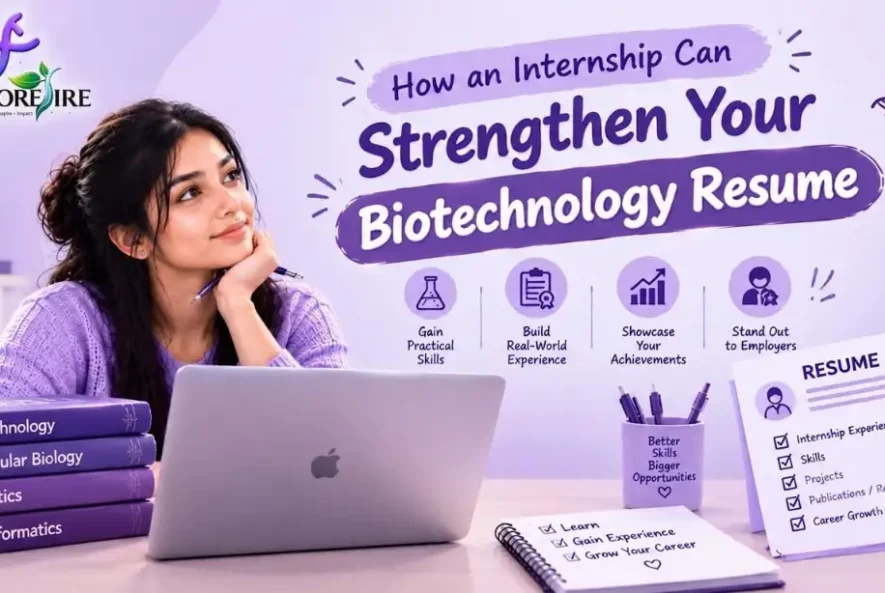
An internship can strengthen your biotechnology resume by helping you develop practical skills, gain research experience, understand professional workflows, and identify your career interests.
It can also give you specific examples to discuss during interviews and help you explain how your academic knowledge applies to real scientific work.
To make the most of an internship, choose a relevant project, learn actively, document your responsibilities, ask for feedback, and describe your experience honestly on your resume.
Remember that an internship does not guarantee a job. However, a well-chosen opportunity combined with relevant skills, academic knowledge, and consistent learning can help you present a stronger and more credible biotechnology profile.
## Frequently Asked Questions
### 1. How does an internship improve a biotechnology resume?
An internship can add practical experience, technical skills, project work, research exposure, and examples of professional responsibilities to your resume.
### 2. Which internships are useful for biotechnology students?
Research laboratory, pharmaceutical, microbiology, molecular biology, quality control, diagnostics, and bioinformatics internships may be useful, depending on your career goals.
### 3. Can an internship help MSc Biotechnology students get a job?
It can strengthen a student’s profile by providing relevant skills and project experience. Job selection still depends on qualifications, demonstrated ability, vacancies, and employer requirements.
### 4. What skills should I mention from my biotechnology internship?
Mention relevant techniques, tools, data analysis, documentation, safety procedures, and project responsibilities that you genuinely practiced.
### 5. How should I describe an internship on my resume?
Include the internship title, organization, dates, project topic, actual responsibilities, tools used, and meaningful outcomes where applicable.
### 6. Is an internship certificate enough to strengthen a resume?
A certificate documents participation, but explaining what you learned and contributed provides more useful information to a recruiter or research supervisor.
### 7. Can a bioinformatics internship help a biotechnology student?
Yes. It may help students develop skills in biological databases, sequence analysis, data interpretation, and computational tools, depending on the project.
### 8. What should I do if I have no internship experience?
Start with academic projects, relevant online learning, practical workshops, and small research exercises. Apply for suitable opportunities and document your work accurately.
## Internal Link Suggestions
Add links to relevant BioResire articles when available:
– Best Bioinformatics Internship Opportunities for BSc and MSc Students
– What Do You Actually Learn in a Bioinformatics Internship?
– How to Approach Research Labs for MSc Dissertation Projects
– Bioinformatics Projects for Beginners
– How to Get a Job in Biotechnology Without Experience
– RNA-Seq Data Analysis: Workflow, Tools, and Applications
## External Resource Suggestions
Use trustworthy resources for career and technical learning:
– NCBI: https://www.ncbi.nlm.nih.gov/
– PubMed: https://pubmed.ncbi.nlm.nih.gov/
– UniProt: https://www.uniprot.org/
– Ensembl: https://www.ensembl.org/
– Official university career and internship pages.
– Official research institute internship announcements.