
Introduction
Biotechnology students often look for internships to gain practical experience, improve their technical skills, and prepare for future careers. However, one common question is whether to choose a summer internship or a final year internship in biotechnology. Both options provide valuable learning opportunities, but they serve different purposes depending on a student’s academic stage, career goals, and available time.
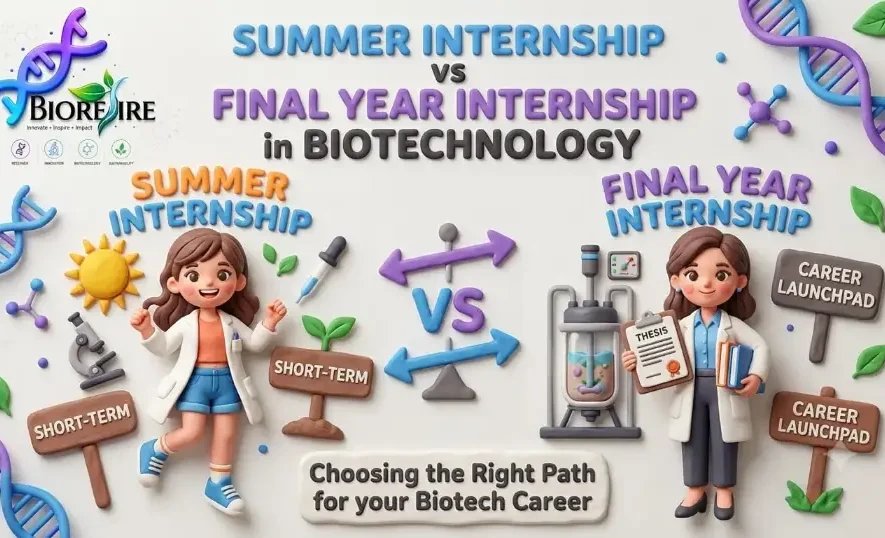
A summer internship is usually completed during the summer vacation or an academic break. A final year internship is generally completed during the last year or final semester of a degree program and may be connected to a dissertation, research project, or industrial training requirement.
Understanding the difference between a summer internship and a final year internship in biotechnology can help students choose an opportunity that matches their goals. This guide explains their duration, benefits, practical experience, project work, career value, and important factors to consider before applying.
## What Is a Summer Internship in Biotechnology?
A summer internship in biotechnology is a short-term training program completed during an academic break. It allows students to explore biotechnology laboratories, research institutes, pharmaceutical companies, diagnostic laboratories, or bioinformatics organizations without interrupting their regular semester schedule.
These internships are useful for students who want to understand how biotechnology concepts are applied in practical settings.
Depending on the organization, a summer internship may focus on laboratory techniques, research methods, computational biology, industrial processes, or data analysis.
### Common Activities in a Summer Internship
Students may participate in activities such as:
– Learning basic laboratory safety and good laboratory practices.
– Understanding DNA extraction and PCR workflows.
– Observing gel electrophoresis and molecular biology experiments.
– Learning microbiology techniques and microbial culture handling.
– Exploring cell culture concepts where suitable training facilities are available.
– Practising basic bioinformatics tools and biological database searches.
– Understanding scientific literature and research papers.
– Preparing a short internship report or presentation.
The activities depend on the internship provider, available facilities, training duration, and the student’s existing knowledge. Some programs offer hands-on work, while others focus mainly on demonstrations, lectures, or guided projects.
### Who Should Choose a Summer Internship?
A summer internship may be suitable for:
– BSc Biotechnology students who want early practical exposure.
– MSc Biotechnology students exploring different research areas.
– Students interested in molecular biology, microbiology, genetics, or bioinformatics.
– Beginners who want to understand laboratory and research environments.
– Students who want to strengthen their resumes before applying for longer internships.
A summer internship can help students identify their interests before committing to a longer research or dissertation project.
## What Is a Final Year Internship in Biotechnology?
A final year internship in biotechnology is a longer or more focused training experience completed during the final year or final semester of a degree program. In many courses, students undertake a research project, dissertation, industrial training program, or laboratory placement as part of their academic requirements.
The exact structure depends on the university, department, course regulations, and internship provider.
Unlike a short introductory internship, a final year internship may allow students to investigate a research question, work with a supervisor, analyse results, and prepare a detailed project report.
### Common Activities in a Final Year Internship
A final year biotechnology internship may involve:
– Selecting or receiving a research project topic.
– Reviewing scientific literature related to the project.
– Developing research objectives under a supervisor’s guidance.
– Learning appropriate experimental or computational methods.
– Collecting and analysing research data.
– Maintaining laboratory records or computational project documentation.
– Interpreting results and identifying limitations.
– Preparing a dissertation, project report, poster, or presentation.
– Discussing findings with a supervisor or research team.
Some internships also provide exposure to quality control, quality assurance, pharmaceutical production, clinical research support, or biotechnology industry workflows.
Students should confirm the project requirements and supervision arrangements before accepting an offer.
### Who Should Choose a Final Year Internship?
A final year internship may be appropriate for:
– Students who need to complete a dissertation or academic project.
– MSc Biotechnology students preparing for their final semester.
– Students planning to apply for research assistant positions.
– Students interested in pursuing a PhD or further research training.
– Students seeking more substantial project experience for future job applications.
A well-structured final year internship can help students demonstrate their ability to work on a defined project and communicate scientific findings.
## Summer Internship vs Final Year Internship in Biotechnology
The main difference is the purpose and depth of the training. A summer internship often introduces students to practical skills and possible career paths, whereas a final year internship may focus on completing a substantial project or dissertation.
The following comparison highlights the major differences.
### 1. Duration
A summer internship is often shorter and may last a few weeks to two or three months. Some programs offer different schedules.
A final year internship may last several months, depending on the academic calendar, research objectives, and university requirements.
Always confirm the exact dates and working hours before applying.
### 2. Main Objective
The main objective of a summer internship is usually to provide practical exposure, introduce new techniques, and help students explore a field.
The main objective of a final year internship may be to complete a project, develop research skills, produce a dissertation, or gain industry-specific experience.
### 3. Learning Experience
Summer internships may introduce several topics in a short period. Students can explore different areas before choosing a specialization.
Final year internships may provide more time to understand one topic, follow a defined workflow, analyse findings, and discuss results with a supervisor.
However, the quality of learning depends more on the training design and mentorship than on duration alone.
### 4. Research Project Opportunities
A summer internship may include a mini-project, practical exercises, or a guided assignment.
A final year internship may involve a more detailed research project with objectives, methods, results, discussion, and conclusions.
Students should ask whether the internship includes an actual project or only general training.
### 5. Academic Requirements
Summer internships are commonly arranged during vacation periods and may be optional.
Final year internships may be connected to university project requirements. Some departments require approval, a specific duration, a faculty guide, or a prescribed report format.
Students should obtain approval from their department before joining an external internship intended to fulfil academic requirements.
### 6. Resume Value
Both internships can strengthen a biotechnology resume when they provide meaningful experience.
A summer internship can demonstrate initiative, basic technical exposure, and interest in a particular subject.
A final year internship can demonstrate project ownership, data interpretation, problem-solving, and scientific communication when these activities are genuinely part of the work.
Employers and research supervisors usually benefit more from specific evidence of skills than from the internship title alone.
### 7. Career Exploration
Summer internships are useful for exploring different career areas, such as molecular biology, microbiology, bioinformatics, pharmaceutical biotechnology, and industrial biotechnology.
Final year internships can help students build experience in a field they have already selected.
Students who are uncertain about their career direction may benefit from early exposure before choosing a specialized final year project.
## Benefits of a Summer Internship in Biotechnology
A summer internship can be valuable even if it is short. The most important benefit is the opportunity to connect classroom learning with practical applications.
### 1. Early Practical Exposure
Students can understand how laboratory procedures, scientific instruments, and research workflows operate in real settings.
This experience may make subjects such as genetics, molecular biology, microbiology, and biochemistry easier to understand.
### 2. Opportunity to Explore Different Fields
Biotechnology includes many specializations. A summer internship can help students discover whether they prefer experimental research, computational analysis, industrial processes, or quality-related work.
Exploring these areas early can help students make more informed decisions about advanced training.
### 3. Technical Skill Development
Depending on the program, students may learn laboratory documentation, experimental planning, biological database searching, data analysis, or scientific presentation.
These skills can become useful when applying for further internships or research projects.
### 4. Networking With Researchers
Students may meet research scholars, laboratory professionals, faculty members, and industry employees.
Maintaining professional relationships can help students learn about future training opportunities, research areas, and application requirements.
### 5. Improved Resume
A relevant summer internship can show that a student has actively explored practical learning outside regular coursework.
Students should describe their actual tasks, techniques, project work, and learning outcomes instead of listing only the organization’s name.
## Benefits of a Final Year Internship in Biotechnology
A final year internship can be especially useful for students preparing for employment, higher education, or research careers.
### 1. Deeper Research Experience
A longer project may give students more time to understand a research question, study previous findings, learn methods, and interpret data.
This experience can develop scientific thinking and help students understand how research progresses from a question to a conclusion.
### 2. Dissertation and Project Development
When approved by the university, a final year internship can support dissertation work or an academic project.
Students may gain experience in writing a literature review, explaining methods, presenting results, and discussing limitations.
Before joining, confirm that the organization can meet your department’s project requirements and documentation deadlines.
### 3. Better Understanding of Research Methods
Students may gain experience in planning tasks, following protocols, maintaining records, and evaluating results.
Computational projects may include data cleaning, sequence analysis, biological database searches, statistical analysis, or visualizing results, depending on the project’s scope.
### 4. Career Preparation
A project-based internship can help students prepare for interviews by giving them a real experience to explain.
Students can discuss the objective of their project, the methods used, challenges faced, and what they learned.
### 5. Preparation for Higher Studies
Students considering a PhD or research-oriented postgraduate opportunities may benefit from experience in literature review, scientific reasoning, project documentation, and research communication.
A strong project does not guarantee admission or employment, but it can help students explain their research interests and demonstrate relevant preparation.
## Which Internship Is Better for BSc and MSc Biotechnology Students?
There is no single best option for every student. The right choice depends on academic level, available time, career interests, and project requirements.
### For BSc Biotechnology Students
A summer internship is often a practical starting point for BSc students who want to explore biotechnology outside the classroom.
Suitable areas may include:
– Basic molecular biology.
– Microbiology and industrial microbiology.
– Biochemistry laboratory practices.
– Introduction to biotechnology research.
– Basic bioinformatics and biological databases.
– Pharmaceutical or food biotechnology, where relevant training is available.
Students should focus on learning foundational techniques, laboratory safety, and scientific documentation.
A short internship can also help students identify the skills they want to develop during an MSc program.
### For MSc Biotechnology Students
MSc students may benefit from both summer and final year internships, depending on their academic schedule.
A summer internship can help MSc students gain exposure to a new technique or research area before beginning a major project.
A final year internship may be more suitable when the student needs to complete a dissertation, build a substantial project, or gain focused experience in a chosen specialization.
Students interested in bioinformatics may consider projects involving sequence analysis, gene expression data, biological databases, or other computational methods. Students interested in experimental biotechnology may explore molecular biology, microbiology, cell biology, or related laboratory research.
The important point is to choose an internship that matches the student’s learning objectives and provides appropriate supervision.
## How to Choose the Right Biotechnology Internship
Before applying, compare opportunities based on the quality of training rather than duration or organization name alone.
### 1. Define Your Goal
Ask yourself what you want to achieve.
Do you want to learn laboratory techniques, explore a career area, complete a dissertation, develop computational skills, or prepare for a research position?
A clear goal helps you shortlist relevant programs.
### 2. Check the Training Content
Read the internship description carefully. Look for specific techniques, project topics, software, instruments, or learning outcomes.
Be cautious if the program promises extensive practical experience but does not explain what students will actually do.
### 3. Confirm the Hands-On Experience
Ask whether students will perform experiments, observe demonstrations, work on datasets, or attend lectures.
All these formats can support learning, but they provide different types of experience.
Do not assume that an internship certificate means you have independently performed every technique listed in a course description.
### 4. Evaluate Mentorship
Good supervision helps students understand methods, correct mistakes, interpret findings, and learn professional practices.
Ask whether a mentor or supervisor will be assigned and how often feedback will be provided.
### 5. Check Project Opportunities
For a final year internship, confirm whether a defined project is available and whether the organization supports academic documentation.
If your university requires a dissertation, check the eligibility conditions, project approval process, evaluation method, and submission timeline in advance.
### 6. Consider Cost and Stipend
Some internships are paid, some are unpaid, and some charge training fees.
Review the total cost, including travel, accommodation, materials, and any certificate or training charges.
Never assume that a program is paid simply because it is described as an internship. Confirm the stipend, payment schedule, and other conditions in writing.
### 7. Verify the Organization
Review the official website, faculty or mentor profiles, project details, eligibility criteria, and contact information.
Be careful with programs that make unrealistic promises about guaranteed jobs, publications, or research outcomes.
### 8. Apply Early
Research internships may have limited seats and fixed application deadlines. Prepare your resume, academic details, statement of interest, and any required documents in advance.
Applying early gives you more time to compare opportunities and arrange university approval.
## How to Make Your Internship Useful for Your Resume
Completing an internship is only one part of professional development. You should also be able to explain what you learned and how you applied it.
Use these steps to get more value from the experience.
**1. Maintain a learning record.** Write down the techniques, tools, project tasks, and concepts you learned.
**2. Understand the purpose of each method.** Do not memorise only the names of techniques. Learn why a method is used, what results it produces, and what its limitations are.
**3. Participate actively.** Ask relevant questions, request feedback, and follow laboratory or data-handling guidelines.
**4. Document your project.** Maintain appropriate records of objectives, methods, observations, analysis, and conclusions, following the organization’s rules.
**5. Prepare a project summary.** Explain the problem, your contribution, the methods used, and the key learning outcomes.
**6. Update your resume accurately.** Include only techniques and responsibilities you actually experienced. Distinguish between observing a technique, assisting with it, and performing it independently.
**7. Practise explaining your work.** Prepare a short explanation of your project for future interviews or academic discussions.
These steps help turn an internship into useful evidence of practical learning.
## Common Mistakes to Avoid When Selecting an Internship
Students sometimes select internships based only on the certificate, duration, or reputation of the organization. This can lead to a poor learning experience.
Avoid these common mistakes:
– Choosing an internship without checking its learning objectives.
– Assuming every program offers hands-on laboratory experience.
– Ignoring university approval requirements for dissertation projects.
– Applying without checking eligibility and deadlines.
– Paying fees without understanding what the program provides.
– Selecting a project unrelated to your interests or career plans.
– Expecting an internship to guarantee a job or publication.
– Listing techniques on a resume that you have not actually performed.
– Waiting until the final semester to search for a project.
– Failing to keep project records and prepare a clear summary of your work.
A carefully selected internship with good supervision can be more useful than a longer program that offers limited learning opportunities.
## Frequently Asked Questions
### 1. Which is better: a summer internship or a final year internship in biotechnology?
A summer internship is often better for short-term exposure and exploring different fields. A final year internship may be better for dissertation work or a more focused research project. The best option depends on your academic requirements and career goals.
### 2. Can BSc Biotechnology students apply for summer internships?
Yes. Many training programs accept undergraduate students, but eligibility varies by organization. Check the required academic level, prerequisites, duration, and application documents before applying.
### 3. Is a final year internship compulsory for MSc Biotechnology students?
Not in every program. Requirements vary by university and course regulations. Check your department’s curriculum and dissertation guidelines to confirm whether an internship or external project is compulsory.
### 4. How long does a biotechnology internship usually last?
Duration varies by program. A summer internship may last a few weeks to a few months, while a final year project may extend across several months. Always verify the official schedule.
### 5. Can a summer internship help with a final year dissertation?
Yes. A summer internship can help students develop foundational skills and identify research interests. However, it counts toward a dissertation only if the university and relevant project supervisor approve it.
### 6. Do biotechnology internships provide stipends?
Some internships offer stipends, while others are unpaid or charge training fees. Read the official terms and confirm all payment conditions before accepting an offer.
### 7. Which internship is more valuable for a biotechnology resume?
Both can be valuable. The most useful internship provides relevant learning, meaningful responsibilities, good supervision, and clearly explainable outcomes. Duration alone does not determine resume value.
### 8. Can a bioinformatics internship be useful for biotechnology students?
Yes. Bioinformatics internships can introduce students to biological databases, sequence analysis, computational tools, and biological data interpretation. The best program depends on the student’s background and the actual project content.
### 9. What should students check before joining a final year internship?
Students should confirm project availability, supervision, duration, eligibility, university approval, report requirements, fees or stipend, and submission deadlines.
### 10. When should students start applying for internships?
Students should begin searching well before their intended start date. Some organizations announce fixed deadlines, while others accept applications according to available projects and supervisors. Early preparation allows time to compare opportunities and complete required paperwork.
## Conclusion
Choosing between a summer internship and a final year internship in biotechnology depends on what you want to learn and what your academic program requires.
A summer internship can provide early practical exposure, introduce different biotechnology specializations, and help students develop foundational skills. A final year internship can offer a more focused project experience, support dissertation work when approved, and help students prepare for research or industry roles.
For BSc students, a summer internship can be a useful way to explore biotechnology careers. For MSc students, a summer internship may help build skills before a major project, while a final year internship may provide the time and structure needed for deeper research experience.
Before choosing, compare the training content, project opportunities, supervision, duration, cost, stipend conditions, and academic requirements. Focus on what you will learn and be able to explain afterward.
A well-chosen biotechnology internship is not just a certificate for your resume. It is an opportunity to develop practical skills, understand scientific work, and make more informed decisions about your future career.
## Suggested Internal Links
Add links to relevant existing BioResire articles:
– Best Bioinformatics Internship Opportunities for BSc and MSc Students
– What Do You Actually Learn in a Bioinformatics Internship?
– How an Internship Can Strengthen Your Biotechnology Resume
– How to Approach Research Labs for MSc Dissertation Projects
– Common Mistakes Students Make in Their Dissertation
## Suggested External Resources
Use official sources relevant to the article and verify the specific pages before publishing:
– CSIR: https://www.csir.res.in/
– Department of Biotechnology, Government of India: https://dbtindia.gov.in/
– Indian Institute of Science: https://iisc.ac.in/
– National Centre for Biological Sciences: https://www.ncbs.res.in/
– National Institute of Biomedical Genomics: https://www.nibmg.ac.in/