
Introduction
CRISPR-Cas9 is one of the most important discoveries in modern biology. It has changed the way scientists study genes and opened new possibilities in medicine, agriculture, and biotechnology. Although the name sounds complex, the idea behind CRISPR-Cas9 is simple. It is a tool that allows scientists to edit DNA in a precise and controlled way.
For students in life sciences, understanding CRISPR-Cas9 is essential because it represents the future of genetic engineering. It helps us understand how genes can be modified to solve real-world problems, from treating diseases to improving crops.
In this blog, you will learn what CRISPR-Cas9 is, how it works, why it is important, and how it is used in real life.
What is CRISPR-Cas9
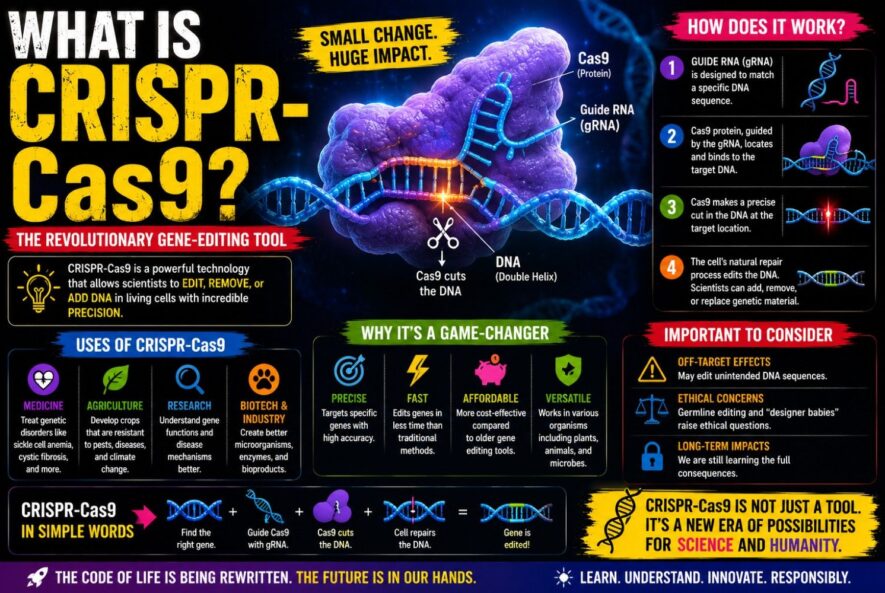
CRISPR-Cas9 is a gene-editing technology that allows scientists to cut and modify DNA at specific locations. It is often compared to a pair of molecular scissors that can precisely target a particular part of the genetic code.
CRISPR refers to a special sequence found in bacterial DNA that helps bacteria defend against viruses. Cas9 is a protein that acts like scissors to cut DNA. When combined, they form a powerful system that can locate and edit genes.
In simple words, CRISPR-Cas9 is a tool that helps scientists find a specific DNA sequence, cut it, and make changes to it.
How Does CRISPR-Cas9 Work
The working of CRISPR-Cas9 can be understood in a few simple steps.
First, scientists design a guide RNA that matches the DNA sequence they want to edit. This guide RNA acts like a search tool that finds the exact location in the DNA.
Second, the Cas9 protein binds to this guide RNA and moves along the DNA until it finds the matching sequence. Once it finds the target, Cas9 cuts the DNA at that specific point.
Third, after the DNA is cut, the cell tries to repair it. During this repair process, scientists can introduce changes such as adding new DNA, removing unwanted parts, or correcting errors.
This entire process allows precise editing of genes.
Why CRISPR-Cas9 is Important
CRISPR-Cas9 is important because it has made gene editing faster, cheaper, and more accurate than older techniques. Earlier methods were complicated and time-consuming, but CRISPR allows scientists to make changes in a much simpler way.
This technology has made it possible to study genes in detail, understand diseases at the genetic level, and develop new treatments. It has also made advanced research more accessible to scientists around the world.
Here is your expanded and humanized version with more depth, explanations, and added value, keeping the same clean format and flow:
Applications of CRISPR-Cas9
Medicine
CRISPR is being used to study and treat genetic diseases. Scientists are working on correcting faulty genes that cause disorders such as sickle cell anemia and certain types of cancer. It is also being explored for personalized medicine, where treatments are designed based on a patient’s genetic makeup.
Beyond this, CRISPR is helping researchers understand how diseases develop at the genetic level. By editing specific genes in cells or model organisms, scientists can observe changes and identify the exact cause of a disease. This makes it easier to design targeted therapies.
CRISPR is also being tested in gene therapy, where defective genes are replaced or repaired directly inside the body. In the future, this could lead to permanent cures for many genetic disorders instead of just managing symptoms.
In agriculture, CRISPR is used to develop crops that are more resistant to pests, diseases, and environmental stress. This helps increase food production and improve crop quality.
For example, crops can be modified to tolerate drought, high temperature, or poor soil conditions. This is especially important in regions affected by climate change. CRISPR can also be used to improve nutritional value, such as increasing vitamins or reducing harmful compounds.
Unlike traditional genetic modification, CRISPR allows precise changes without introducing foreign DNA in many cases. This makes it a faster and more efficient approach for crop improvement.
Research
CRISPR is widely used in research to study gene function. By editing genes, scientists can understand what each gene does and how it affects the organism.
Researchers can “turn off” or modify specific genes and observe the results. This helps in identifying gene functions, understanding biological pathways, and discovering new drug targets.
CRISPR has made research faster and more accessible. Earlier, studying genes required complex and time-consuming methods, but now scientists can perform experiments more efficiently.
Biotechnology and Industry
CRISPR is also used in industrial biotechnology for improving microorganisms that produce enzymes, biofuels, and other useful products.
For example, bacteria or yeast can be genetically modified to produce higher amounts of enzymes used in detergents, food processing, or pharmaceuticals. It can also be used to improve biofuel production by making microorganisms more efficient.
In addition, CRISPR is being used in environmental biotechnology, such as developing microbes that can break down pollutants or clean up waste. This shows its potential beyond medicine and agriculture.
Emerging Applications
CRISPR is also expanding into new and innovative areas. It is being explored in diagnostics, where CRISPR-based tools can detect diseases quickly and accurately. It is also being studied for use in synthetic biology, where scientists design new biological systems.
Another exciting area is regenerative medicine, where CRISPR may help repair damaged tissues or organs by modifying cells at the genetic level.
These emerging applications show that CRISPR is not just a current tool but also a future technology with vast potential.
Advantages of CRISPR-Cas9
CRISPR-Cas9 offers several advantages. It is highly precise, which means it can target specific genes without affecting others. It is also faster and more cost-effective compared to older gene-editing methods. The technique is relatively simple to use, making it accessible to many researchers.
One of the biggest advantages is its efficiency. Scientists can design experiments quickly and obtain results in a shorter time. This has accelerated research in many fields.
Another advantage is flexibility. CRISPR can be used in a wide range of organisms, from bacteria to plants to animals. This makes it a universal tool in genetic engineering.
CRISPR also allows multiple genes to be edited at once, which was difficult with older techniques. This is especially useful in complex studies involving multiple pathways or traits.
In addition, its cost-effectiveness has made advanced research more accessible to smaller laboratories and institutions, increasing global participation in scientific discovery.
These advantages have made CRISPR one of the most widely used and transformative tools in genetic engineering.
Final Insight
CRISPR-Cas9 is not just another scientific technique. It is a powerful tool that is transforming medicine, agriculture, research, and industry. Its ability to precisely edit genes has opened new possibilities that were once unimaginable.
Understanding its applications and advantages helps students see the real impact of biotechnology in the modern world and prepares them for future advancements in science.
Limitations and Challenges
Despite its benefits, CRISPR-Cas9 has some limitations. One major concern is off-target effects, where unintended parts of DNA may be edited. There are also ethical concerns related to editing human genes, especially in embryos.
Scientists are continuously working to improve the accuracy and safety of this technology. Proper guidelines and regulations are important to ensure responsible use.
Real-Life Example
Consider a genetic disease caused by a faulty gene. Using CRISPR-Cas9, scientists can identify the defective gene, cut it, and replace it with a correct version. This approach has the potential to cure diseases at their root cause rather than just treating symptoms.
Another example is improving crops. Scientists can edit genes in plants to make them more resistant to drought or pests, which helps farmers and increases food security.
Skills Required to Understand CRISPR-Cas9
To understand CRISPR-Cas9, students should focus on basic concepts of molecular biology such as DNA structure, gene expression, and protein synthesis. Knowledge of genetics and biotechnology is also important.
In addition, analytical thinking and problem-solving skills help in understanding how gene editing works and how it is applied in research.
Common Mistakes Students Make
Many students try to memorize the steps of CRISPR without understanding the concept. This makes it difficult to apply the knowledge in exams or practical situations. Some students also ignore the connection between CRISPR and real-world applications.
To avoid this, focus on understanding the basic idea of targeting, cutting, and editing DNA.
How to Study CRISPR-Cas9 Effectively
To study CRISPR effectively, break the concept into simple steps and understand each part clearly. Use diagrams and animations to visualize the process. Practice explaining the concept in your own words. Relating CRISPR to real-life examples can also make learning easier.
Regular revision and active learning will help you remember the concept for a longer time.
FAQs
- What is CRISPR-Cas9 in simple words
It is a tool used to edit DNA by cutting and modifying genes. - Why is CRISPR important
It allows precise gene editing for research, medicine, and agriculture. - What does Cas9 do
Cas9 cuts DNA at a specific location. - Can CRISPR cure diseases
It has the potential to treat genetic diseases by correcting faulty genes. - Is CRISPR safe
It is still being studied to improve accuracy and ensure safe use.
Conclusion
CRISPR-Cas9 is a powerful gene-editing technology that has transformed modern biology. It allows scientists to make precise changes in DNA and has opened new possibilities in medicine, agriculture, and research.
For students, understanding CRISPR-Cas9 is important because it represents the future of biotechnology and genetic engineering. It is not just a concept to study, but a tool that is shaping the future of science.
Call to Action
Don’t wait for oppurtunities
- Start building your understanding today
- Focus on concepts, practice regularly, and stay curious.
Join BioResire and take your first step toward mastering modern biotechnology.
Email: info@bioresire.in
Phone / WhatsApp: 6301352398
BioResire Quote:
The ability to edit genes is powerful, but the ability to understand them is what truly creates change.