Introduction
Finding a suitable dissertation project is an important step in completing an MSc degree. For students studying Biotechnology, Microbiology, Biochemistry, Genetics, Molecular Biology, Bioinformatics, and other life science subjects, a dissertation provides an opportunity to apply theoretical knowledge to practical research.
However, many students face one common problem: they do not know how to approach research labs for MSc dissertation projects. Some students wait for their colleges to provide opportunities, while others send emails without knowing what to write or whom to contact.
The good news is that students can approach university laboratories, research institutes, biotechnology companies, and other scientific organizations directly. A professional email, a clear research interest, and a well-prepared CV can help students communicate their goals effectively.
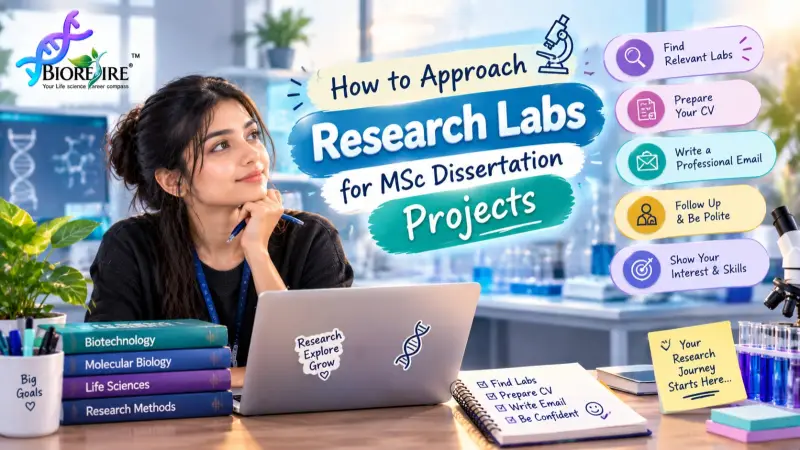
This guide explains how to find research laboratories, identify suitable supervisors, write professional emails, prepare application documents, and improve your chances of securing an MSc dissertation project.
## What Is an MSc Dissertation Project?
An MSc dissertation project is a research-based academic project completed as part of a postgraduate degree. It allows students to investigate a scientific question, learn research techniques, analyze results, and present their findings in a dissertation report.
Depending on the institution and project, students may work in a laboratory, analyze biological data using computational tools, conduct field studies, or perform a combination of experimental and computational research.
For example, Biotechnology students may work on molecular biology, microbial biotechnology, cell culture, genetics, or protein analysis. Students interested in Bioinformatics may work on genomic data analysis, protein structure analysis, RNA sequencing, or biological database research.
A dissertation project helps students develop technical knowledge, critical thinking, scientific writing, and problem-solving skills.
## Why Should MSc Students Approach Research Labs Directly?
Approaching research laboratories directly can help students discover opportunities beyond the options available through their colleges.
Some research groups announce project openings on their websites, while others may consider students who contact them professionally. Availability depends on the laboratory’s research priorities, funding, supervision capacity, and institutional policies.
Here are some important benefits of approaching research labs.
### 1. Gain Practical Research Experience
Students can learn how scientific research is conducted in a professional environment. Depending on the project, this may include laboratory experiments, data collection, bioinformatics analysis, scientific documentation, and result interpretation.
### 2. Learn Advanced Techniques
Research laboratories may provide exposure to techniques such as PCR, gel electrophoresis, microbial culture, microscopy, chromatography, cell culture, sequencing analysis, or computational biology tools.
The techniques available depend on the laboratory and the student’s assigned project.
### 3. Improve Your Research Profile
A well-planned dissertation project can strengthen your CV and help you explain your research interests during future academic or job applications.
### 4. Explore Future Career Opportunities
Working with a research group can help students understand whether they want to pursue research positions, a PhD, biotechnology industry roles, or computational life science careers.
### 5. Build Professional Connections
Communicating with researchers and supervisors can help students develop professional relationships and learn about future research opportunities.
## Step 1: Decide Your Research Area Before Contacting Labs
The first step is to identify the research area that matches your academic background and interests.
Do not send the same general request to every laboratory. Researchers are more likely to understand your application when you explain the type of project you are looking for.
Consider these research areas:
### Biotechnology
Suitable topics may include molecular biotechnology, recombinant DNA technology, industrial biotechnology, and microbial biotechnology.
### Molecular Biology and Genetics
Possible areas include gene expression, DNA analysis, genetic variation, molecular diagnostics, and gene regulation.
### Microbiology
Students may explore microbial identification, antimicrobial resistance, microbial biotechnology, environmental microbiology, or industrial microorganisms.
### Bioinformatics and Computational Biology
Projects may involve biological sequence analysis, protein structure analysis, genomics, transcriptomics, molecular docking, or biological database research.
### Cell Biology and Stem Cell Research
Depending on the laboratory, students may explore cell signaling, cellular processes, stem cell biology, or cell culture methods.
### Cancer Biology and Genomics
Possible research areas include cancer-associated genes, gene expression, molecular pathways, and genomic data analysis.
Before choosing a laboratory, read about its current research projects and determine whether its work matches your interests and academic requirements.
## Step 2: Find Suitable Research Laboratories
After selecting your research area, prepare a list of laboratories that may offer relevant projects.
### A. University Research Departments
Contact university departments that conduct research in your subject. Explore faculty profiles, research publications, laboratory pages, and department announcements.
Look for faculty members whose research interests match your dissertation goals.
### B. Government Research Institutes
Explore national and regional research institutions working in biotechnology, life sciences, microbiology, agriculture, biomedical research, and related disciplines.
Read each institute’s official project and student-training guidelines. Some institutions offer formal dissertation programs, while others accept applications only through specific notifications.
### C. Research Centres and Specialized Laboratories
Some research centres focus on particular areas such as genomics, cancer biology, structural biology, neuroscience, infectious diseases, or computational biology.
These centres may be suitable when you already have a clear research interest.
### D. Biotechnology and Pharmaceutical Companies
Biotechnology companies, pharmaceutical organizations, and contract research organizations may offer research training or dissertation opportunities in areas such as molecular biology, microbiology, quality control, analytical techniques, and bioinformatics.
Check whether the company accepts academic dissertation projects and whether the work satisfies your university’s requirements.
### E. Official Websites and Research Publications
Use the following resources to identify laboratories and researchers:
1. Official university and research institute websites.
2. Faculty research profiles.
3. PubMed for biomedical research publications.
4. Google Scholar for researcher publications.
5. LinkedIn for professional profiles and publicly announced opportunities.
6. Official internship and dissertation notifications.
When you identify a relevant paper, read its abstract and note the corresponding author’s research affiliation. Visit the institution’s official website to find the researcher’s professional contact details.
## Step 3: Check Whether the Laboratory Is Suitable
Before emailing a scientist, investigate the laboratory carefully.
Check the following points:
– Research areas and ongoing projects.
– Recent publications and scientific interests.
– Whether MSc students are eligible to apply.
– Minimum project duration.
– Available project dates.
– Application deadlines.
– Required academic documents.
– Whether the project is paid, unpaid, or fee-based.
– Whether the laboratory can support an external dissertation.
– Whether a project completion certificate or formal evaluation is provided.
Do not assume that every laboratory accepts external students. Some institutes have strict eligibility requirements, limited seats, or fixed application periods.
Also, verify whether your university permits an external dissertation and whether it requires an approval letter, a supervisor’s consent, a project proposal, or a formal agreement.
## Step 4: Prepare a Professional CV
Your CV is one of the first documents a researcher may review when considering your application.
Keep it clear, relevant, and preferably one or two pages long, depending on your experience.
Include these sections:
### Personal and Contact Information
Mention your professional email address, phone number, and current city if relevant. Avoid including unnecessary sensitive personal information.
### Educational Qualifications
List your postgraduate degree, undergraduate degree, and other relevant qualifications. Include your institution, subject, and marks or grades when appropriate.
### Research Interests
Mention two or three relevant areas, such as molecular biology, biotechnology, genomics, microbiology, or bioinformatics.
### Technical Skills
List only the techniques and tools you genuinely know. Separate practical laboratory experience from theoretical familiarity.
For example:
– PCR and gel electrophoresis, if you have practical experience.
– BLAST and biological database searching, if you have used them.
– R or Python, if you have relevant coding experience.
– Sequence analysis tools, if you have completed related training or projects.
### Internships and Projects
Include previous internships, academic projects, workshops, research training, or relevant assignments.
Clearly describe your responsibilities and what you learned. Never claim laboratory experience or technical proficiency you do not have.
### Certifications and Achievements
Add relevant courses, workshops, presentations, and academic achievements when they strengthen your application.
Save the CV as a PDF with a professional filename, such as:
MSc_Dissertation_CV_YourName.pdf
## Step 5: Write a Professional Email to the Research Supervisor
Email is one of the most practical ways to approach a research scientist or laboratory supervisor.
Your email should be polite, specific, and easy to understand. Avoid sending very long messages or writing only, “Sir/Madam, I need an internship. Please help me.”
A good email should communicate who you are, what you want, why you selected that laboratory, and when you are available.
### What Should You Include in the Email?
**Subject line:** Request for MSc Dissertation Project Opportunity in Biotechnology
**Greeting:** Address the researcher respectfully using their correct title and surname, when known.
**Introduction:** Briefly mention your degree, institution, and current semester.
**Research interest:** Explain why the laboratory’s research interests match your goals. Refer to a relevant research area or publication when appropriate.
**Project request:** State that you are seeking an MSc dissertation opportunity and mention your proposed project period.
**Attachments:** Attach your CV and any other documents specifically requested by the laboratory.
**Closing:** Thank the researcher for their time and consideration.
### Sample Email for an MSc Dissertation Project
Subject: Request for MSc Dissertation Project Opportunity in Biotechnology
Dear Professor [Surname],
I hope you are doing well.
My name is [Your Name], and I am pursuing an MSc in Biotechnology at [University Name]. I am looking for a research laboratory to complete my MSc dissertation project during [Project Period].
I am particularly interested in [Research Area], and I found your laboratory’s work on [Specific Research Topic] relevant to my academic interests. I would be grateful for an opportunity to work under your guidance and develop my research skills.
I have attached my CV for your consideration. Please let me know if there are any available dissertation opportunities and whether I should provide any additional documents.
Thank you for your time and consideration.
Kind regards,
[Your Name]
[MSc Biotechnology, University Name]
[Email Address]
[Phone Number]
Before sending the email, replace every placeholder with accurate information. Do not mention a research paper or laboratory project unless you have actually reviewed it.
## Step 6: Contact the Right Person
Sending your email to the correct person can improve the chances of receiving a relevant response.
Depending on the institution, you may contact:
– Principal Investigator (PI).
– Professor or faculty member.
– Research scientist.
– Laboratory head.
– Project coordinator.
– Official internship or dissertation program coordinator.
If the laboratory has a formal application portal, follow that process first. An email may be useful for clarification, but it should not replace required application procedures.
Avoid emailing many people in the same institution with identical messages at the same time. Prepare a targeted application for each relevant laboratory.
## Step 7: Follow Up Professionally
Researchers may receive many emails and may not respond immediately. A delayed response does not necessarily mean that your application has been rejected.
If you do not receive a reply, consider sending one polite follow-up after approximately five to seven working days, unless the institution specifies a different timeline.
### Sample Follow-Up Email
Subject: Follow-Up on MSc Dissertation Project Request
Dear Professor [Surname],
I hope you are doing well.
I am writing to follow up on my previous email regarding an MSc dissertation project opportunity in your laboratory.
I remain interested in your research area and would be grateful if you could let me know whether any suitable opportunities are available.
Thank you for your time.
Kind regards,
[Your Name]
If there is no response after the follow-up, continue exploring other suitable laboratories. Avoid repeatedly messaging the same researcher within a short period.
## Step 8: Prepare a Short Research Proposal
Some laboratories may ask students to suggest a project topic or submit a short proposal.
A proposal demonstrates that you have thought about the research question and understand the basic purpose of the project.
A simple proposal can include:
### 1. Title
Choose a specific and understandable research title.
### 2. Background
Explain the scientific problem and why it matters.
### 3. Research Question
State what you want to investigate.
### 4. Objectives
List the main aims of the project.
### 5. Proposed Methodology
Describe the general experimental or computational approach. Do not claim that a method is feasible without checking the laboratory’s resources and supervisor’s guidance.
### 6. Expected Outcomes
Explain what the project may help you understand. Avoid promising specific results before the research has been conducted.
### 7. Timeline
Provide a realistic schedule based on your university’s dissertation duration.
For example, a computational biology project may involve literature review, data collection, analysis, interpretation, and report preparation. A wet-lab project may require additional time for training, experimental optimization, sample processing, and validation.
Always allow the supervisor to refine the topic according to the laboratory’s priorities and available resources.
## Step 9: Understand Stipends, Fees, and Project Conditions
Not every dissertation opportunity provides a stipend. Some projects are funded, some are unpaid, and some training programs charge fees.
Before accepting an offer, ask for written clarification about:
– Stipend or financial support, if any.
– Tuition or training fees, if applicable.
– Project duration and working hours.
– Accommodation or travel support, if relevant.
– Supervisor availability.
– Laboratory access and training.
– Certificate and evaluation requirements.
– Dissertation ownership, confidentiality, and publication policies.
Be cautious if an organization promises guaranteed research publications, demands large unexplained payments, or offers a position without clearly explaining the project.
Verify the organization’s official identity and contact details. Discuss any proposed fees with your college before making a payment.
## Step 10: Prepare for an Interview or Discussion
Some supervisors may arrange a short online or in-person discussion before accepting a student.
Prepare to answer questions such as:
1. Why do you want to work in our laboratory?
2. What research areas interest you?
3. What do you know about our current research?
4. Which laboratory or computational techniques have you learned?
5. What is your dissertation submission deadline?
6. How long can you work on the project?
7. What do you hope to learn from the experience?
Review the fundamentals of your chosen research area and be honest about your technical abilities.
If you do not know an answer, explain what you understand and show your willingness to learn. Supervisors may value curiosity, reliability, and a realistic understanding of your skills.
## Common Mistakes to Avoid When Contacting Research Labs
### 1. Sending Generic Emails
A message that could be sent to any laboratory may not communicate genuine interest. Personalize each email using accurate information about the research group.
### 2. Attaching an Unprofessional CV
Spelling errors, unclear formatting, irrelevant information, and exaggerated skills can weaken an application. Proofread your CV before sending it.
### 3. Applying Without Checking Eligibility
Some opportunities are limited to particular degrees, institutions, semesters, or project durations. Read the requirements before applying.
### 4. Waiting Until the Last Minute
Research projects may require approvals, selection procedures, safety training, and administrative paperwork. Start early and check your university’s deadlines.
### 5. Exaggerating Technical Skills
Do not claim experience with advanced instruments or software simply because you attended a workshop. Clearly distinguish hands-on experience from basic theoretical knowledge.
### 6. Ignoring College Requirements
An external laboratory may be willing to host you, but your university may require formal approval or a specific supervisor arrangement. Confirm these requirements before accepting.
### 7. Following Up Too Frequently
Repeated messages can appear unprofessional. Send a concise follow-up and then allow the researcher time to respond.
### 8. Accepting Without Clarifying the Conditions
Confirm the project topic, duration, supervision, costs, and required documentation before committing.
## A Practical Timeline for Finding an MScDissertation Project
The following is a suggested plan. Adjust it according to your university’s academic calendar and the deadlines of individual laboratories.
**Week 1: Research planning**
Choose your research area, review your university’s dissertation rules, and prepare a list of suitable laboratories.
**Week 2: Application preparation**
Read about each laboratory, prepare your CV, and draft personalized emails.
**Week 3: Applications and communication**
Submit applications according to official instructions. Record the date of each application and any response received.
**Week 4: Follow-ups and discussions**
Send appropriate follow-up emails, attend interviews if invited, and clarify project requirements.
**After selection: Formal approval**
Obtain written confirmation, complete institutional paperwork, and confirm your start date before beginning the project.
This timeline is only a planning example. Some research opportunities require applications months in advance, while others follow fixed annual selection cycles.
## Final Checklist Before Sending Your Application
Use this checklist to make sure your application is ready.
– I have identified a relevant research laboratory.
– I have checked the laboratory’s research interests.
– I have verified the application requirements.
– I have prepared an updated CV in PDF format.
– I have written a personalized email.
– I have mentioned my project duration and availability.
– I have checked my university’s dissertation rules.
– I have attached the required documents.
– I have checked the researcher’s name and email address.
– I have saved the application details for follow-up.
## Conclusion
Learning how to approach research labs for MSc dissertation projects can help students take a more active role in their academic and professional development.
Start by identifying your research interests, finding laboratories that match those interests, and reviewing their official requirements. Prepare a clear CV, write a professional and personalized email, and explain your availability honestly.
Remember that receiving a dissertation opportunity depends on several factors, including eligibility, project availability, research funding, supervision capacity, and institutional rules. A carefully prepared application cannot guarantee selection, but it can help you present your qualifications and interests professionally.
Most importantly, start early, remain consistent, and continue applying to suitable laboratories. A well-matched dissertation project can provide valuable researchexperience and help you prepare for future opportunities in biotechnology, life sciences, bioinformatics, and related fields.
## Frequently Asked Questions (FAQs)
### 1. How can I find research labs for an MSc dissertation?
Search official university and research institute websites, faculty profiles, research publications, and formal internship announcements. Identify laboratories that work in your preferred research area and check their eligibility requirements.
### 2. When should I contact research labs for my dissertation?
Start several months before your expected project start date whenever possible. Some institutions have fixed deadlines or selection cycles, so check their official announcements early.
### 3. How do I email a professor for an MSc dissertation project?
Introduce yourself, mention your degree and institution, explain your research interests, refer to the laboratory’s relevant work, and ask whether a suitable dissertation opportunity is available. Attach your CV and follow the institution’s application instructions.
### 4. Can MSc Biotechnology students apply for external dissertation projects?
Yes, some research institutions and laboratories accept external MSc Biotechnology students. Eligibility depends on the institution, available projects, academic requirements, and approval from the student’s university.
### 5. Do research laboratories provide stipends for dissertation projects?
Some funded projects or training programs provide stipends, while others are unpaid or charge fees. Check the official conditions and obtain written clarification before accepting an opportunity.
### 6. What documents are required to apply for a dissertation project?
Commonly requested documents include a CV, academic transcripts, a student or bonafide certificate, a statement of research interests, a recommendation letter, or a project proposal. The exact requirements vary by institution.
### 7. What should I do if a professor does not reply to my email?
Wait approximately five to seven working days before sending one polite follow-up, unless the institution specifies otherwise. Continue exploring other suitable laboratories instead of depending on one application.
### 8. Can I approach a research lab without previous research experience?
Yes. Some laboratories consider students who have limited research experience but demonstrate relevant academic knowledge, genuine interest, and willingness to learn. However, selection depends on the project’s requirements and the supervisor’s decision.
## Internal Link Suggestions
Add relevant links to other BioResire articles where appropriate:
– Bioinformatics Projects for Beginners
– RNA-Seq Data Analysis: Workflow, Tools, and Applications
– Identification of Disease-Associated Genes Using Public Databases
– Research Poster Using Free AI Tools
– How to Write a Research Paper
– ## External Resource Suggestions
Use authoritative resources that help readers explore research opportunities:
– Official websites of universities and research institutes.
– PubMed for biomedical research publications.
– Google Scholar for finding research papers and author profiles.
– Official internship and dissertation program announcements.
– University dissertation guidelines and academic regulations.
Always link to the actual relevant page rather than inserting a homepage link that does not help the reader find the information.